Li Shu, An You-zhong, Ren Jing-yi, Zhu Feng-xue, Chen Hong
Department of Critical Care Medicine, Peking University People's Hospital, Beijing, China.
Department of Cardiology, Peking University People's Hospital, Beijing, China.
PLoS One. 2014 Nov 19;9(11):e113410. doi: 10.1371/journal.pone.0113410. eCollection 2014.
Myocardial injury after noncardiac surgery (MINS) is a newly proposed concept that is common among adults undergoing noncardiac surgery and associated with substantial mortality. We analyzed whether MINS was a risk factor for weaning failure in critical patients who underwent major abdominal surgery.
This retrospective study was conducted in the Department of Critical Care Medicine of Peking University People's Hospital. The subjects were all critically ill patients who underwent major abdominal surgery between January 2011 and December 2013. Clinical and laboratory parameters during the perioperative period were investigated. Backward stepwise regression analysis was performed to evaluate MINS relative to the rate of weaning failure. Age, hypertension, chronic renal disease, left ventricular ejection fraction before surgery, Acute Physiologic and Chronic Health Evaluation II score, pleural effusion, pneumonia, acute kidney injury, duration of mechanical ventilation before weaning and the level of albumin after surgery were treated as independent variables.
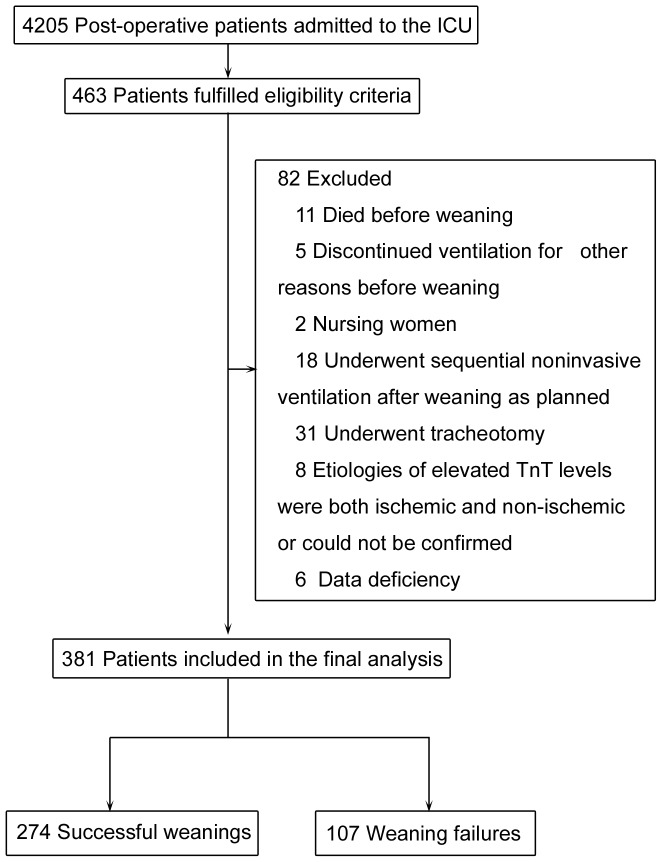
This study included 381 patients, of whom 274 were successfully weaned. MINS was observed in 42.0% of the patients. The MINS incidence was significantly higher in patients who failed to be weaned compared to patients who were successfully weaned (56.1% versus 36.5%; P<0.001). Independent predictive factors of weaning failure were MINS, age, lower left ventricular ejection fraction before surgery and lower serum albumin level after surgery. The MINS odds ratio was 4.098 (95% confidence interval, 1.07 to 15.6; P = 0.04). The patients who were successfully weaned had shorter hospital stay lengths and a higher survival rate than those who failed to be weaned.
MINS is a risk factor for weaning failure from mechanical ventilation in critical patients who have undergone major abdominal surgery, independent of age, lower left ventricular ejection fraction before surgery and lower serum albumin levels after surgery.
非心脏手术术后心肌损伤(MINS)是一个新提出的概念,在接受非心脏手术的成年人中很常见,且与较高的死亡率相关。我们分析了MINS是否是接受大型腹部手术的重症患者脱机失败的危险因素。
本回顾性研究在北京大学人民医院重症医学科进行。研究对象为2011年1月至2013年12月期间接受大型腹部手术的所有重症患者。调查围手术期的临床和实验室参数。进行向后逐步回归分析以评估MINS与脱机失败率的相关性。将年龄、高血压、慢性肾病、术前左心室射血分数、急性生理与慢性健康状况评分II、胸腔积液、肺炎、急性肾损伤、脱机前机械通气时间以及术后白蛋白水平作为自变量。
本研究纳入381例患者,其中274例成功脱机。42.0%的患者发生了MINS。脱机失败患者的MINS发生率显著高于成功脱机患者(56.1%对36.5%;P<0.001)。脱机失败的独立预测因素为MINS、年龄、术前较低的左心室射血分数和术后较低的血清白蛋白水平。MINS的比值比为4.098(95%置信区间为1.07至15.6;P = 0.04)。成功脱机的患者住院时间较短,生存率高于脱机失败的患者。
MINS是接受大型腹部手术的重症患者机械通气脱机失败的危险因素,独立于年龄、术前较低的左心室射血分数和术后较低的血清白蛋白水平。