Jämsen Esa, Nevalainen Pasi I, Eskelinen Antti, Kalliovalkama Jarkko, Moilanen Teemu
Coxa, Hospital for Joint Replacement, Tampere.
Acta Orthop. 2015 Apr;86(2):175-82. doi: 10.3109/17453674.2014.987064. Epub 2014 Nov 18.
Perioperative hyperglycemia has been associated with adverse outcomes in several fields of surgery. In this observational study, we identified factors associated with an increased risk of hyperglycemia following hip and knee replacement.
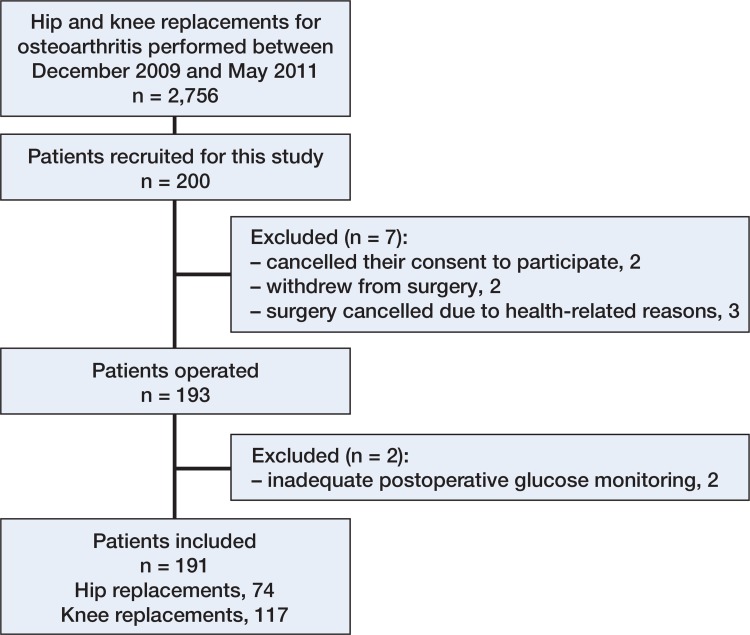
We prospectively monitored changes in glucose following primary hip and knee replacements in 191 patients with osteoarthritis. Possible associations of patient characteristics and operation-related factors with hyperglycemia (defined as glucose > 7.8 mmol/L in 2 consecutive measurements) and severe hyperglycemia (glucose > 10 mmol/L) were analyzed using binary logistic regression with adjustment for age, sex, operated joint, and anesthesiological risk score.
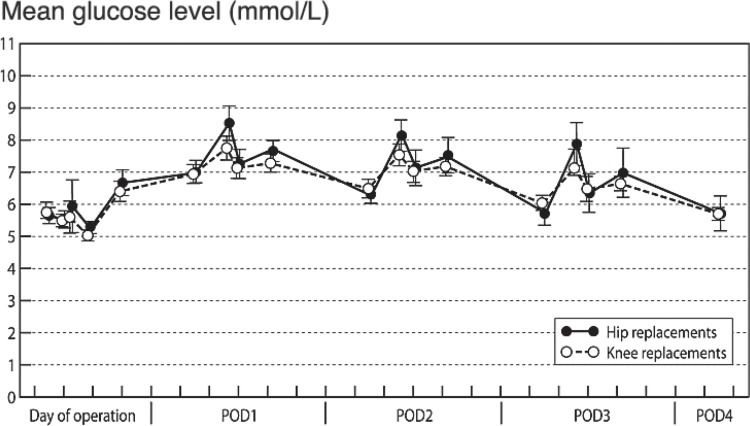
76 patients (40%) developed hyperglycemia, and 48 of them (25% of the whole cohort) had severe hyperglycemia. Glycemic responses were similar following hip replacement and knee replacement. Previously diagnosed diabetes was associated with an increased risk of hyperglycemia and severe hyperglycemia, compared to patients with normal glucose metabolism, whereas newly diagnosed diabetes and milder glucose metabolism disorders had no effect. In patients without previously diagnosed diabetes, increased values of preoperative glycosylated hemoglobin (HbA1c) and fasting glucose on the day of operation were associated with hyperglycemia. Higher anesthesiological risk score-but none of the operation-related factors analyzed-was associated with an increased risk of hyperglycemia.
Perioperative hyperglycemia is common in primary hip and knee replacements. Previously diagnosed diabetes is the strongest risk factor for hyperglycemia. In patients with no history of diabetes, preoperative HbA1c and fasting glucose on the day of operation can be used to stratify the risk of hyperglycemia.
围手术期高血糖与多个外科领域的不良预后相关。在这项观察性研究中,我们确定了与髋膝关节置换术后高血糖风险增加相关的因素。
我们前瞻性监测了191例骨关节炎患者初次髋膝关节置换术后的血糖变化。使用二元逻辑回归分析患者特征和手术相关因素与高血糖(定义为连续两次测量血糖>7.8 mmol/L)和严重高血糖(血糖>10 mmol/L)的可能关联,并对年龄、性别、手术关节和麻醉风险评分进行了调整。
76例患者(40%)出现高血糖,其中48例(占整个队列的25%)出现严重高血糖。髋关节置换和膝关节置换后的血糖反应相似。与糖代谢正常的患者相比,先前诊断为糖尿病的患者发生高血糖和严重高血糖的风险增加,而新诊断的糖尿病和较轻的糖代谢紊乱则无影响。在先前未诊断为糖尿病的患者中,术前糖化血红蛋白(HbA1c)值升高和手术当天空腹血糖升高与高血糖相关。麻醉风险评分较高——但所分析的手术相关因素均无此关联——与高血糖风险增加相关。
围手术期高血糖在初次髋膝关节置换术中很常见。先前诊断为糖尿病是高血糖的最强危险因素。在无糖尿病病史的患者中,术前HbA1c和手术当天空腹血糖可用于对高血糖风险进行分层。