Hobbs Sarah Jane, Baxter Joanna, Broom Louise, Rossell Laura-Ann, Sinclair Jonathan, Clayton Hilary M
Centre for Applied Sport and Exercise Sciences, University of Central Lancashire, Preston, UK.
Craven College, Skipton, UK.
J Hum Kinet. 2014 Oct 10;42:113-25. doi: 10.2478/hukin-2014-0066. eCollection 2014 Sep 29.
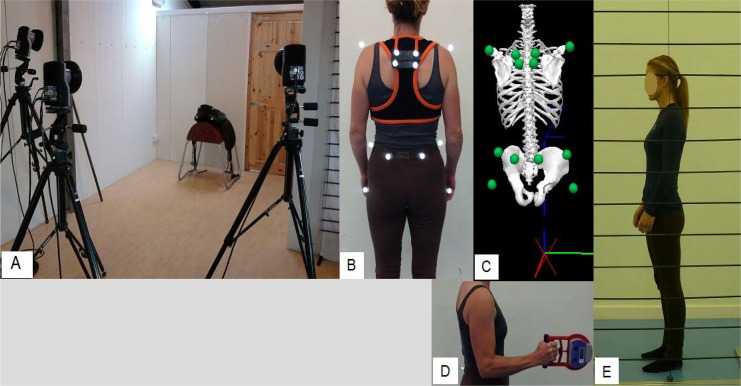
Since the ability to train the horse to be ambidextrous is considered highly desirable, rider asymmetry is recognized as a negative trait. Acquired postural and functional asymmetry can originate from numerous anatomical regions, so it is difficult to suggest if any is developed due to riding. The aim of this study was therefore to assess symmetry of posture, strength and flexibility in a large population of riders and to determine whether typical traits exist due to riding. 127 right handed riders from the UK and USA were categorized according to years riding (in 20 year increments) and their competition level (using affiliated test levels). Leg length, grip strength and spinal posture were measured and recorded by a physiotherapist. Standing and sitting posture and trunk flexibility were measured with 3-D motion capture technology. Right-left differences were explored in relation to years riding and rider competitive experience. Significant anatomical asymmetry was found for the difference in standing acromion process height for a competition level (-0.07±1.50 cm Intro/Prelim; 0.02±1.31 cm Novice; 0.43±1.27 cm Elementary+; p=0.048) and for sitting iliac crest height for years riding (-0.23±1.36 cm Intro/Prelim; 0.01±1.50 cm Novice; 0.86±0.41 cm Elementary+; p=0.021). For functional asymmetry, a significant interaction was found for lateral bending ROM for years riding x competition level (p=0.047). The demands on dressage riders competing at higher levels may predispose these riders to a higher risk of developing asymmetry and potentially chronic back pain rather than improving their symmetry.
由于训练马匹具备双手灵活使用能力被认为是非常理想的,骑手的不对称性被视为一种负面特征。后天获得的姿势和功能不对称可能源于众多解剖区域,因此很难判断是否有任何不对称是由于骑马造成的。因此,本研究的目的是评估大量骑手的姿势、力量和灵活性的对称性,并确定是否存在因骑马而产生的典型特征。来自英国和美国的127名右利手骑手根据骑马年限(以20年为增量)和他们的比赛水平(使用附属测试级别)进行分类。一名物理治疗师测量并记录了腿长、握力和脊柱姿势。使用三维运动捕捉技术测量了站立和坐姿以及躯干灵活性。探讨了左右差异与骑马年限和骑手比赛经验的关系。发现比赛水平导致的站立肩峰高度差异存在显著的解剖学不对称(入门/预赛:-0.07±1.50厘米;新手:0.02±1.31厘米;初级及以上:0.43±1.27厘米;p=0.048),以及骑马年限导致的坐姿髂嵴高度差异存在显著的解剖学不对称(入门/预赛:-0.23±1.36厘米;新手:0.01±1.50厘米;初级及以上:0.86±0.41厘米;p=0.021)。对于功能不对称,发现骑马年限x比赛水平的侧屈活动度存在显著交互作用(p=0.047)。高水平比赛的盛装舞步骑手所面临的要求可能使这些骑手面临更高的不对称发展风险,并可能导致慢性背痛,而不是改善他们的对称性。