Department of Psychiatry, University of Illinois at Chicago , Chicago, IL , USA ; Jesse Brown VA Medical Center, U.S. Department of Veterans Affairs , Chicago, IL , USA ; Department of Environmental and Occupational Health Sciences, University of Washington , Seattle, WA , USA.
Department of Psychiatry, University of Illinois at Chicago , Chicago, IL , USA ; Jesse Brown VA Medical Center, U.S. Department of Veterans Affairs , Chicago, IL , USA.
Front Pediatr. 2014 Nov 11;2:123. doi: 10.3389/fped.2014.00123. eCollection 2014.
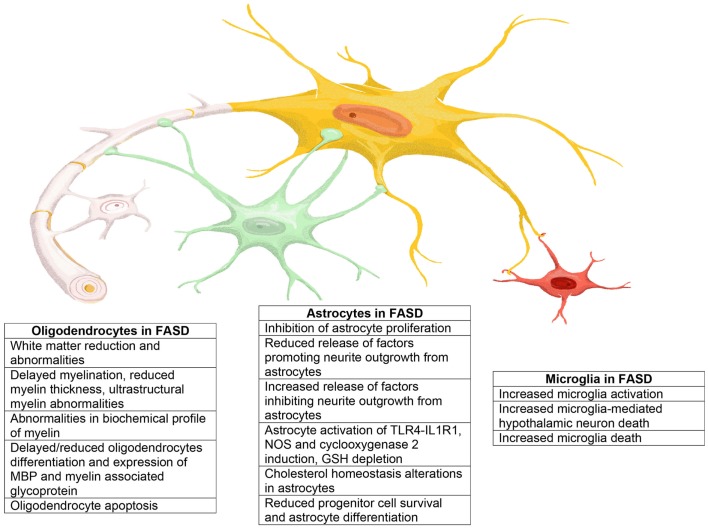
During the last 20 years, new and exciting roles for glial cells in brain development have been described. Moreover, several recent studies implicated glial cells in the pathogenesis of neurodevelopmental disorders including Down syndrome, Fragile X syndrome, Rett Syndrome, Autism Spectrum Disorders, and Fetal Alcohol Spectrum Disorders (FASD). Abnormalities in glial cell development and proliferation and increased glial cell apoptosis contribute to the adverse effects of ethanol on the developing brain and it is becoming apparent that the effects of fetal alcohol are due, at least in part, to effects on glial cells affecting their ability to modulate neuronal development and function. The three major classes of glial cells, astrocytes, oligodendrocytes, and microglia as well as their precursors are affected by ethanol during brain development. Alterations in glial cell functions by ethanol dramatically affect neuronal development, survival, and function and ultimately impair the development of the proper brain architecture and connectivity. For instance, ethanol inhibits astrocyte-mediated neuritogenesis and oligodendrocyte development, survival and myelination; furthermore, ethanol induces microglia activation and oxidative stress leading to the exacerbation of ethanol-induced neuronal cell death. This review article describes the most significant recent findings pertaining the effects of ethanol on glial cells and their significance in the pathophysiology of FASD and other neurodevelopmental disorders.
在过去的 20 年中,神经胶质细胞在大脑发育中的新作用和新功能不断被描述。此外,最近的几项研究表明,神经胶质细胞参与了神经发育障碍的发病机制,包括唐氏综合征、脆性 X 综合征、雷特综合征、自闭症谱系障碍和胎儿酒精谱系障碍(FASD)。神经胶质细胞发育和增殖异常以及神经胶质细胞凋亡增加导致乙醇对发育中大脑的不良影响,越来越明显的是,胎儿酒精的影响至少部分是由于对神经胶质细胞的影响,从而影响其调节神经元发育和功能的能力。在大脑发育过程中,三种主要的神经胶质细胞,即星形胶质细胞、少突胶质细胞和小胶质细胞及其前体细胞,都受到乙醇的影响。乙醇对神经胶质细胞功能的改变显著影响神经元的发育、存活和功能,最终损害适当的大脑结构和连接的发育。例如,乙醇抑制星形胶质细胞介导的突起生成和少突胶质细胞的发育、存活和髓鞘形成;此外,乙醇诱导小胶质细胞激活和氧化应激,导致乙醇诱导的神经元细胞死亡加剧。本文综述了最近关于乙醇对神经胶质细胞的影响及其在胎儿酒精谱系障碍和其他神经发育障碍的病理生理学中的意义的重要发现。