Ortega Alvaro D, Quereda Juan J, Pucciarelli M Graciela, García-del Portillo Francisco
Centro Nacional de Biotecnología - Consejo Superior de Investigaciones Científicas (CNB-CSIC) Madrid, Spain.
Centro Nacional de Biotecnología - Consejo Superior de Investigaciones Científicas (CNB-CSIC) Madrid, Spain ; Departamento de Biología Molecular, Universidad Autónoma de Madrid, Centro de Biología Molecular 'Severo Ochoa' (CBMSO-CSIC) Madrid, Spain.
Front Cell Infect Microbiol. 2014 Nov 12;4:162. doi: 10.3389/fcimb.2014.00162. eCollection 2014.
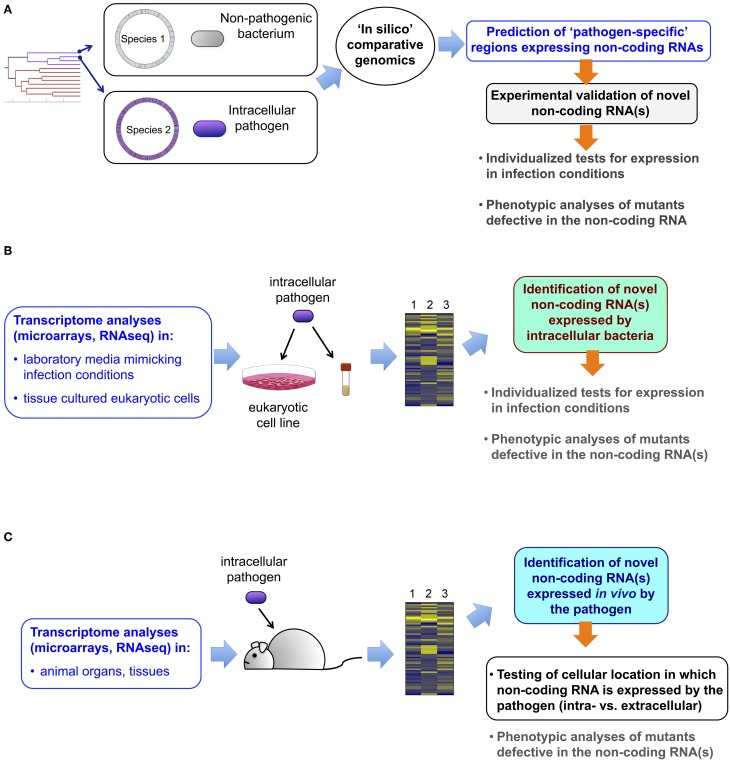
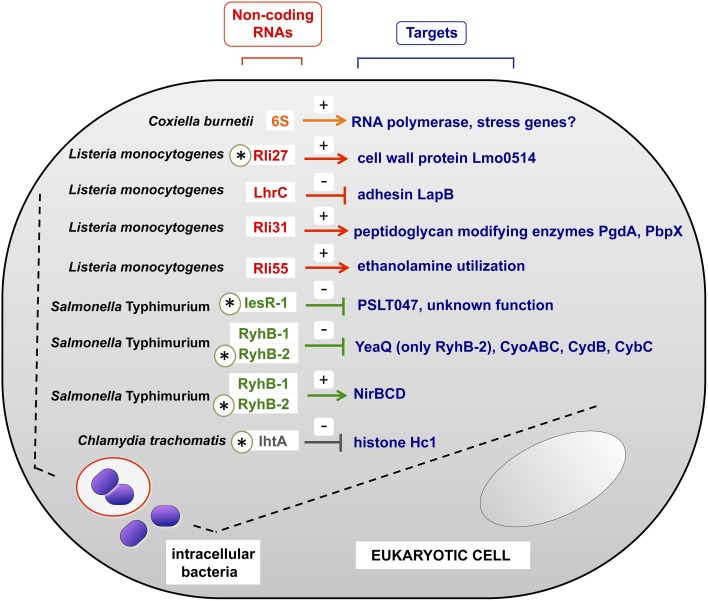
Intracellular bacterial pathogens have evolved distinct lifestyles inside eukaryotic cells. Some pathogens coexist with the infected cell in an obligate intracellular state, whereas others transit between the extracellular and intracellular environment. Adaptation to these intracellular lifestyles is regulated in both space and time. Non-coding small RNAs (sRNAs) are post-transcriptional regulatory molecules that fine-tune important processes in bacterial physiology including cell envelope architecture, intermediate metabolism, bacterial communication, biofilm formation, and virulence. Recent studies have shown production of defined sRNA species by intracellular bacteria located inside eukaryotic cells. The molecules targeted by these sRNAs and their expression dynamics along the intracellular infection cycle remain, however, poorly characterized. Technical difficulties linked to the isolation of "intact" intracellular bacteria from infected host cells might explain why sRNA regulation in these specialized pathogens is still a largely unexplored field. Transition from the extracellular to the intracellular lifestyle provides an ideal scenario in which regulatory sRNAs are intended to participate; so much work must be done in this direction. This review focuses on sRNAs expressed by intracellular bacterial pathogens during the infection of eukaryotic cells, strategies used with these pathogens to identify sRNAs required for virulence, and the experimental technical challenges associated to this type of studies. We also discuss varied techniques for their potential application to study RNA regulation in intracellular bacterial infections.
细胞内细菌病原体在真核细胞内进化出了独特的生存方式。一些病原体以专性细胞内状态与受感染细胞共存,而另一些则在细胞外和细胞内环境之间穿梭。对这些细胞内生存方式的适应在空间和时间上都受到调控。非编码小RNA(sRNA)是转录后调控分子,可微调细菌生理学中的重要过程,包括细胞壁结构、中间代谢、细菌通讯、生物膜形成和毒力。最近的研究表明,位于真核细胞内的细胞内细菌会产生特定种类的sRNA。然而,这些sRNA的靶分子及其在细胞内感染周期中的表达动态仍知之甚少。与从受感染宿主细胞中分离“完整”细胞内细菌相关的技术难题,可能解释了为什么这些特殊病原体中的sRNA调控仍是一个很大程度上未被探索的领域。从细胞外生存方式向细胞内生存方式的转变提供了一个理想的场景,调控性sRNA有望参与其中;因此必须在这个方向上开展大量工作。本综述重点关注细胞内细菌病原体在感染真核细胞过程中表达的sRNA、这些病原体用于鉴定毒力所需sRNA的策略,以及与此类研究相关的实验技术挑战。我们还讨论了它们在研究细胞内细菌感染中RNA调控方面潜在应用的各种技术。