Chi Wen-Chou, Chang Kwang-Hwa, Escorpizo Reuben, Yen Chia-Feng, Liao Hua-Fang, Chang Feng-Hang, Chiou Hung-Yi, Teng Sue-Wen, Chiu Wen-Ta, Liou Tsan-Hon
Department of Physical Medicine and Rehabilitation, Shuang Ho Hospital, Taipei Medical University, Taipei 235, Taiwan.
Department of Physical Medicine and Rehabilitation, Wan Fang Hospital, Taipei Medical University, Taipei 116, Taiwan.
Int J Environ Res Public Health. 2014 Nov 25;11(12):12148-61. doi: 10.3390/ijerph111212148.
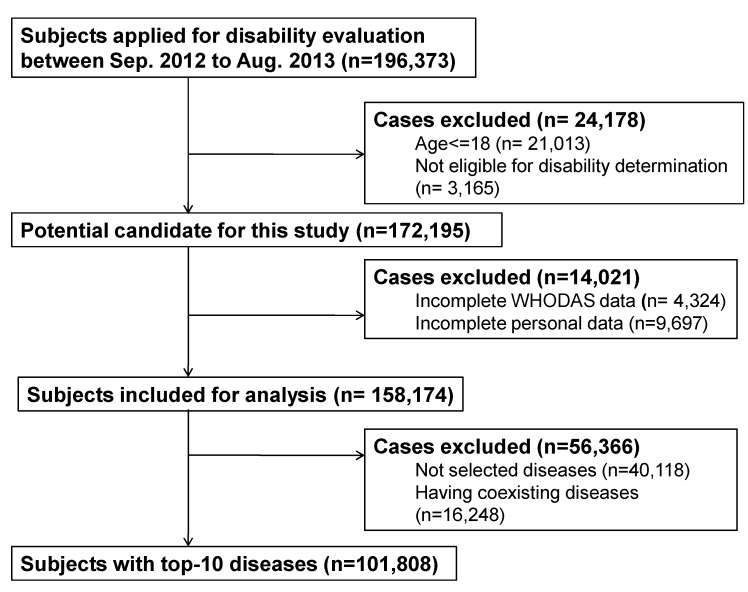
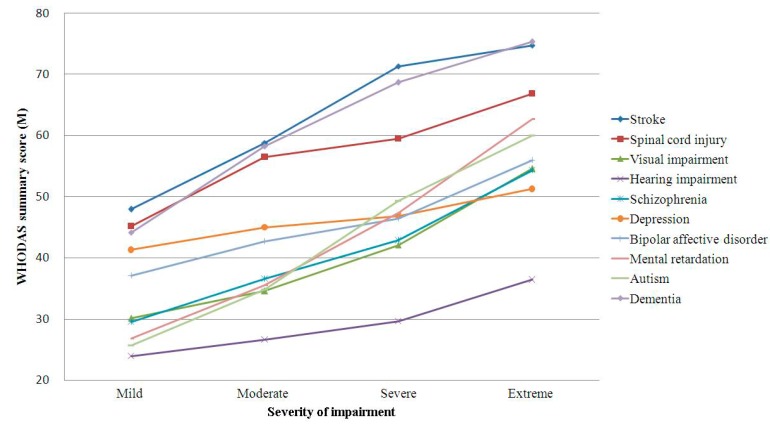
The definition of disability had been unclear until the International Classification of Functioning, Disability, and Health was promulgated in 2001 by the World Health Organization (WHO). Disability is a critical but relatively neglected public-health concern. We conducted this study to measure disabilities by using the WHO Disability Assessment Schedule 2.0 (WHODAS 2.0) and identify the factors that contribute to disabilities. We obtained and analyzed the data on people who applied to Taiwan's disability registration system between September 2012 and August 2013. A total of 158,174 cases were selected for this study. Among the people included in this study, 53% were male, and the females were on average 3 years older than the males. More males than females were of a low socioeconomic status, but the rate of employment was higher among the males than among the females. Age, sex, place of residence, and types and severity of impairment were all determined to be factors that independently contributed to disability. This study has demonstrated that disability can be measured and compared using WHODAS 2.0. Increasing the public-health attention devoted to disability and identifying the factors associated with disability can promote independence and social participation in people with disabilities.
在世界卫生组织(WHO)于2001年颁布《国际功能、残疾和健康分类》之前,残疾的定义一直不明确。残疾是一个关键但相对被忽视的公共卫生问题。我们开展这项研究,旨在使用世界卫生组织残疾评定量表2.0(WHODAS 2.0)来衡量残疾情况,并确定导致残疾的因素。我们获取并分析了2012年9月至2013年8月期间申请台湾残疾登记系统的人员数据。本研究共选取了158,174个案例。在纳入本研究的人群中,53%为男性,女性平均比男性大3岁。社会经济地位较低的男性多于女性,但男性的就业率高于女性。年龄、性别、居住地点以及损伤类型和严重程度均被确定为独立导致残疾的因素。本研究表明,可使用WHODAS 2.0对残疾进行衡量和比较。加强对残疾问题的公共卫生关注并确定与残疾相关的因素,可促进残疾人的独立性和社会参与。