Kuo Chia-Ying, Liou Tsan-Hon, Chang Kwang-Hwa, Chi Wen-Chou, Escorpizo Reuben, Yen Chia-Feng, Liao Hua-Fang, Chiou Hung-Yi, Chiu Wen-Ta, Tsai Jo-Ting
School of Public Health, College of Public Health and Nutrition, Taipei Medical University, Taipei 11031, Taiwan.
Office of Medical Affairs, Shuang Ho Hospital, Taipei Medical University, New Taipei City 23561, Taiwan.
Int J Environ Res Public Health. 2015 Apr 14;12(4):4116-27. doi: 10.3390/ijerph120404116.
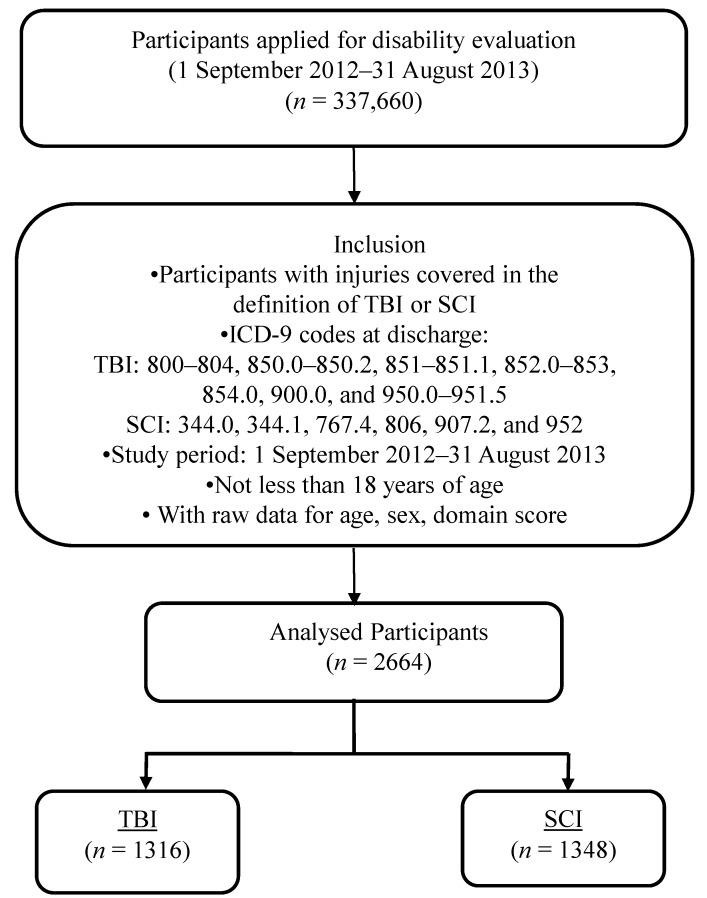
The purpose of this study is to compare traumatic brain injuries (TBI) and spinal cord injuries (SCI) patients' function and disability by using the World Health Organization Disability Assessment Schedule 2.0 (WHODAS 2.0); and to clarify the factors that contribute to disability. We analyzed data available between September 2012 and August 2013 from Taiwan's national disability registry which is based on the International Classification of Functioning, Disability, and Health (ICF) framework. Of the 2664 cases selected for the study, 1316 pertained to TBI and 1348 to SCI. A larger percentage of patients with TBI compared with those with SCI exhibited poor cognition, self-care, relationships, life activities, and participation in society (all p < 0.001). Age, sex, injury type, socioeconomic status, place of residence, and severity of impairment were determined as factors that independently contribute to disability (all p < 0.05). The WHODAS 2.0 is a generic assessment instrument which is appropriate for assessing the complex and multifaceted disability associated with TBI and SCI. Further studies are needed to validate the WHODAS 2.0 for TBI and SCI from a multidisciplinary perspective.
本研究的目的是使用世界卫生组织残疾评定量表2.0(WHODAS 2.0)比较创伤性脑损伤(TBI)和脊髓损伤(SCI)患者的功能与残疾情况;并阐明导致残疾的因素。我们分析了2012年9月至2013年8月间来自台湾国家残疾登记处的数据,该登记处以国际功能、残疾和健康分类(ICF)框架为基础。在入选研究的2664例病例中,1316例为TBI,1348例为SCI。与SCI患者相比,TBI患者在认知、自我护理、人际关系、生活活动及社会参与方面表现较差的比例更高(所有p<0.001)。年龄、性别、损伤类型、社会经济地位、居住地点及损伤严重程度被确定为独立导致残疾的因素(所有p<0.05)。WHODAS 2.0是一种通用评估工具,适用于评估与TBI和SCI相关的复杂多面的残疾情况。需要进一步开展研究,从多学科角度验证WHODAS 2.0在TBI和SCI方面的有效性。