Gasque Kellen C S, Foster Brian L, Kuss Pia, Yadav Manisha C, Liu Jin, Kiffer-Moreira Tina, van Elsas Andrea, Hatch Nan, Somerman Martha J, Millán José Luis
Sanford Children's Health Research Center, Sanford-Burnham Medical Research Institute, La Jolla, CA 92037, USA.
Laboratory of Oral Connective Tissue Biology, National Institute of Arthritis and Musculoskeletal and Skin Diseases, National Institutes of Health, Bethesda, MD, USA.
Bone. 2015 Mar;72:137-47. doi: 10.1016/j.bone.2014.11.017. Epub 2014 Nov 26.
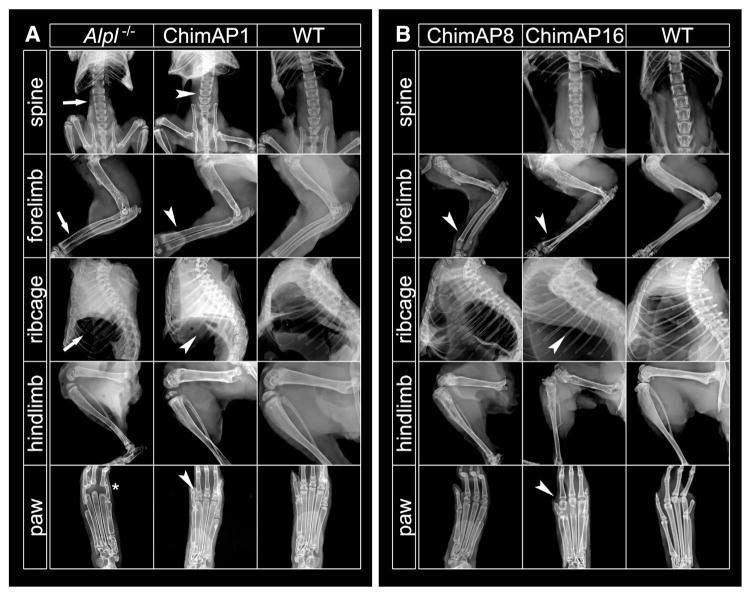
Hypophosphatasia (HPP) results from ALPL gene mutations, which lead to a deficiency of tissue-nonspecific alkaline phosphatase (TNAP), and accumulation of inorganic pyrophosphate, a potent inhibitor of mineralization that is also a natural substrate of TNAP, in the extracellular space. HPP causes mineralization disorders including soft bones (rickets or osteomalacia) and defects in teeth and periodontal tissues. Enzyme replacement therapy using mineral-targeting recombinant TNAP has proven effective in preventing skeletal and dental defects in TNAP knockout (Alpl(-/-)) mice, a model for life-threatening HPP. Here, we show that the administration of a soluble, intestinal-like chimeric alkaline phosphatase (ChimAP) improves the manifestations of HPP in Alpl(-/-) mice. Mice received daily subcutaneous injections of ChimAP at doses of 1, 8 or 16 mg/kg, from birth for up to 53 days. Lifespan and body weight of Alpl(-/-) mice were normalized, and vitamin B6-associated seizures were absent with 16 mg/kg/day of ChimAP. Radiographs, μCT and histological analyses documented improved mineralization in cortical and trabecular bone and secondary ossification centers in long bones of ChimAP16-treated mice. There was no evidence of craniosynostosis in the ChimAP16-treated mice and we did not detect ectopic calcification by radiography and histology in the aortas, stomachs, kidneys or lungs in any of the treatment groups. Molar tooth development and function improved with the highest ChimAP dose, including enamel, dentin, and tooth morphology. Cementum remained deficient and alveolar bone mineralization was reduced compared to controls, though ChimAP-treated Alpl(-/-) mice featured periodontal attachment and retained teeth. This study provides the first evidence for the pharmacological efficacy of ChimAP for use in the treatment of skeletal and dental manifestations of HPP.
低磷性佝偻病(HPP)由ALPL基因突变引起,该突变导致组织非特异性碱性磷酸酶(TNAP)缺乏,无机焦磷酸盐在细胞外空间蓄积,无机焦磷酸盐是矿化的强效抑制剂,也是TNAP的天然底物。HPP会导致矿化障碍,包括骨骼软化(佝偻病或骨软化症)以及牙齿和牙周组织缺陷。在TNAP基因敲除(Alpl(-/-))小鼠(一种危及生命的HPP模型)中,使用靶向矿物质的重组TNAP进行酶替代疗法已被证明可有效预防骨骼和牙齿缺陷。在此,我们表明,给予可溶性、肠样嵌合碱性磷酸酶(ChimAP)可改善Alpl(-/-)小鼠的HPP表现。小鼠从出生起每天皮下注射剂量为1、8或16 mg/kg的ChimAP,持续53天。Alpl(-/-)小鼠的寿命和体重恢复正常,每天给予16 mg/kg的ChimAP可避免与维生素B6相关的癫痫发作。X线片、显微CT和组织学分析表明,接受ChimAP16治疗的小鼠长骨皮质骨、小梁骨和二级骨化中心的矿化得到改善。接受ChimAP16治疗的小鼠没有颅缝早闭的迹象,并且在任何治疗组中,通过X线摄影和组织学检查均未在主动脉、胃、肾脏或肺中检测到异位钙化。最高剂量的ChimAP可改善磨牙的发育和功能,包括牙釉质、牙本质和牙齿形态。与对照组相比,牙骨质仍然缺乏,牙槽骨矿化减少,尽管接受ChimAP治疗的Alpl(-/-)小鼠具有牙周附着并保留了牙齿。本研究首次证明了ChimAP在治疗HPP骨骼和牙齿表现方面的药理疗效。