Yu Tianwei, Bai Yun
BMC Bioinformatics. 2014;15 Suppl 13(Suppl 13):S6. doi: 10.1186/1471-2105-15-S13-S6. Epub 2014 Nov 13.
High-throughput expression data, such as gene expression and metabolomics data, exhibit modular structures. Groups of features in each module follow a latent factor model, while between modules, the latent factors are quasi-independent. Recovering the latent factors can shed light on the hidden regulation patterns of the expression. The difficulty in detecting such modules and recovering the latent factors lies in the high dimensionality of the data, and the lack of knowledge in module membership.
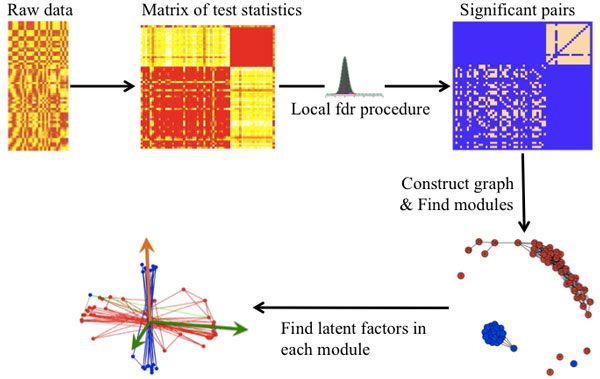
Here we describe a method based on community detection in the co-expression network. It consists of inference-based network construction, module detection, and interacting latent factor detection from modules.
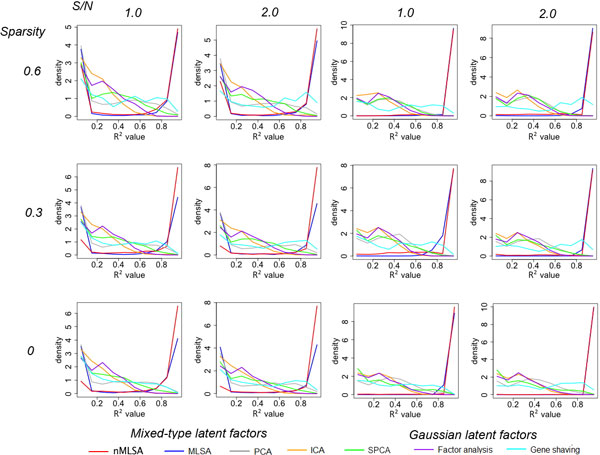
In simulations, the method outperformed projection-based modular latent factor discovery when the input signals were not Gaussian. We also demonstrate the method's value in real data analysis.
The new method nMLSA (network-based modular latent structure analysis) is effective in detecting latent structures, and is easy to extend to non-linear cases. The method is available as R code at http://web1.sph.emory.edu/users/tyu8/nMLSA/.
高通量表达数据,如基因表达和代谢组学数据,呈现出模块化结构。每个模块中的特征组遵循一个潜在因子模型,而在模块之间,潜在因子是准独立的。恢复潜在因子可以揭示表达的隐藏调控模式。检测此类模块并恢复潜在因子的困难在于数据的高维度以及模块成员关系方面的知识缺失。
在此我们描述一种基于共表达网络中社区检测的方法。它由基于推理的网络构建、模块检测以及从模块中检测相互作用的潜在因子组成。
在模拟中,当输入信号不是高斯分布时,该方法优于基于投影的模块化潜在因子发现方法。我们还展示了该方法在实际数据分析中的价值。
新方法nMLSA(基于网络的模块化潜在结构分析)在检测潜在结构方面有效,并且易于扩展到非线性情况。该方法可通过R代码获取,网址为http://web1.sph.emory.edu/users/tyu8/nMLSA/ 。