Pedreschi Debbi, Kelly-Quinn Mary, Caffrey Joe, O'Grady Martin, Mariani Stefano, Phillimore Albert
School of Biology & Environmental Science, University College Dublin Belfield, Ireland.
Inland Fisheries Ireland, Swords Business Campus Co Dublin, Ireland.
J Biogeogr. 2014 Mar;41(3):548-560. doi: 10.1111/jbi.12220.
We investigated genetic variation of Irish pike populations and their relationship with European outgroups, in order to elucidate the origin of this species to the island, which is largely assumed to have occurred as a human-mediated introduction over the past few hundred years. We aimed thereby to provide new insights into population structure to improve fisheries and biodiversity management in Irish freshwaters.
Ireland, Britain and continental Europe.
A total of 752 pike () were sampled from 15 locations around Ireland, and 9 continental European sites, and genotyped at six polymorphic microsatellite loci. Patterns and mechanisms of population genetic structure were assessed through a diverse array of methods, including Bayesian clustering, hierarchical analysis of molecular variance, and approximate Bayesian computation.
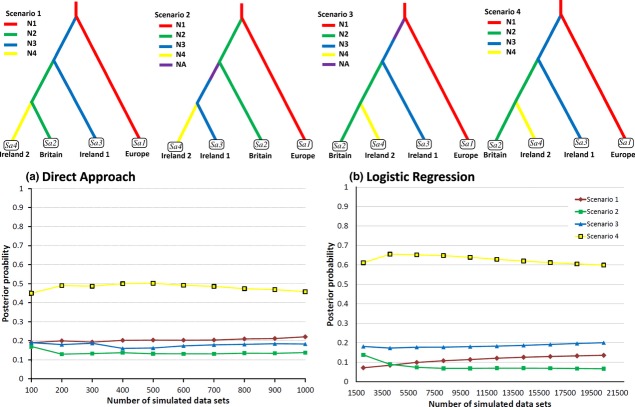
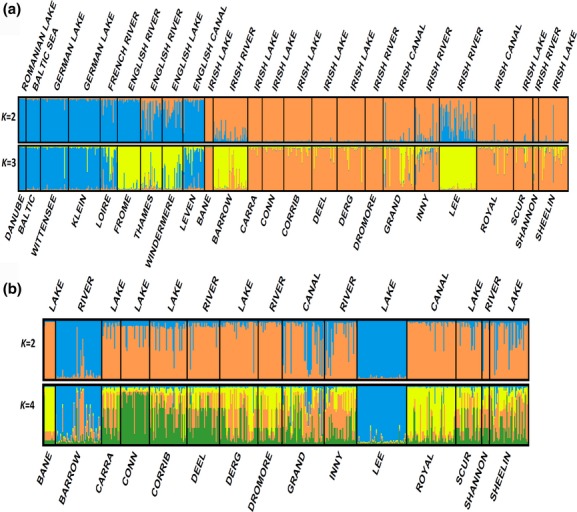
Varying levels of genetic diversity and a high degree of population genetic differentiation were detected. Clear substructure within Ireland was identified, with two main groups being evident. One of the Irish populations showed high similarity with British populations. The other, more widespread, Irish strain did not group with any European population examined. Approximate Bayesian computation suggested that this widespread Irish strain is older, and may have colonized Ireland independently of humans.
Population genetic substructure in Irish pike is high and comparable to the levels observed elsewhere in Europe. A comparison of evolutionary scenarios upholds the possibility that pike may have colonized Ireland in two 'waves', the first of which, being independent of human colonization, would represent the first evidence for natural colonization of a non-anadromous freshwater fish to the island of Ireland. Although further investigations using comprehensive genomic techniques will be necessary to confirm this, the present results warrant a reappraisal of current management strategies for this species.
我们研究了爱尔兰梭子鱼种群的遗传变异及其与欧洲外部种群的关系,以阐明该物种在该岛屿的起源,目前普遍认为这是过去几百年来人类介导引入的结果。我们旨在借此提供有关种群结构的新见解,以改善爱尔兰淡水水域的渔业和生物多样性管理。
爱尔兰、英国和欧洲大陆。
从爱尔兰各地的15个地点以及欧洲大陆的9个地点共采集了752条梭子鱼样本,并对其六个多态微卫星位点进行基因分型。通过多种方法评估种群遗传结构的模式和机制,包括贝叶斯聚类、分子方差层次分析和近似贝叶斯计算。
检测到不同程度的遗传多样性和高度的种群遗传分化。在爱尔兰境内发现了明显的亚结构,有两个主要群体较为明显。其中一个爱尔兰种群与英国种群表现出高度相似性。另一个分布更广的爱尔兰种群与所检测的任何欧洲种群都没有聚类在一起。近似贝叶斯计算表明,这个分布广泛的爱尔兰种群更为古老,可能是独立于人类而在爱尔兰定殖的。
爱尔兰梭子鱼的种群遗传亚结构程度较高,与欧洲其他地方观察到的水平相当。对进化情景的比较支持了梭子鱼可能分两“波”在爱尔兰定殖的可能性,其中第一波独立于人类定殖,这将是一种非溯河洄游性淡水鱼自然定殖到爱尔兰岛的首个证据。尽管需要使用全面的基因组技术进行进一步调查来证实这一点,但目前的结果值得对该物种当前的管理策略进行重新评估。