Llufriu Sara, Sepúlveda María, Blanco Yolanda, Marín Pedro, Moreno Beatriz, Berenguer Joan, Gabilondo Iñigo, Martínez-Heras Eloy, Sola-Valls Nuria, Arnaiz Joan-Albert, Andreu Enrique J, Fernández Begoña, Bullich Santi, Sánchez-Dalmau Bernardo, Graus Francesc, Villoslada Pablo, Saiz Albert
Center of Neuroimmunology, Service of Neurology, Hospital Clinic and Institut d'Investigacions Biomèdiques August Pi i Sunyer (IDIBAPS), University of Barcelona, Barcelona, Spain.
Hemotherapy Service, CDB, Hospital Clínic, Barcelona, Spain.
PLoS One. 2014 Dec 1;9(12):e113936. doi: 10.1371/journal.pone.0113936. eCollection 2014.
Uncontrolled studies of mesenchymal stem cells (MSCs) in multiple sclerosis suggested some beneficial effect. In this randomized, double-blind, placebo-controlled, crossover phase II study we investigated their safety and efficacy in relapsing-remitting multiple sclerosis patients. Efficacy was evaluated in terms of cumulative number of gadolinium-enhancing lesions (GEL) on magnetic resonance imaging (MRI) at 6 months and at the end of the study.
Patients unresponsive to conventional therapy, defined by at least 1 relapse and/or GEL on MRI scan in past 12 months, disease duration 2 to 10 years and Expanded Disability Status Scale (EDSS) 3.0-6.5 were randomized to receive IV 1-2×10(6) bone-marrow-derived-MSCs/Kg or placebo. After 6 months, the treatment was reversed and patients were followed-up for another 6 months. Secondary endpoints were clinical outcomes (relapses and disability by EDSS and MS Functional Composite), and several brain MRI and optical coherence tomography measures. Immunological tests were explored to assess the immunomodulatory effects.
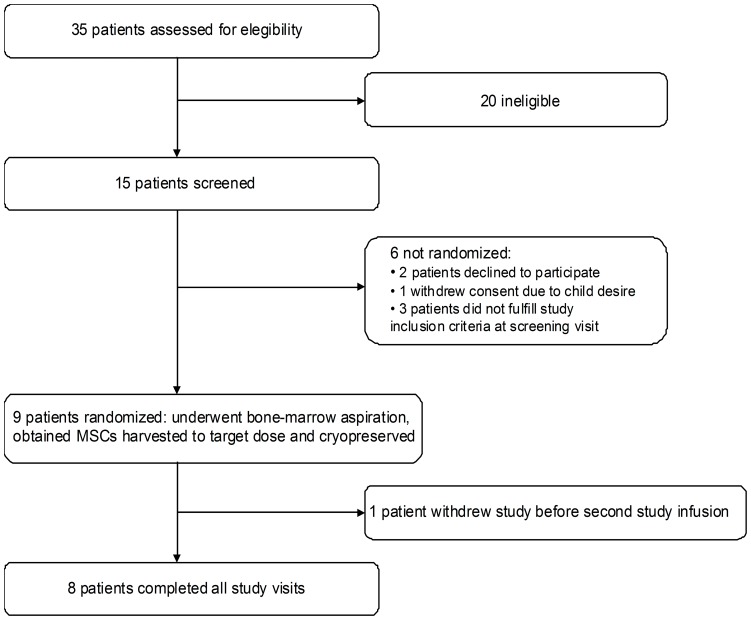
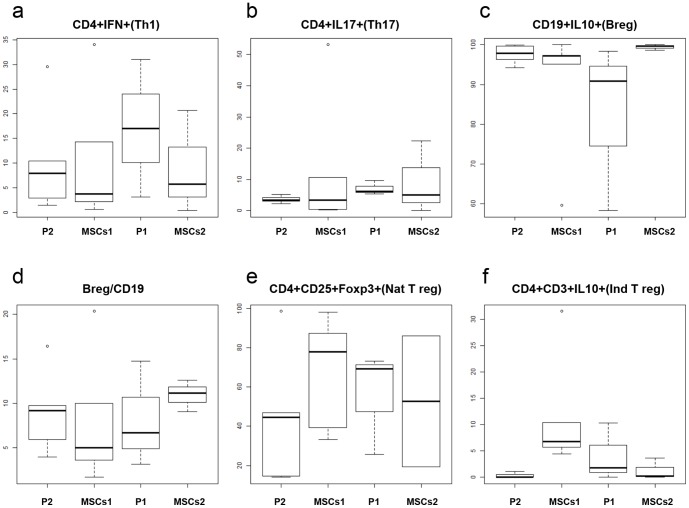
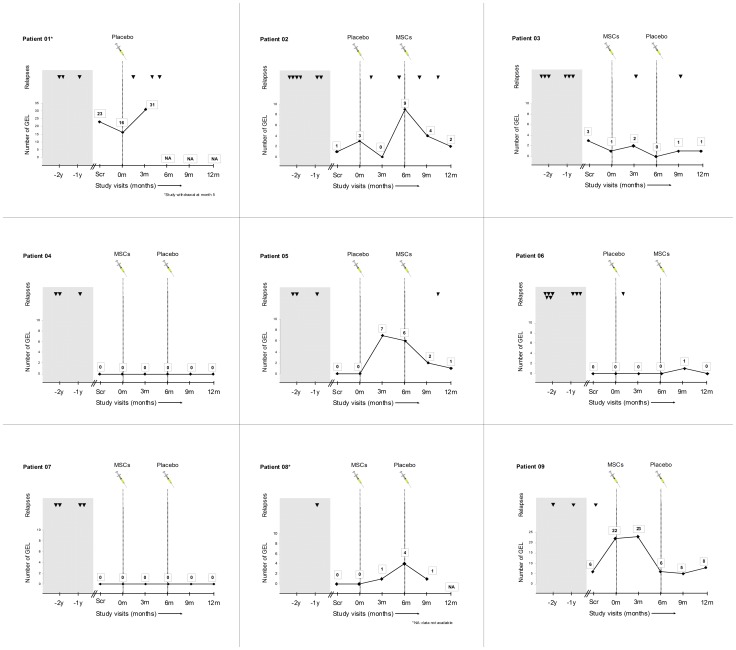
At baseline 9 patients were randomized to receive MSCs (n = 5) or placebo (n = 4). One patient on placebo withdrew after having 3 relapses in the first 5 months. We did not identify any serious adverse events. At 6 months, patients treated with MSCs had a trend to lower mean cumulative number of GEL (3.1, 95% CI = 1.1-8.8 vs 12.3, 95% CI = 4.4-34.5, p = 0.064), and at the end of study to reduced mean GEL (-2.8±5.9 vs 3±5.4, p = 0.075). No significant treatment differences were detected in the secondary endpoints. We observed a non-significant decrease of the frequency of Th1 (CD4+ IFN-γ+) cells in blood of MSCs treated patients.
Bone-marrow-MSCs are safe and may reduce inflammatory MRI parameters supporting their immunomodulatory properties. ClinicalTrials.gov NCT01228266.
间充质干细胞(MSCs)在多发性硬化症中的非对照研究显示出一些有益效果。在这项随机、双盲、安慰剂对照、交叉II期研究中,我们调查了其在复发缓解型多发性硬化症患者中的安全性和疗效。通过6个月时以及研究结束时磁共振成像(MRI)上钆增强病灶(GEL)的累积数量来评估疗效。
对传统治疗无反应的患者,定义为在过去12个月中至少有1次复发和/或MRI扫描显示GEL,病程2至10年且扩展残疾状态量表(EDSS)为3.0 - 6.5,被随机分配接受静脉注射1 - 2×10(6) 骨髓来源的间充质干细胞/千克或安慰剂。6个月后,治疗方案互换,患者再随访6个月。次要终点为临床结局(复发以及EDSS和MS功能综合评分所评估的残疾情况),以及多项脑MRI和光学相干断层扫描指标。探索免疫检测以评估免疫调节作用。
基线时9名患者被随机分配接受间充质干细胞治疗(n = 5)或安慰剂治疗(n = 4)。1名接受安慰剂治疗的患者在最初5个月内复发3次后退出。我们未发现任何严重不良事件。6个月时,接受间充质干细胞治疗的患者平均GEL累积数量有降低趋势(3.1,95%可信区间 = 1.1 - 8.8 对比 12.3,95%可信区间 = 4.4 - 34.5,p = 0.064),且在研究结束时平均GEL数量减少(-2.8±5.9对比3±5.4,p = 0.