Hibberd Patricia L, Kleimola Lauren, Fiorino Anne-Maria, Botelho Christine, Haverkamp Miriam, Andreyeva Irina, Poutsiaka Debra, Fraser Claire, Solano-Aguilar Gloria, Snydman David R
Division of Global Health, Massachusetts General Hospital for Children, Boston, MA, United States of America.
Division of Geographic Medicine and Infectious Diseases, Tufts Medical Center, Boston, MA, United States of America.
PLoS One. 2014 Dec 1;9(12):e113456. doi: 10.1371/journal.pone.0113456. eCollection 2014.
Although Lactobacillus rhamnosus GG ATCC 53103 (LGG) has been consumed by 2 to 5 million people daily since the mid 1990s, there are few clinical trials describing potential harms of LGG, particularly in the elderly.
The primary objective of this open label clinical trial is to assess the safety and tolerability of 1×10¹⁰ colony forming units (CFU) of LGG administered orally twice daily to elderly volunteers for 28 days. The secondary objectives were to evaluate the effects of LGG on the gastrointestinal microbiome, host immune response and plasma cytokines.
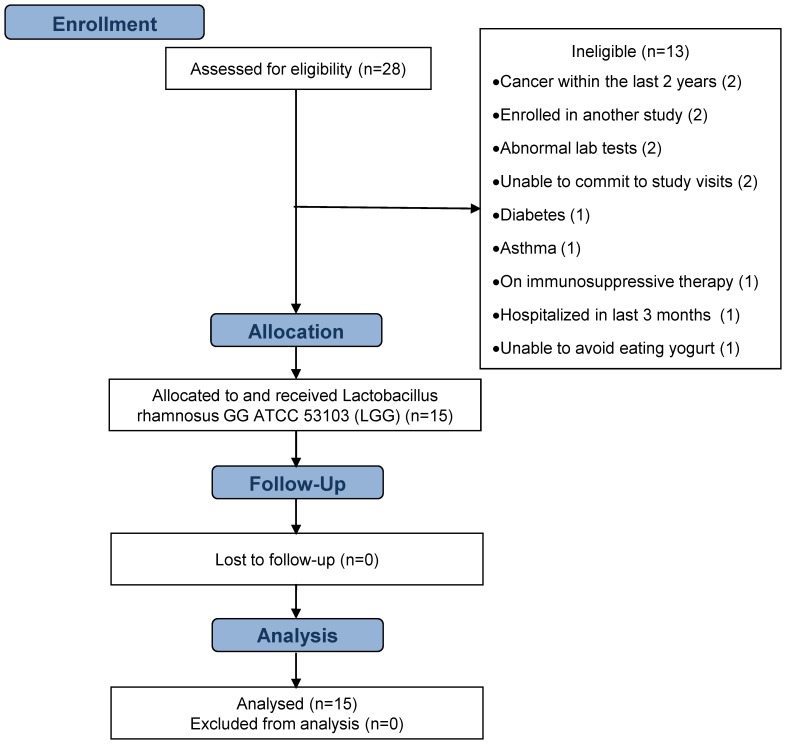
Fifteen elderly volunteers, aged 66-80 years received LGG capsules containing 1×10¹⁰ CFU, twice daily for 28 days and were followed through day 56. Volunteers completed a daily diary, a telephone call on study days 3, 7 and 14 and study visits in the Clinical Research Center at baseline, day 28 and day 56 to determine whether adverse events had occurred. Assessments included prompted and open-ended questions.
There were no serious adverse events. The 15 volunteers had a total of 47 events (range 1-7 per volunteer), 39 (83%) of which were rated as mild and 40% of which were considered related to consuming LGG. Thirty-one (70%) of the events were expected, prompted symptoms while 16 were unexpected events. The most common adverse events were gastrointestinal (bloating, gas, and nausea), 27 rated as mild and 3 rated as moderate. In the exploratory analysis, the pro-inflammatory cytokine interleukin 8 decreased during LGG consumption, returning towards baseline one month after discontinuing LGG (p = 0.038) while there was no difference in other pro- or anti-inflammatory plasma cytokines.
Lactobacillus rhamnosus GG ATCC 53103 is safe and well tolerated in healthy adults aged 65 years and older.
ClinicalTrials.gov NCT 01274598.
自20世纪90年代中期以来,尽管鼠李糖乳杆菌GG ATCC 53103(LGG)每天被200万至500万人食用,但很少有临床试验描述LGG的潜在危害,尤其是在老年人中。
这项开放标签临床试验的主要目的是评估每天口服两次1×10¹⁰菌落形成单位(CFU)的LGG,持续28天,对老年志愿者的安全性和耐受性。次要目的是评估LGG对胃肠道微生物群、宿主免疫反应和血浆细胞因子的影响。
15名年龄在66 - 80岁的老年志愿者接受含1×10¹⁰CFU的LGG胶囊,每天两次,持续28天,并随访至第56天。志愿者完成每日日记,在研究第3、7和14天进行电话随访,并在基线、第28天和第56天到临床研究中心进行研究访视,以确定是否发生不良事件。评估包括提示性和开放性问题。
未发生严重不良事件。15名志愿者共有47起事件(每名志愿者1 - 7起),其中39起(83%)被评为轻度,40%被认为与食用LGG有关。31起(70%)事件为预期的、提示性症状,16起为意外事件。最常见的不良事件是胃肠道事件(腹胀、气体和恶心),27起被评为轻度,3起被评为中度。在探索性分析中,食用LGG期间促炎细胞因子白细胞介素8下降,停用LGG一个月后恢复至基线水平(p = 0.038),而其他促炎或抗炎血浆细胞因子无差异。
鼠李糖乳杆菌GG ATCC 53103在65岁及以上的健康成年人中是安全且耐受性良好的。
ClinicalTrials.gov NCT (美国国立医学图书馆设立的一个临床试验注册库)01274598 。