Chowdhury Basudev, Cho Il-Hoon, Hahn Noah, Irudayaraj Joseph
Bindley Bioscience & Birck Nanotechnology Center, Department of Agricultural & Biological Engineering, Purdue University, 225 South University Street, West Lafayette, IN 47907, USA.
Bindley Bioscience & Birck Nanotechnology Center, Department of Agricultural & Biological Engineering, Purdue University, 225 South University Street, West Lafayette, IN 47907, USA; Dept. of Biomedical Laboratory Science, College of Health Science, Eulji University, Seongnam 461-713, Republic of Korea.
Anal Chim Acta. 2014 Dec 10;852:212-7. doi: 10.1016/j.aca.2014.09.020. Epub 2014 Sep 18.
Genome-wide aberrations of the classic epigenetic modification 5-methylcytosine (5mC), considered the hallmark of gene silencing, has been implicated to play a pivotal role in mediating carcinogenic transformation of healthy cells. Recently, three epigenetic marks derived from enzymatic oxidization of 5mC namely 5-hydroxymethylcytosine (5hmC), 5-formylcytosine (5fC) and 5-carboxylcytosine (5caC), have been discovered in the mammalian genome. Growing evidence suggests that these novel bases possess unique regulatory functions and may play critical roles in carcinogenesis.
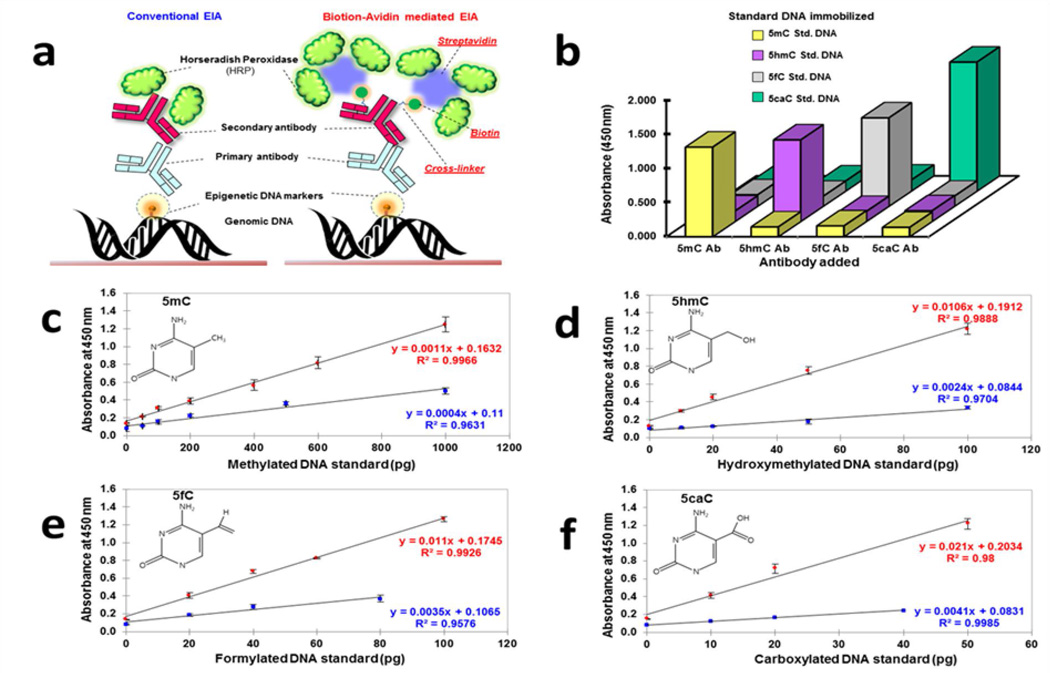
To provide a quantitative basis for these rare epigenetic marks, we have designed a biotin-avidin mediated enzyme-based immunoassay (EIA) and evaluated its performance in genomic DNA isolated from blood of patients diagnosed with metastatic forms of lung, pancreatic and bladder cancer, as well as healthy controls. The proposed EIA incorporates spatially optimized biotinylated antibody and a high degree of horseradish-peroxidase (HRP) labeled streptavidin, facilitating signal amplification and sensitive detection.
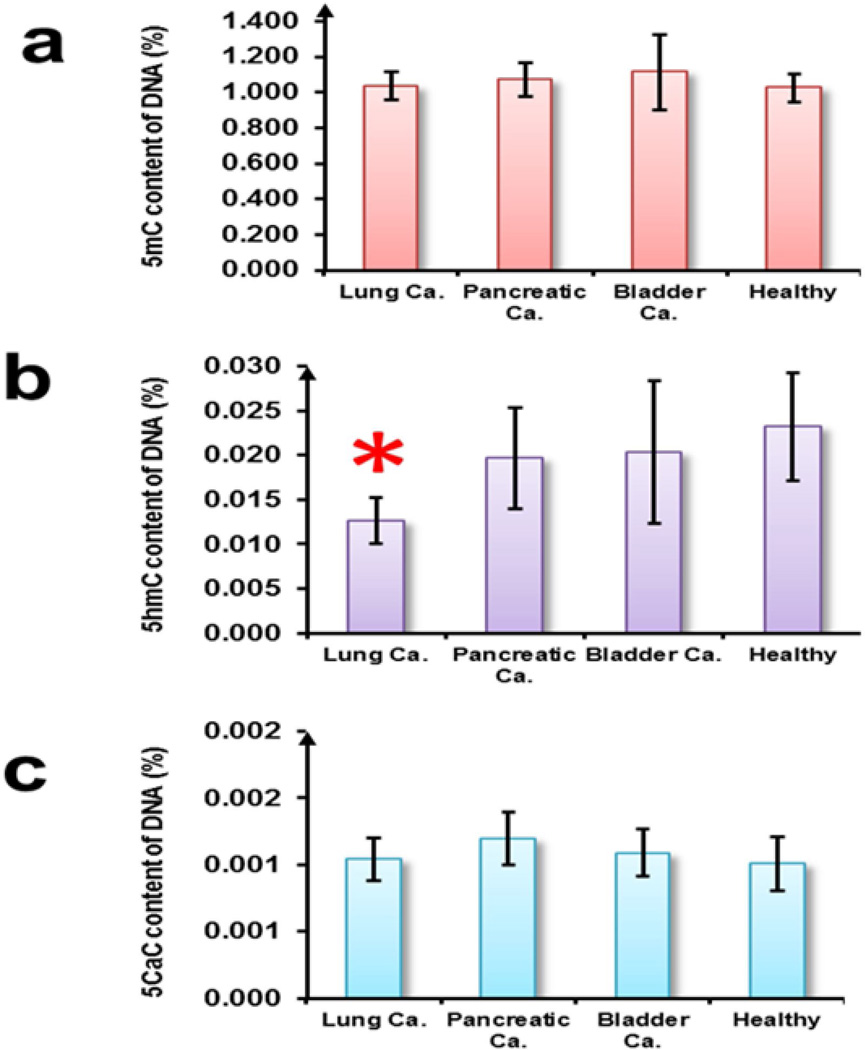
We report that the percentages of 5mC, 5hmC and 5caC present in the genomic DNA of blood in healthy controls as 1.025±0.081, 0.023±0.006 and 0.001±0.0002, respectively. We observed a significant (p<0.05) decrease in the mean global percentage of 5hmC in blood of patients with malignant lung cancer (0.013±0.003%) in comparison to healthy controls.
The precise biological roles of these epigenetic modifications in cancers are still unknown but in the past two years it has become evident that the global 5hmC content is drastically reduced in a variety of cancers. To the best of our knowledge, this is the first report of decreased 5hmC content in the blood of metastatic lung cancer patients and the clinical utility of this observation needs to be further validated in larger sample datasets.
经典表观遗传修饰5-甲基胞嘧啶(5mC)的全基因组异常被认为是基因沉默的标志,已被证明在介导健康细胞的致癌转化中起关键作用。最近,在哺乳动物基因组中发现了三种由5mC酶促氧化衍生而来的表观遗传标记,即5-羟甲基胞嘧啶(5hmC)、5-甲酰基胞嘧啶(5fC)和5-羧基胞嘧啶(5caC)。越来越多的证据表明,这些新碱基具有独特的调节功能,可能在致癌过程中起关键作用。
为了为这些罕见的表观遗传标记提供定量依据,我们设计了一种生物素-抗生物素蛋白介导的基于酶的免疫测定法(EIA),并评估了其在从诊断为转移性肺癌、胰腺癌和膀胱癌的患者以及健康对照者的血液中分离出的基因组DNA中的性能。所提出的EIA结合了空间优化的生物素化抗体和高度辣根过氧化物酶(HRP)标记的链霉亲和素,有助于信号放大和灵敏检测。
我们报告,健康对照者血液基因组DNA中5mC、5hmC和5caC的百分比分别为1.025±0.081、0.023±0.006和0.001±0.0002。我们观察到,与健康对照者相比,恶性肺癌患者血液中5hmC的平均总体百分比显著降低(p<0.05)(0.013±0.003%)。
这些表观遗传修饰在癌症中的精确生物学作用仍然未知,但在过去两年中已经明显看出,在多种癌症中,总体5hmC含量急剧降低。据我们所知,这是转移性肺癌患者血液中5hmC含量降低的首次报告,这一观察结果的临床实用性需要在更大的样本数据集中进一步验证。