Ghofrani Hossein-Ardeschir, Humbert Marc
Dept of Internal Medicine, University Hospital Giessen and Marburg, Giessen, Germany. Service de Pneumologie, Université Paris-Sud, AP-HP, Hôpital Bicêtre, Inserm U999, Le Kremlin Bicêtre, France
Dept of Internal Medicine, University Hospital Giessen and Marburg, Giessen, Germany. Service de Pneumologie, Université Paris-Sud, AP-HP, Hôpital Bicêtre, Inserm U999, Le Kremlin Bicêtre, France.
Eur Respir Rev. 2014 Dec;23(134):469-75. doi: 10.1183/09059180.00007314. Epub 2014 Dec 1.
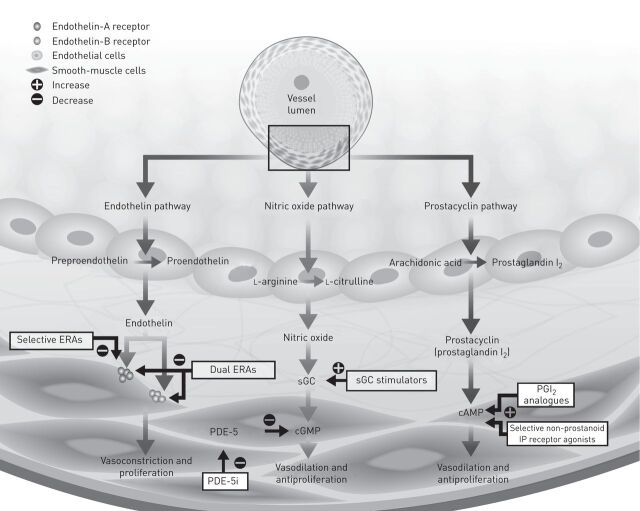
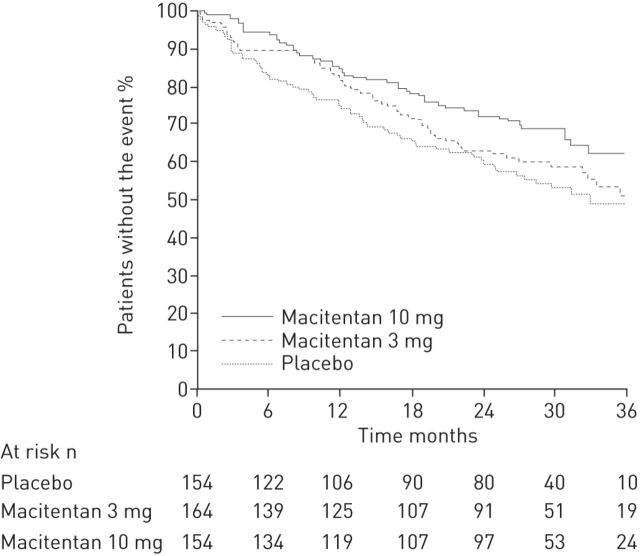
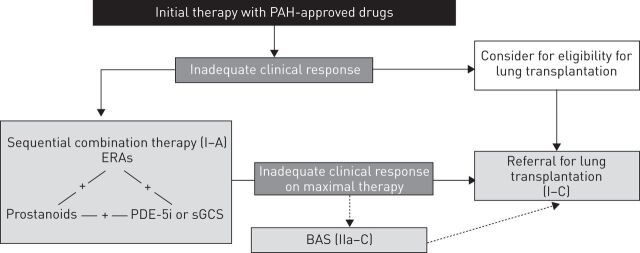
Pulmonary arterial hypertension (PAH) is a complex, progressive disease with several pathobiological mechanisms, including the endothelin, nitric oxide and prostacyclin pathways. Current treatments for PAH target one of these pathways and, in more severe cases or instances of disease worsening, may be combined with a view to target multiple pathways in parallel. Treatment combination is performed sequentially (as an intensification from initial monotherapy) or upfront (use of two or more therapies in treatment-naïve patients). Whilst combination therapy has been historically considered to be an option for the treatment of PAH, supporting evidence was typically limited to expert opinion, clinical experience and registry data. Data from randomised controlled trials on sequential combination therapy in particular has grown in recent years, resulting in a change in the level of recommendations in the latest update to the PAH treatment algorithm. However, short-term trials have shown inconsistent results, and have not been powered to assess morbidity/mortality outcomes. More recent data from long-term trials suggest a potential clinical benefit associated with sequential combination therapy. In this review we will introduce the concept of combination therapy, consider the latest evidence for both sequential and upfront combination therapy, and discuss additional considerations when initiating combination therapy in clinical practice.
肺动脉高压(PAH)是一种复杂的进行性疾病,具有多种病理生物学机制,包括内皮素、一氧化氮和前列环素途径。目前针对PAH的治疗针对这些途径之一,在病情更严重或疾病恶化的情况下,可能会联合使用以同时针对多个途径。联合治疗可按顺序进行(作为从初始单药治疗的强化)或一开始就使用(在未接受过治疗的患者中使用两种或更多种疗法)。虽然联合治疗在历史上一直被认为是治疗PAH的一种选择,但支持证据通常仅限于专家意见、临床经验和登记数据。近年来,特别是关于序贯联合治疗的随机对照试验数据有所增加,导致PAH治疗算法的最新更新中推荐水平发生了变化。然而,短期试验结果并不一致,且未进行足够的样本量来评估发病率/死亡率结果。来自长期试验的最新数据表明序贯联合治疗具有潜在的临床益处。在本综述中,我们将介绍联合治疗的概念,考虑序贯和初始联合治疗的最新证据,并讨论在临床实践中开始联合治疗时的其他注意事项。