Outten F Wayne
University of South Carolina, Department of Chemistry and Biochemistry, 631 Sumter Street, Columbia, SC 29208, USA.
Biochim Biophys Acta. 2015 Jun;1853(6):1464-9. doi: 10.1016/j.bbamcr.2014.11.001. Epub 2014 Nov 7.
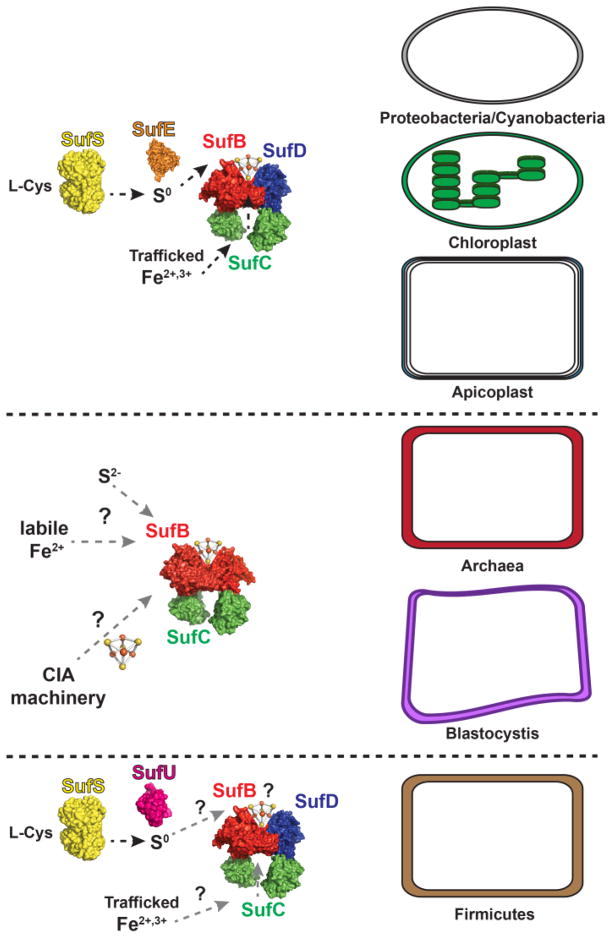
Fe-S clusters play critical roles in cellular function throughout all three kingdoms of life. Consequently, Fe-S cluster biogenesis systems are present in most organisms. The Suf (sulfur formation) system is the most ancient of the three characterized Fe-S cluster biogenesis pathways, which also include the Isc and Nif systems. Much of the first work on the Suf system took place in Gram-negative Proteobacteria used as model organisms. These early studies led to a wealth of biochemical, genetic, and physiological information on Suf function. From those studies we have learned that SufB functions as an Fe-S scaffold in conjunction with SufC (and in some cases SufD). SufS and SufE together mobilize sulfur for cluster assembly and SufA traffics the complete Fe-S cluster from SufB to target apo-proteins. However, recent progress on the Suf system in other organisms has opened up new avenues of research and new hypotheses about Suf function. This review focuses primarily on the most recent discoveries about the Suf pathway and where those new models may lead the field. This article is part of a Special Issue entitled: Fe/S proteins: Analysis, structure, function, biogenesis and diseases.
铁硫簇在生命的所有三个界的细胞功能中都起着关键作用。因此,大多数生物体中都存在铁硫簇生物合成系统。Suf(硫形成)系统是已被表征的三种铁硫簇生物合成途径中最古老的一种,另外两种途径还包括Isc和Nif系统。关于Suf系统的最初研究大多是在用作模式生物的革兰氏阴性变形杆菌中进行的。这些早期研究产生了大量关于Suf功能的生化、遗传和生理信息。从这些研究中我们了解到,SufB与SufC(在某些情况下还有SufD)一起作为铁硫支架发挥作用。SufS和SufE共同为簇组装动员硫,而SufA将完整的铁硫簇从SufB转运到目标脱辅基蛋白。然而,最近在其他生物体中对Suf系统的研究进展开辟了新的研究途径,并提出了关于Suf功能的新假设。本综述主要关注关于Suf途径的最新发现以及这些新模型可能引领该领域的方向。本文是名为:铁硫蛋白:分析、结构、功能、生物合成与疾病的特刊的一部分。