Cao Yali, Liu Kuo, Tian Zhigang, Hogan Susan L, Yang Jiajin, Poulton Caroline J, Falk Ronald J, Li Wenge
From the Department of Nephrology, China-Japan Friendship Hospital; Emergency Department, China MeiTan General Hospital, National Mining Medical Center; Department of Surgery, Beijing LuHe Hospital, Beijing, China; Division of Nephrology and Hypertension, University of North Carolina (UNC) Kidney Center, Department of Medicine, UNC at Chapel Hill, Chapel Hill, North Carolina, USA.Y. Cao, MD, PhD, Department of Nephrology, China-Japan Friendship Hospital; K. Liu, MD, PhD, Emergency Department, China MeiTan General Hospital, National Mining Medical Center; Z. Tian, MD, Department of Surgery, Beijing LuHe Hospital; S.L. Hogan, MPH, PhD; J. Yang, MD; C.J. Poulton, MSW; R.J. Falk, MD, UNC Kidney Center, Department of Medicine, UNC at Chapel Hill; W. Li, MD, PhD, Department of Nephrology, China-Japan Friendship Hospital.
J Rheumatol. 2015 Feb;42(2):292-9. doi: 10.3899/jrheum.131430. Epub 2014 Dec 1.
No clear consensus has been reached on the PTPN22 R620W polymorphism and anti-neutrophil cytoplasmic antibody (ANCA) disease, especially when stratified by ANCA specificity and disease phenotypes.
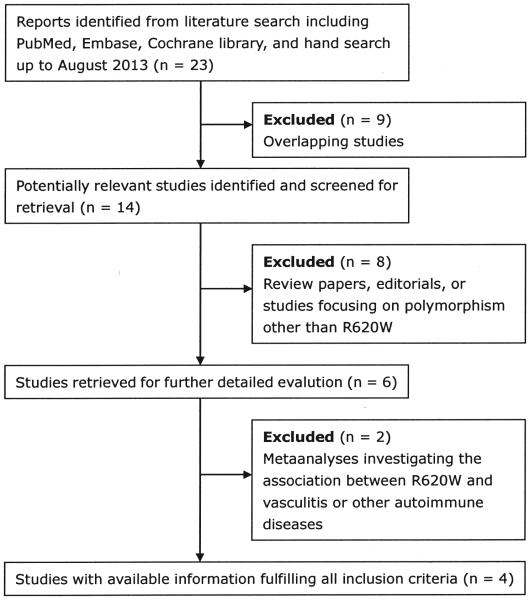
A metaanalysis was conducted on the PTPN22 R620W polymorphism across 4 studies in 1399 white patients with ANCA disease and 9934 normal control subjects.
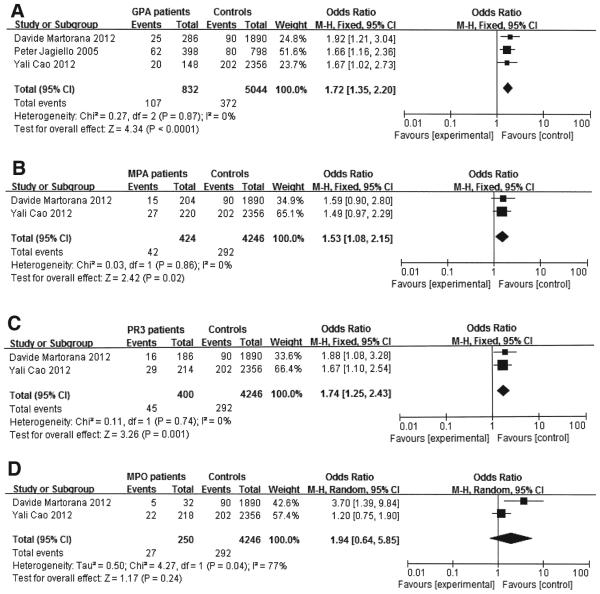
Overall, metaanalysis showed a statistically significant association between the A allele and ANCA disease in all subjects (OR 1.44, 95% CI 1.26-1.64, p < 0.00001), and stratification by disease category indicated the A allele was associated with granulomatosis with polyangiitis (Wegener's; GPA; OR 1.72, 95% CI 1.35-2.20, p < 0.0001) and microscopic polyangiitis (MPA; OR 1.53, 95% CI 1.08-2.15, p = 0.02) as compared to controls. However, when stratified by ANCA specificity, the association of the A allele was statistically evident among those with proteinase 3 (PR3) ANCA disease (OR 1.74, 95% CI 1.25-2.430, p = 0.001), with the same trend but not statistically associated with myeloperoxidase ANCA disease (OR 1.94, 95% CI 0.64-5.85, p = 0.24). The marked associations were also demonstrated between this allele with lung (OR 1.69, 95% CI 1.21-2.36, p = 0.002), ENT (OR 2.03, 95% CI 1.45-2.84, p < 0.0001), skin (OR 2.55, 95% CI 1.69-3.84, p < 0.0001), and peripheral neuropathy involvement (OR 2.12, 95% CI 1.39-3.22, p = 0.0005).
The PTPN22 620W allele confers susceptibility to the occurrence and development of ANCA disease in whites, with specific evidence among subsets with GPA, MPA, and PR3 ANCA.
关于蛋白酪氨酸磷酸酶非受体型22(PTPN22)基因R620W多态性与抗中性粒细胞胞浆抗体(ANCA)相关疾病,尚未达成明确共识,尤其是按ANCA特异性和疾病表型分层时。
对4项研究中的1399例白人ANCA相关疾病患者和9934例正常对照者的PTPN22 R620W多态性进行荟萃分析。
总体而言,荟萃分析显示在所有受试者中,A等位基因与ANCA相关疾病之间存在统计学显著关联(比值比[OR] 1.44,95%置信区间[CI] 1.26 - 1.64,p < 0.00001),按疾病类别分层表明,与对照组相比,A等位基因与肉芽肿性多血管炎(韦格纳肉芽肿;GPA;OR 1.72,95% CI 1.35 - 2.20,p < 0.0001)和显微镜下多血管炎(MPA;OR 1.53,95% CI 1.08 - 2.15,p = 0.02)相关。然而,按ANCA特异性分层时,A等位基因在蛋白酶3(PR3)ANCA相关疾病患者中具有统计学显著关联(OR 1.74,95% CI 1.25 - 2.430,p = 0.001),有相同趋势但与髓过氧化物酶ANCA相关疾病无统计学关联(OR 1.94,95% CI 0.64 - 5.85,p = 0.24)。该等位基因与肺部受累(OR 1.69,95% CI 1.21 - 2.36,p = 0.002)、耳鼻喉科受累(OR 2.03,95% CI 1.45 -