Ronsein Graziella E, Pamir Nathalie, von Haller Priska D, Kim Daniel S, Oda Michael N, Jarvik Gail P, Vaisar Tomas, Heinecke Jay W
Departments of Medicine, University of Washington, Seattle, WA 98109, USA.
Departments of Medicine, University of Washington, Seattle, WA 98109, USA.
J Proteomics. 2015 Jan 15;113:388-99. doi: 10.1016/j.jprot.2014.10.017. Epub 2014 Oct 31.
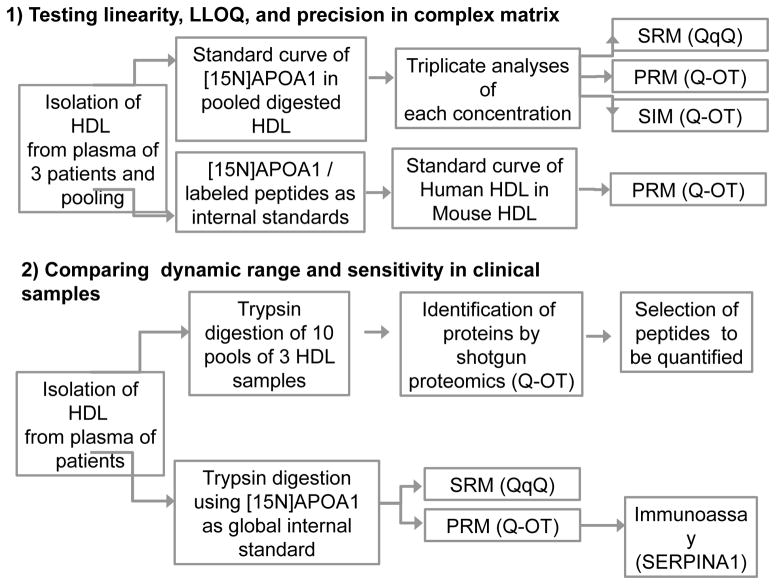
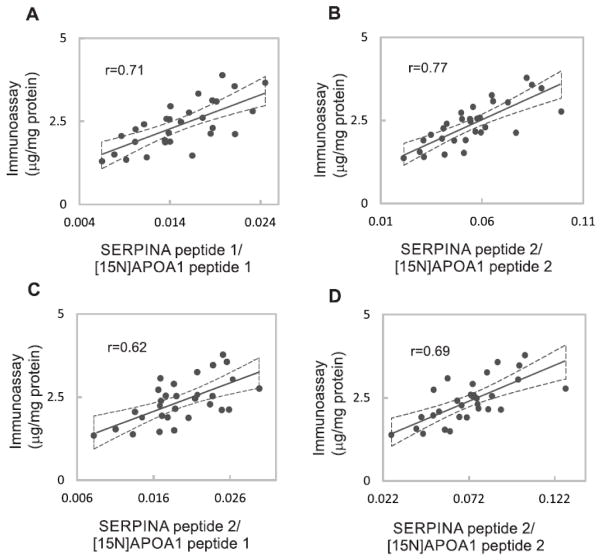
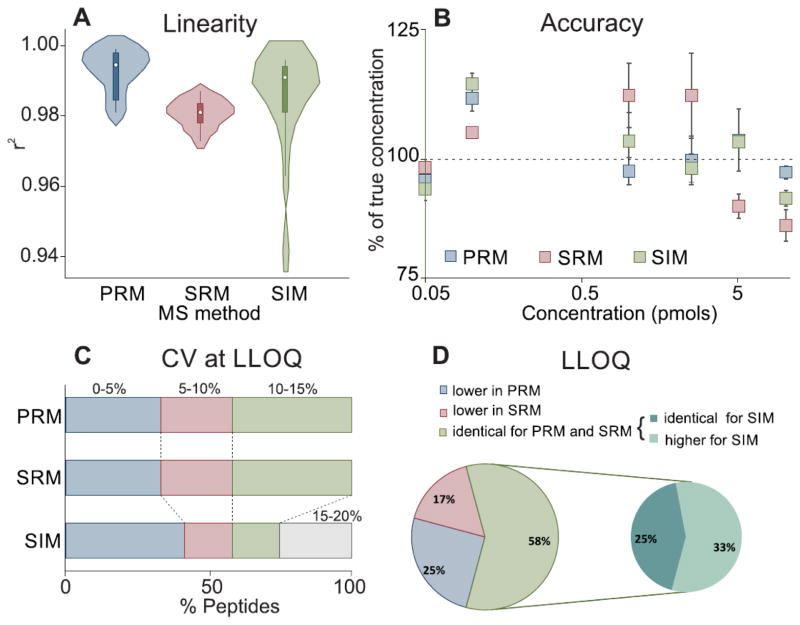
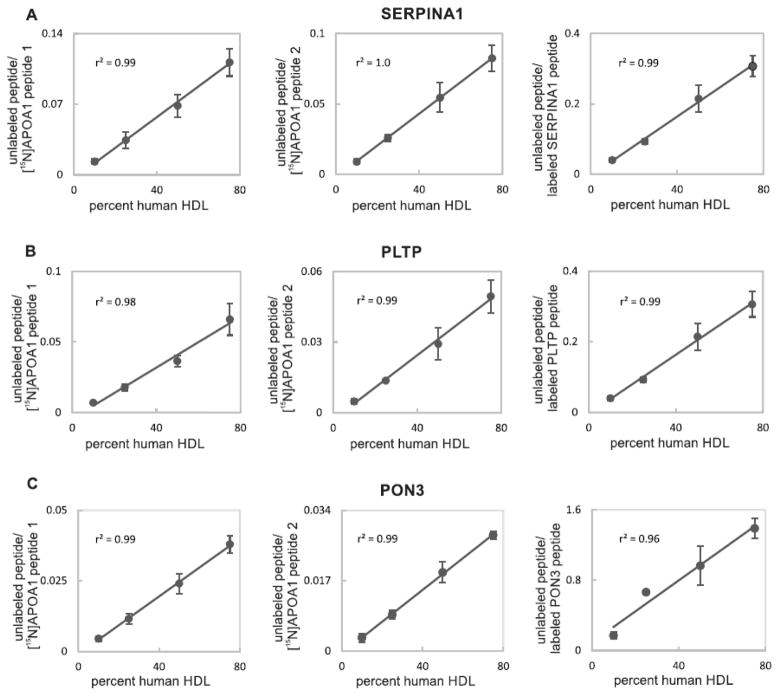
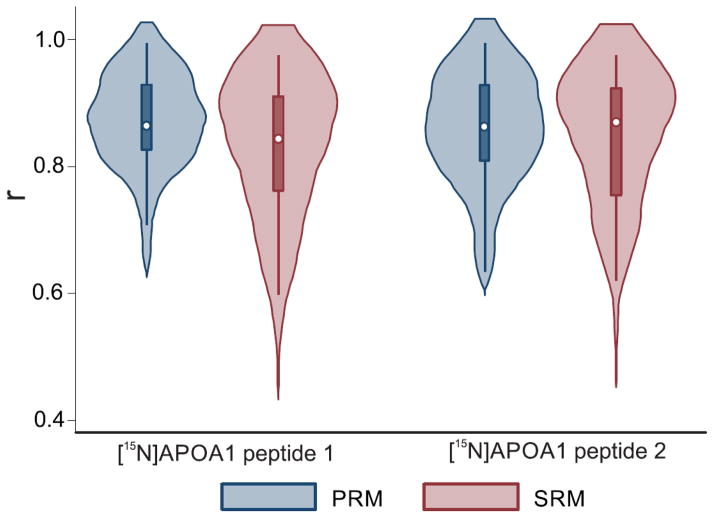
High-density lipoprotein (HDL), a lipid nanoparticle containing many different low abundance proteins, is an attractive target for clinical proteomics because its compositional heterogeneity is linked to its cardioprotective effects. Selected reaction monitoring (SRM) is currently the method of choice for targeted quantification of proteins in such a complex biological matrix. However, model system studies suggest that parallel reaction monitoring (PRM) is more specific than SRM because many product ions can be used to confirm the identity of a peptide. We therefore compared PRM and SRM for their abilities to quantify proteins in HDL, using (15)N-labeled apolipoprotein A-I (HDL's most abundant protein) as the internal standard. PRM and SRM exhibited comparable linearity, dynamic range, precision, and repeatability for protein quantification of HDL. Moreover, the single internal standard protein performed as well as protein-specific peptide internal standards when quantifying 3 different proteins. Importantly, PRM and SRM yielded virtually identical quantitative results for 26 proteins in HDL isolated from 44 subjects. Because PRM requires less method development than SRM and is potentially more specific, our observations indicate that PRM in concert with a single isotope-labeled protein is a promising new strategy for quantifying HDL proteins in translational studies.
HDL, a complex matrix composed of lipids and proteins, is implicated in cardioprotection. Its cholesterol content correlates inversely with cardiovascular disease and it is the current metric to assess cardiovascular risk. However, the cholesterol content does not capture HDL's complexity and heterogeneity. Devising metrics that better capture HDL's cardioprotective effects, we developed an optimized method for quantification of HDL proteome, using PRM in concert with a single labeled protein as internal standard. The availability of a method that increases sample throughput without compromising the reproducibility, sensitivity, and accuracy could therefore point to better risk assessment for CVD or other diseases.
高密度脂蛋白(HDL)是一种含有许多不同低丰度蛋白质的脂质纳米颗粒,因其组成异质性与心脏保护作用相关,所以是临床蛋白质组学的一个有吸引力的靶点。选择反应监测(SRM)目前是在此类复杂生物基质中对蛋白质进行靶向定量的首选方法。然而,模型系统研究表明,平行反应监测(PRM)比SRM更具特异性,因为许多产物离子可用于确认肽的身份。因此,我们使用(15)N标记的载脂蛋白A-I(HDL中最丰富的蛋白质)作为内标,比较了PRM和SRM对HDL中蛋白质进行定量的能力。PRM和SRM在HDL蛋白质定量方面表现出相当的线性、动态范围、精密度和重复性。此外,在对3种不同蛋白质进行定量时,单一内标蛋白的表现与蛋白质特异性肽内标相当。重要的是,对于从44名受试者中分离出的HDL中的26种蛋白质,PRM和SRM产生的定量结果几乎相同。由于PRM比SRM所需的方法开发更少且可能更具特异性,我们的观察结果表明,PRM与单一同位素标记蛋白相结合是转化研究中定量HDL蛋白质的一种有前景的新策略。
HDL是一种由脂质和蛋白质组成的复杂基质,与心脏保护有关。其胆固醇含量与心血管疾病呈负相关,是目前评估心血管风险的指标。然而,胆固醇含量并不能反映HDL的复杂性和异质性。为了设计出能更好反映HDL心脏保护作用的指标,我们开发了一种优化的HDL蛋白质组定量方法,使用PRM并结合单一标记蛋白作为内标。因此,一种在不影响重现性、灵敏度和准确性的情况下提高样品通量的方法的出现,可能有助于更好地评估心血管疾病或其他疾病的风险。