
多灶性基底节区T2*加权磁共振成像低信号的自动分割
Automated segmentation of multifocal basal ganglia T2*-weighted MRI hypointensities.
作者信息
Glatz Andreas, Bastin Mark E, Kiker Alexander J, Deary Ian J, Wardlaw Joanna M, Valdés Hernández Maria C
机构信息
Brain Research Imaging Centre, Neuroimaging Sciences, University of Edinburgh, Western General Hospital, Crewe Road, Edinburgh EH4 2XU, UK; SINAPSE Collaboration, Brain Research Imaging Centre, Neuroimaging Sciences, University of Edinburgh, Western General Hospital, Crewe Road, Edinburgh EH4 2XU, UK.
Brain Research Imaging Centre, Neuroimaging Sciences, University of Edinburgh, Western General Hospital, Crewe Road, Edinburgh EH4 2XU, UK; SINAPSE Collaboration, Brain Research Imaging Centre, Neuroimaging Sciences, University of Edinburgh, Western General Hospital, Crewe Road, Edinburgh EH4 2XU, UK; Centre for Clinical Brain Sciences, University of Edinburgh, Edinburgh, UK; Centre for Cognitive Ageing and Cognitive Epidemiology, University of Edinburgh, Edinburgh EH8 9JZ, UK.
出版信息
Neuroimage. 2015 Jan 15;105:332-46. doi: 10.1016/j.neuroimage.2014.10.001. Epub 2014 Oct 14.
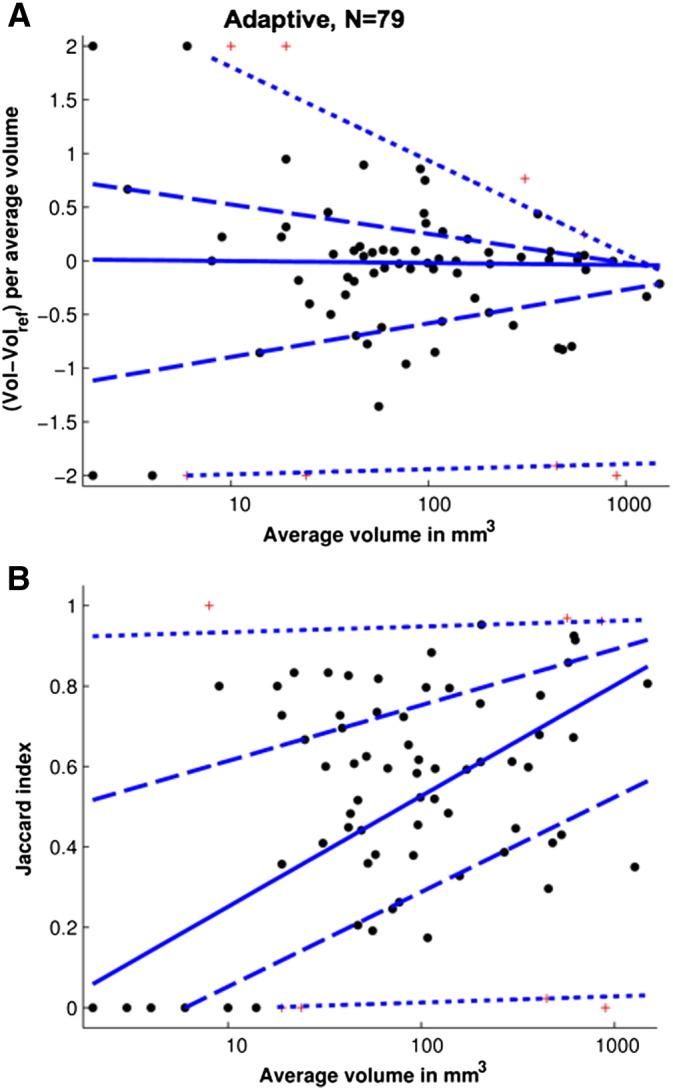
Multifocal basal ganglia T2*-weighted (T2w) hypointensities, which are believed to arise mainly from vascular mineralization, were recently proposed as a novel MRI biomarker for small vessel disease and ageing. These T2w hypointensities are typically segmented semi-automatically, which is time consuming, associated with a high intra-rater variability and low inter-rater agreement. To address these limitations, we developed a fully automated, unsupervised segmentation method for basal ganglia T2w hypointensities. This method requires conventional, co-registered T2w and T1-weighted (T1w) volumes, as well as region-of-interest (ROI) masks for the basal ganglia and adjacent internal capsule generated automatically from T1w MRI. The basal ganglia T2w hypointensities were then segmented with thresholds derived with an adaptive outlier detection method from respective bivariate T2w/T1w intensity distributions in each ROI. Artefacts were reduced by filtering connected components in the initial masks based on their standardised T2w intensity variance. The segmentation method was validated using a custom-built phantom containing mineral deposit models, i.e. gel beads doped with 3 different contrast agents in 7 different concentrations, as well as with MRI data from 98 community-dwelling older subjects in their seventies with a wide range of basal ganglia T2w hypointensities. The method produced basal ganglia T2w hypointensity masks that were in substantial volumetric and spatial agreement with those generated by an experienced rater (Jaccard index = 0.62 ± 0.40). These promising results suggest that this method may have use in automatic segmentation of basal ganglia T2w hypointensities in studies of small vessel disease and ageing.
多灶性基底节T2加权(T2w)低信号,据信主要源于血管矿化,最近被提议作为小血管疾病和衰老的一种新型MRI生物标志物。这些T2w低信号通常采用半自动分割,这很耗时,且评分者内变异性高、评分者间一致性低。为解决这些局限性,我们开发了一种用于基底节T2w低信号的全自动、无监督分割方法。该方法需要常规的、配准好的T2w和T1加权(T1w)容积,以及从T1w MRI自动生成的基底节和相邻内囊的感兴趣区域(ROI)掩码。然后,利用自适应离群值检测方法从每个ROI中各自的双变量T2w/T1w强度分布得出的阈值对基底节T2w低信号进行分割。通过基于其标准化T2w强度方差过滤初始掩码中的连通分量来减少伪影。使用一个包含矿质沉积模型的定制体模(即掺杂7种不同浓度的3种不同造影剂的凝胶珠)以及来自98名70多岁社区居住老年受试者的MRI数据(这些受试者的基底节T2w低信号范围广泛)对分割方法进行了验证。该方法生成的基底节T2w低信号掩码在体积和空间上与经验丰富的评分者生成的掩码基本一致(杰卡德指数 = 0.62 ± 0.40)。这些有前景的结果表明,该方法可能可用于小血管疾病和衰老研究中基底节T2*w低信号的自动分割。


 Zotero 插件