Nakazawa Youya, Kawano Satoshi, Matsui Junji, Funahashi Yasuhiro, Tohyama Osamu, Muto Hiroki, Nakagawa Takayuki, Matsushima Tomohiro
Tsukuba Research Laboratory, Eisai Co., Ltd., Ibaraki, Japan.
Cancer Sci. 2015 Feb;106(2):201-7. doi: 10.1111/cas.12581. Epub 2015 Feb 4.
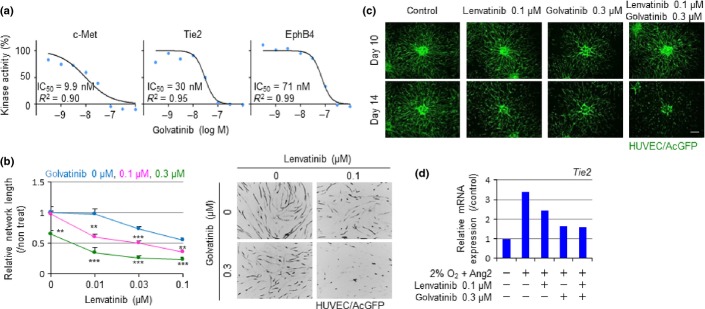
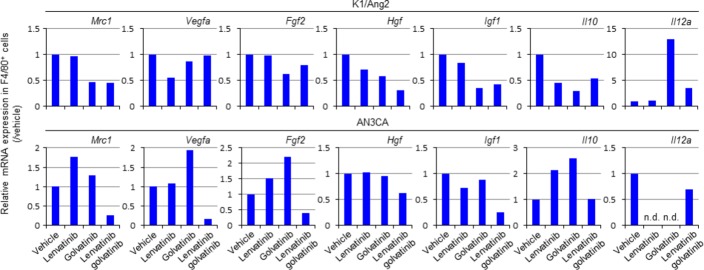
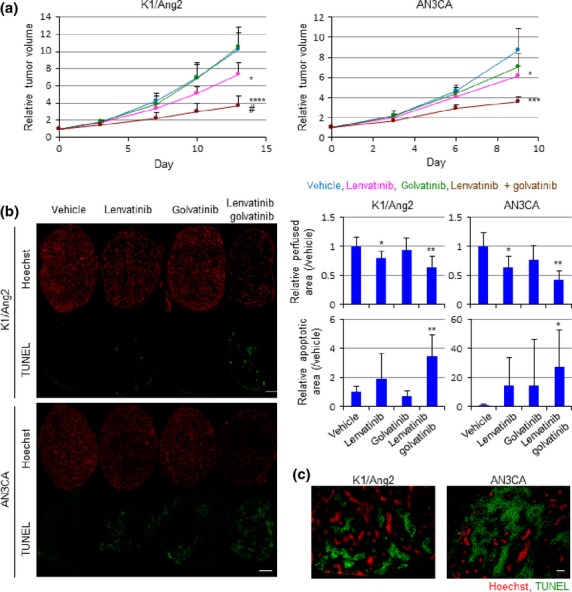
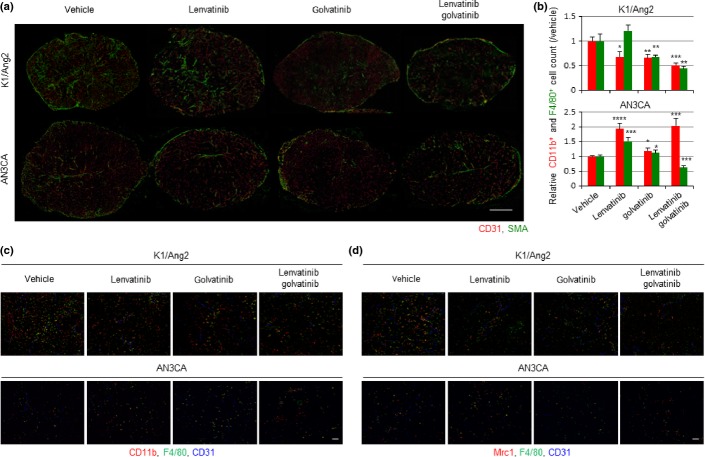
Almost all cancers show intrinsic and/or evasive resistance to vascular endothelial growth factor (VEGF) inhibitors by multiple mechanisms. Serum angiopoietin-2 (Ang2) level has been proposed as a potential biomarker of VEGF inhibitor response in several cancers. From these clinical observations, the Ang2 and Tie2 (its receptor) axis has been focused on as a promising target. Here, we show a novel strategy to circumvent the resistance by combining multi-tyrosine kinase inhibitors lenvatinib (VEGF receptor, fibroblast growth factor receptor, and RET inhibitor) and golvatinib (E7050; c-Met, Tie2, and EphB4 inhibitor). Tie2 identifies a highly pro-angiogenic macrophage subset, Tie2-expressing macrophages (TEM). Angi-Tie2 and EphB4-EphrinB2 signaling plays critical roles in pericyte-mediated vessel stabilization. In vitro analyses suggested that golvatinib combined with lenvatinib inhibited pericyte-mediated vessel stabilization and TEM differentiation. In thyroid and endometrial cancer models, golvatinib and lenvatinib inhibited pericyte network development and TEM infiltration, resulting in severe perfusion disorder and massive apoptosis. Body weight loss was tolerable, and no macroscopic change was observed. These preclinical studies suggest that modulation of the tumor microenvironment by a strategic and well-tolerated combination of multi-targeting tyrosine kinase inhibitors may sensitize cancer to VEGF inhibitors.
几乎所有癌症都会通过多种机制对血管内皮生长因子(VEGF)抑制剂表现出内在和/或逃避性耐药。血清血管生成素-2(Ang2)水平已被提议作为几种癌症中VEGF抑制剂反应的潜在生物标志物。基于这些临床观察,Ang2和Tie2(其受体)轴已成为一个有前景的靶点。在此,我们展示了一种新策略,即通过联合多酪氨酸激酶抑制剂乐伐替尼(VEGF受体、成纤维细胞生长因子受体和RET抑制剂)和戈伐替尼(E7050;c-Met、Tie2和EphB4抑制剂)来克服耐药性。Tie2可识别一个高度促血管生成的巨噬细胞亚群,即表达Tie2的巨噬细胞(TEM)。Angi-Tie2和EphB4-EphrinB2信号在周细胞介导的血管稳定中起关键作用。体外分析表明,戈伐替尼与乐伐替尼联合使用可抑制周细胞介导的血管稳定和TEM分化。在甲状腺癌和子宫内膜癌模型中,戈伐替尼和乐伐替尼抑制周细胞网络发育和TEM浸润,导致严重的灌注紊乱和大量细胞凋亡。体重减轻是可耐受的,且未观察到宏观变化。这些临床前研究表明,通过多靶点酪氨酸激酶抑制剂的策略性和耐受性良好的联合来调节肿瘤微环境,可能会使癌症对VEGF抑制剂敏感。