Ravinet Mark, Takeuchi Naoko, Kume Manabu, Mori Seiichi, Kitano Jun
Ecological Genetics Laboratory, National Institute of Genetics, Mishima, Japan.
Biological Laboratory, Gifu-keizai University, Ogaki, Japan.
PLoS One. 2014 Dec 2;9(12):e112404. doi: 10.1371/journal.pone.0112404. eCollection 2014.
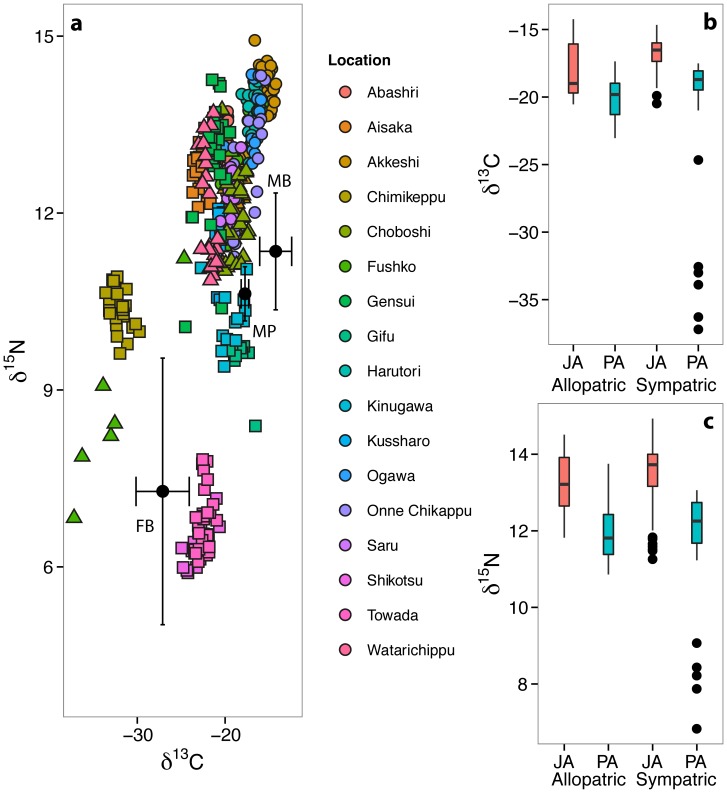
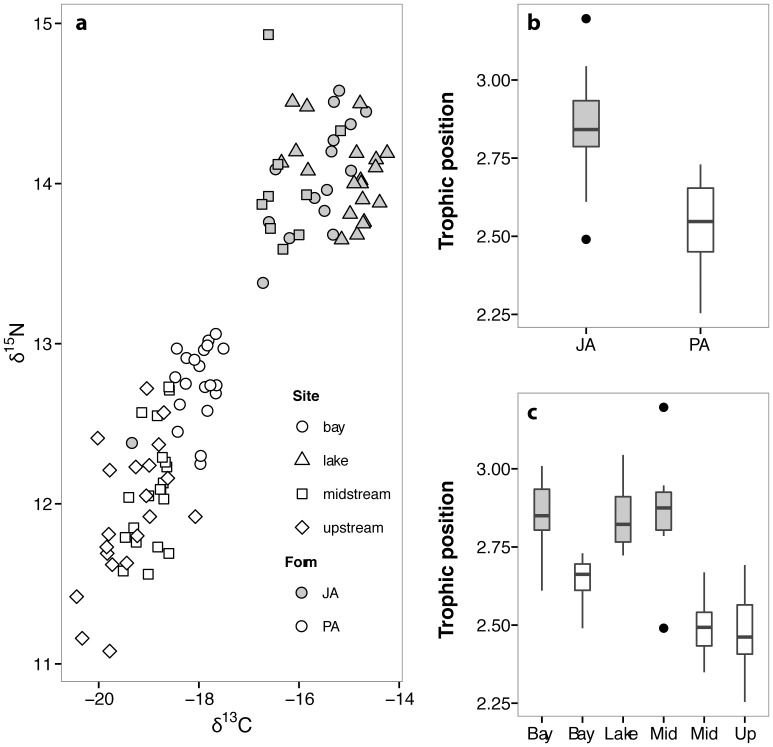
Divergent selection and adaptive divergence can increase phenotypic diversification amongst populations and lineages. Yet adaptive divergence between different environments, habitats or niches does not occur in all lineages. For example, the colonization of freshwater environments by ancestral marine species has triggered adaptive radiation and phenotypic diversification in some taxa but not in others. Studying closely related lineages differing in their ability to diversify is an excellent means of understanding the factors promoting and constraining adaptive evolution. A well-known example of the evolution of increased phenotypic diversification following freshwater colonization is the three-spined stickleback. Two closely related stickleback lineages, the Pacific Ocean and the Japan Sea occur in Japan. However, Japanese freshwater stickleback populations are derived from the Pacific Ocean lineage only, suggesting the Japan Sea lineage is unable to colonize freshwater. Using stable isotope data and trophic morphology, we first show higher rates of phenotypic and ecological diversification between marine and freshwater populations within the Pacific Ocean lineage, confirming adaptive divergence has occurred between the two lineages and within the Pacific Ocean lineage but not in the Japan Sea lineage. We further identified consistent divergence in diet and foraging behaviour between marine forms from each lineage, confirming Pacific Ocean marine sticklebacks, from which all Japanese freshwater populations are derived, are better adapted to freshwater environments than Japan Sea sticklebacks. We suggest adaptive divergence between ancestral marine populations may have played a role in constraining phenotypic diversification and adaptive evolution in Japanese sticklebacks.
趋异选择和适应性分化能够增加种群和谱系间的表型多样化。然而,不同环境、栖息地或生态位之间的适应性分化并非在所有谱系中都会发生。例如,海洋祖先物种对淡水环境的定殖在某些类群中引发了适应性辐射和表型多样化,但在其他类群中却没有。研究在多样化能力上存在差异的近缘谱系是理解促进和限制适应性进化因素的绝佳方式。淡水定殖后表型多样化增加的一个著名例子是三刺鱼。在日本存在两个近缘的三刺鱼谱系,即太平洋谱系和日本海谱系。然而,日本的淡水三刺鱼种群仅源自太平洋谱系,这表明日本海谱系无法定殖到淡水环境中。利用稳定同位素数据和营养形态学,我们首先表明太平洋谱系内海洋和淡水种群之间的表型和生态多样化速率更高,证实了两个谱系之间以及太平洋谱系内部发生了适应性分化,而日本海谱系中则没有。我们进一步确定了每个谱系的海洋形态在饮食和觅食行为上存在一致的差异,证实了所有日本淡水种群的祖先——太平洋海洋三刺鱼比日本海三刺鱼更能适应淡水环境。我们认为祖先海洋种群之间的适应性分化可能在限制日本三刺鱼的表型多样化和适应性进化中发挥了作用。