
免疫反应加剧爆炸所致眼外伤
Exacerbation of blast-induced ocular trauma by an immune response.
作者信息
Bricker-Anthony Courtney, Hines-Beard Jessica, D'Surney Lauren, Rex Tonia S
机构信息
Vanderbilt Eye Institute, Vanderbilt University, 11425 MRB IV, 2213 Garland Ave., Nashville, TN, 37232, USA.
Vanderbilt Brain Institute, Vanderbilt University, 11425 MRB IV, 2213 Garland Ave., Nashville, TN, 37232, USA.
出版信息
J Neuroinflammation. 2014 Nov 29;11(1):192. doi: 10.1186/s12974-014-0192-5.
BACKGROUND
Visual prognosis after an open globe injury is typically worse than after a closed globe injury due, in part, to the immune response that ensues following open globe trauma. There is a need for an animal model of open globe injury in order to investigate mechanisms of vision loss and test potential therapeutics.
METHODS
The left eyes of DBA/2 J mice were exposed to an overpressure airwave blast. This strain lacks a fully functional ocular immune privilege, so even though the blast wave does not rupture the globe, immune infiltrate and neuroinflammation occurs as it would in an open globe injury. For the first month after blast wave exposure, the gross pathology, intraocular pressure, visual function, and retinal integrity of the blast-exposed eyes were monitored. Eyes were collected at three, seven, and 28 days to study the histology of the cornea, retina, and optic nerve, and perform immunohistochemical labeling with markers of cell death, oxidative stress, and inflammation.
RESULTS
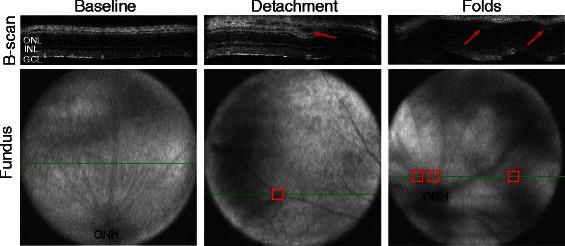
The overpressure airwave caused anterior injuries including corneal edema, neovascularization, and hyphema. Immune infiltrate was detected throughout the eyes after blast wave exposure. Posterior injuries included occasional retinal detachments and epiretinal membranes, large retinal pigment epithelium vacuoles, regional photoreceptor cell death, and glial reactivity. Optic nerve degeneration was evident at 28 days post-blast wave exposure. The electroretinogram (ERG) showed an early deficit in the a wave that recovered over time. Both visual acuity and the ERG b wave showed an early decrease, then a transient improvement that was followed by further decline at 28 days post-blast wave exposure.
CONCLUSIONS
Ocular blast injury in the DBA/2 J mouse recapitulates damage that is characteristic of open globe injuries with the advantage of a physically intact globe that prevents complications from infection. The injury was more severe in DBA/2 J mice than in C57Bl/6 J mice, which have an intact ocular immune privilege. Early injury to the outer retina mostly recovers over time. In contrast, inner retinal dysfunction seems to drive later vision loss.
背景
开放性眼球损伤后的视觉预后通常比闭合性眼球损伤后的更差,部分原因是开放性眼球创伤后随之而来的免疫反应。需要一种开放性眼球损伤的动物模型来研究视力丧失的机制并测试潜在的治疗方法。
方法
将DBA/2 J小鼠的左眼暴露于超压气浪冲击。该品系缺乏完全功能性的眼免疫赦免,因此即使冲击波未使眼球破裂,免疫浸润和神经炎症仍会如开放性眼球损伤那样发生。在冲击波暴露后的第一个月,监测受冲击眼睛的大体病理学、眼压、视觉功能和视网膜完整性。在第3天、第7天和第28天收集眼睛,以研究角膜、视网膜和视神经的组织学,并使用细胞死亡、氧化应激和炎症标志物进行免疫组织化学标记。
结果
超压气浪造成前部损伤,包括角膜水肿、新生血管形成和前房积血。冲击波暴露后在整个眼睛中检测到免疫浸润。后部损伤包括偶尔的视网膜脱离和视网膜前膜、大的视网膜色素上皮空泡、局部光感受器细胞死亡和胶质细胞反应性。冲击波暴露后28天视神经变性明显。视网膜电图(ERG)显示a波早期缺陷,随时间恢复。视力和ERG b波均显示早期下降,然后短暂改善,随后在冲击波暴露后28天进一步下降。
结论
DBA/2 J小鼠的眼冲击伤重现了开放性眼球损伤的特征性损伤,其优点是眼球物理上完整,可防止感染并发症。DBA/2 J小鼠的损伤比具有完整眼免疫赦免的C57Bl/6 J小鼠更严重。外层视网膜的早期损伤大多随时间恢复。相比之下,内层视网膜功能障碍似乎导致后期视力丧失。




 Zotero 插件