Department of Child Health, University of Arizona College of Medicine - Phoenix, 425 N. 5th St. | 322 ABC-1 Building, Phoenix, AZ, 85004-2127, USA.
Barrow Neurological Institute at Phoenix Children's Hospital, Phoenix Children's Hospital, Phoenix, AZ, USA.
BMC Neurosci. 2023 Oct 10;24(1):52. doi: 10.1186/s12868-023-00822-3.
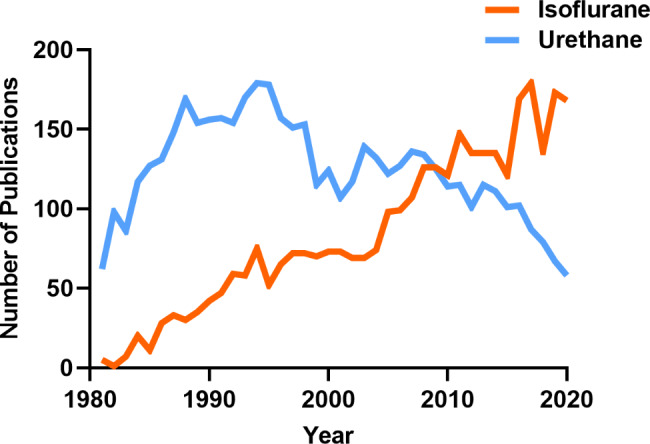
Aspects of glutamate neurotransmission implicated in normal and pathological conditions are predominantly evaluated using in vivo recording paradigms in rats anesthetized with isoflurane or urethane. Urethane and isoflurane anesthesia influence glutamate neurotransmission through different mechanisms; however, real-time outcome measures of potassium chloride (KCl)-evoked glutamate overflow and glutamate clearance kinetics have not been compared within and between regions of the brain. In order to maintain rigor and reproducibility within the literature between the two most common methods of anesthetized in vivo recording of glutamate, we compared glutamate signaling as a function of anesthesia and brain region in the rat strain most used in neuroscience.
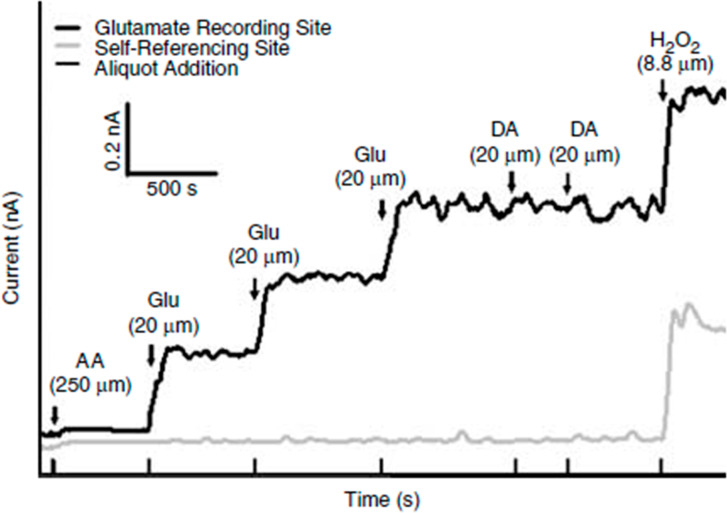
In the following experiments, in vivo amperometric recordings of KCl-evoked glutamate overflow and glutamate clearance kinetics (uptake rate and T) in the cortex, hippocampus, and thalamus were performed using glutamate-selective microelectrode arrays (MEAs) in young adult male, Sprague-Dawley rats anesthetized with either isoflurane or urethane.
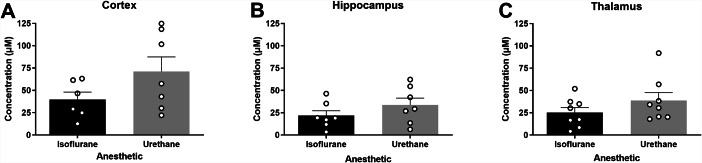
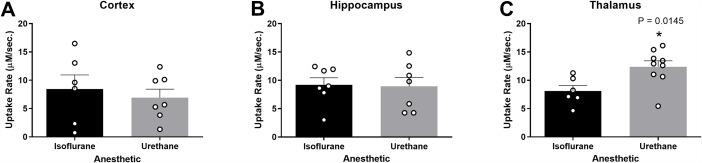
Potassium chloride (KCl)-evoked glutamate overflow was similar under urethane and isoflurane anesthesia in all brain regions studied. Analysis of glutamate clearance determined that the uptake rate was significantly faster (53.2%, p < 0.05) within the thalamus under urethane compared to isoflurane, but no differences were measured in the cortex or hippocampus. Under urethane, glutamate clearance parameters were region-dependent, with significantly faster glutamate clearance in the thalamus compared to the cortex but not the hippocampus (p < 0.05). No region-dependent differences were measured for glutamate overflow using isoflurane.
These data support that amperometric recordings of KCl-evoked glutamate under isoflurane and urethane anesthesia result in similar and comparable data. However, certain parameters of glutamate clearance can vary based on choice of anesthesia and brain region. In these circumstances, special considerations are needed when comparing previous literature and planning future experiments.
在使用异氟烷或氨基甲酸乙酯麻醉的大鼠体内记录范式中,主要评估与谷氨酸神经递质传递有关的正常和病理条件的各个方面。氨基甲酸乙酯和异氟烷麻醉通过不同的机制影响谷氨酸神经递质传递;然而,尚未在脑内不同区域之间比较氯化钾(KCl)诱发的谷氨酸溢出和谷氨酸清除动力学的实时结果测量。为了在文献中维持两种最常用的麻醉体内记录谷氨酸方法之间的严格性和可重复性,我们比较了麻醉和脑区对最常用于神经科学的大鼠品系谷氨酸信号的影响。
在以下实验中,使用谷氨酸选择性微电极阵列(MEA)在成年雄性 Sprague-Dawley 大鼠中进行体内安培记录,以评估 KCl 诱发的谷氨酸溢出和谷氨酸清除动力学(摄取率和 T)在皮质、海马和丘脑。大鼠用异氟烷或氨基甲酸乙酯麻醉。
在所有研究的脑区中,KCl 诱发的谷氨酸溢出在氨基甲酸乙酯和异氟烷麻醉下相似。谷氨酸清除分析表明,与异氟烷相比,在氨基甲酸乙酯下丘脑内的摄取率明显更快(53.2%,p<0.05),但在皮质或海马区没有差异。在氨基甲酸乙酯下,谷氨酸清除参数与脑区有关,与皮质相比,丘脑内的谷氨酸清除明显更快,但与海马相比没有差异(p<0.05)。在使用异氟烷时,没有测量到与谷氨酸溢出有关的区域依赖性差异。
这些数据支持在异氟烷和氨基甲酸乙酯麻醉下,安培记录 KCl 诱发的谷氨酸产生相似且可比的数据。然而,根据麻醉和脑区的选择,某些谷氨酸清除参数可能会有所不同。在这种情况下,在比较以前的文献和规划未来的实验时需要特殊考虑。