Nicolas Gaëlle, Chevalier Véronique, Tantely Luciano Michaël, Fontenille Didier, Durand Benoît
International Centre of Research in Agronomy for Development (CIRAD), ES Department- AGIRs Unit, Montpellier, France; Paris-Est University, Anses, Laboratory for Animal Health, Epidemiology Unit, Maisons-Alfort, France.
International Centre of Research in Agronomy for Development (CIRAD), ES Department- AGIRs Unit, Montpellier, France.
PLoS Negl Trop Dis. 2014 Dec 4;8(12):e3346. doi: 10.1371/journal.pntd.0003346. eCollection 2014 Dec.
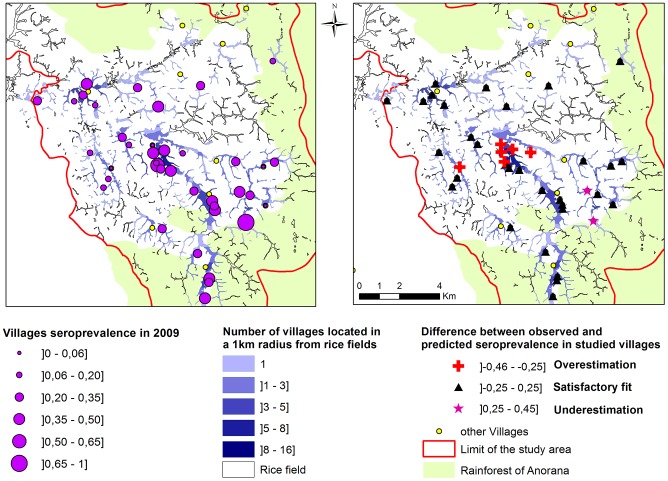
Rift Valley fever (RVF) is a vector-borne zoonotic disease that causes high morbidity and mortality in ruminants. In 2008-2009, a RVF outbreak affected the whole Madagascar island, including the Anjozorobe district located in Madagascar highlands. An entomological survey showed the absence of Aedes among the potential RVF virus (RVFV) vector species identified in this area, and an overall low abundance of mosquitoes due to unfavorable climatic conditions during winter. No serological nor virological sign of infection was observed in wild terrestrial mammals of the area, suggesting an absence of wild RVF virus (RVFV) reservoir. However, a three years serological and virological follow-up in cattle showed a recurrent RVFV circulation. The objective of this study was to understand the key determinants of this unexpected recurrent transmission. To achieve this goal, a spatial deterministic discrete-time metapopulation model combined with cattle trade network was designed and parameterized to reproduce the local conditions using observational data collected in the area. Three scenarios that could explain the RVFV recurrent circulation in the area were analyzed: (i) RVFV overwintering thanks to a direct transmission between cattle when viraemic cows calve, vectors being absent during the winter, (ii) a low level vector-based circulation during winter thanks to a residual vector population, without direct transmission between cattle, (iii) combination of both above mentioned mechanisms. Multi-model inference methods resulted in a model incorporating both a low level RVFV winter vector-borne transmission and a direct transmission between animals when viraemic cows calve. Predictions satisfactorily reproduced field observations, 84% of cattle infections being attributed to vector-borne transmission, and 16% to direct transmission. These results appeared robust according to the sensitivity analysis. Interweaving between agricultural works in rice fields, seasonality of vector proliferation, and cattle exchange practices could be a key element for understanding RVFV circulation in this area of Madagascar highlands.
裂谷热(RVF)是一种由媒介传播的人畜共患病,可导致反刍动物的高发病率和死亡率。在2008 - 2009年,一次裂谷热疫情影响了整个马达加斯加岛,包括位于马达加斯加高地的安佐罗贝区。一项昆虫学调查显示,在该地区确定的潜在裂谷热病毒(RVFV)媒介物种中没有伊蚊,并且由于冬季气候条件不利,蚊子的总体数量较低。在该地区的野生陆生哺乳动物中未观察到感染的血清学或病毒学迹象,这表明不存在野生裂谷热病毒(RVFV)宿主。然而,对牛进行的为期三年的血清学和病毒学跟踪显示裂谷热病毒反复传播。本研究的目的是了解这种意外反复传播的关键决定因素。为实现这一目标,设计并参数化了一个结合牛贸易网络的空间确定性离散时间集合种群模型,以利用该地区收集的观测数据重现当地情况。分析了三种可以解释该地区裂谷热病毒反复传播的情景:(i)由于病毒血症奶牛产犊时牛之间的直接传播,裂谷热病毒越冬,冬季没有媒介,(ii)由于残留的媒介种群,冬季存在低水平的基于媒介的传播,牛之间没有直接传播,(iii)上述两种机制的组合。多模型推断方法得出一个模型,该模型既包含低水平的裂谷热病毒冬季媒介传播,也包含病毒血症奶牛产犊时动物之间的直接传播。预测结果令人满意地重现了实地观测结果,84%的牛感染归因于媒介传播,16%归因于直接传播。根据敏感性分析,这些结果似乎很可靠。稻田农业作业、媒介繁殖的季节性和牛的交换行为之间的相互交织可能是理解马达加斯加高地该地区裂谷热病毒传播的关键因素。