Cai Anping, Li Guang, Chen Jiyan, Li Xida, Wei Xuebiao, Li Liwen, Zhou Yingling
Department of Cardiology, Guangdong Cardiovascular Institute, Guangdong General Hospital, Guangdong Academy of Medical Sciences, 106 Zhongshan Road 2, Guangzhou 510080, China.
Lipids Health Dis. 2014 Dec 4;13:181. doi: 10.1186/1476-511X-13-181.
To investigate relationship between glycated hemoglobin (HbA1c) level and coronary artery disease (CAD) severity.
Observational study was conducted and 573 participants were enrolled and baseline characteristics were collected. Clinical presentations in terms of stable angina, unstable angina or acute myocardial infarction were diagnosed. All participants were performed coronary angiography to figure out the numbers of coronary artery stenosis in terms of none-stenosis (< 50% stenosis), single or multiple vessels stenoses (≥ 50% stenosis). All participants were divided into subgroups according to two categories in terms of severity of clinical presentation (stable angina, unstable angina, or acute myocardial infarction) and the number of coronary artery stenosis (none, single, and multiple vessels). Primary endpoint was to evaluate relationship between baseline HbA1c value and CAD severity.
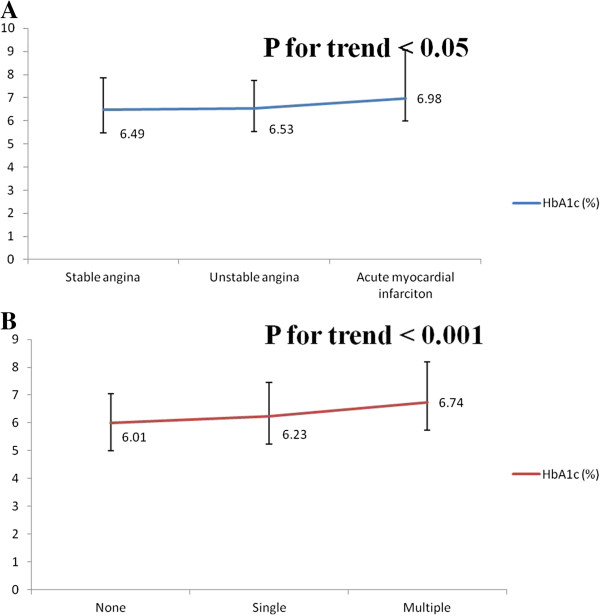
Consistent to previous studies, participants with CAD had more risk factors such as elderly, smoking, low HDL-C and high CRP levels. Notably, HbA1c level was more prominent in CAD group than that without CAD. As compared to stable angina subgroup, HbA1c levels were gradually increased in unstable angina and acute myocardial infarction groups. Similar trend was identified in another category in terms of higher HbA1c level corresponding to more vessels stenoses. Multivariate regression analyses showed that after adjusted for traditional risk factors as well as fasting blood glucose, HbA1c remained strongly associated with the severity of CAD. Nonetheless, there was no significant association when CRP was accounted for.
HbA1c may be a useful indicator for CAD risk evaluation in non-diabetic adults.
探讨糖化血红蛋白(HbA1c)水平与冠状动脉疾病(CAD)严重程度之间的关系。
进行观察性研究,纳入573名参与者并收集其基线特征。诊断稳定型心绞痛、不稳定型心绞痛或急性心肌梗死方面的临床表现。所有参与者均接受冠状动脉造影,以确定冠状动脉狭窄的数量,分为无狭窄(<50%狭窄)、单支或多支血管狭窄(≥50%狭窄)。根据临床表现的严重程度(稳定型心绞痛、不稳定型心绞痛或急性心肌梗死)和冠状动脉狭窄数量(无、单支和多支血管)这两类将所有参与者分为亚组。主要终点是评估基线HbA1c值与CAD严重程度之间的关系。
与先前研究一致,CAD患者有更多的危险因素,如老年人、吸烟、低高密度脂蛋白胆固醇(HDL-C)和高C反应蛋白(CRP)水平。值得注意的是,CAD组的HbA1c水平比无CAD组更显著。与稳定型心绞痛亚组相比,不稳定型心绞痛和急性心肌梗死组的HbA1c水平逐渐升高。在另一类中也发现了类似趋势,即HbA1c水平越高,血管狭窄越多。多变量回归分析显示,在调整传统危险因素以及空腹血糖后,HbA1c仍与CAD的严重程度密切相关。然而,在考虑CRP后,没有显著关联。
HbA1c可能是评估非糖尿病成年人CAD风险的有用指标。