Segal Ganit, Elbaz Avi, Parsi Alon, Heller Ziv, Palmanovich Ezequiel, Nyska Meir, Feldbrin Zeev, Kish Benjamin
AposTherapy Research Group, 1 Abba Even Blvd, Herzliya, 46733 Israel.
Department of Orthopedic Surgery, Meir Medical Center, Kfar-Saba, Israel.
J Foot Ankle Res. 2014 Nov 28;7(1):50. doi: 10.1186/s13047-014-0050-9. eCollection 2014.
The purpose of the current study was to examine objective and subjective differences between three severity groups of ankle fractures patients compared to healthy controls.
This was a case-controlled study. 92 patients with an ankle fracture injury of which 41 patients were eligible to participate in the study. 72 healthy people served as controls. All patients underwent a computerized gait test, completed self-assessment questionnaires (The Foot and Ankle Outcome Score (FAOS) and the SF-36), evaluated with the American Foot and Ankle Score (AOFAS) form and completed the 6-min walk test. The control group performed a computerized gait test and completed the SF-36 health survey.
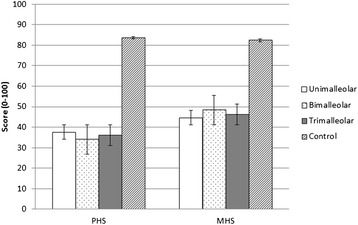
All ankle fracture patients presented compromised gait patterns and limb symmetry compared to controls (p < 0.05). Ankle fracture patients also had lower SF-36 scores compared to controls (p < 0.05). Significant differences were found between the unimalleolar group compared to the bimalleolar and trimalleolar groups in most parameters, except for the FAOS scores. There were no significant differences between the bimalleolar fracture group and the trimalleolar fracture groups.
Although all fracture severity classification groups presented a compromised gait pattern and worse clinical symptoms compared to controls, it seems that patients with a unimalleolar fracture is a different group compared to bimalleolar and trimalleolar fracture. Furthermore, it seems that bimalleolar fracture and trimalleolar fracture affect the gait pattern and clinical symptoms to an equal extent, at least in the short-term.
NCT01127776.
本研究旨在探讨与健康对照组相比,三组不同严重程度踝关节骨折患者的客观和主观差异。
这是一项病例对照研究。92例踝关节骨折患者中,41例符合研究纳入标准。72名健康人作为对照组。所有患者均接受计算机化步态测试,完成自我评估问卷(足踝结局评分(FAOS)和SF-36),采用美国足踝评分(AOFAS)表格进行评估,并完成6分钟步行测试。对照组进行计算机化步态测试并完成SF-36健康调查。
与对照组相比,所有踝关节骨折患者均表现出步态模式受损和肢体对称性降低(p < 0.05)。踝关节骨折患者的SF-36评分也低于对照组(p < 0.05)。除FAOS评分外,单踝骨折组与双踝骨折组和三踝骨折组在大多数参数上存在显著差异。双踝骨折组和三踝骨折组之间无显著差异。
尽管与对照组相比,所有骨折严重程度分类组均表现出步态模式受损和更差的临床症状,但单踝骨折患者似乎与双踝骨折和三踝骨折患者属于不同组别。此外,至少在短期内,双踝骨折和三踝骨折对步态模式和临床症状的影响程度相当。
NCT01127776。