Carney Dwayne D, Vyas Parth S, Hicks Justin J, Johnson Jeffrey E, McCormick Jeremy J, Klein Sandra E, Backus Jonathon D
Department of Orthopaedic Surgery, Washington University in St Louis, MO, USA.
Mercy Hospital, St Louis, MO, USA.
Foot Ankle Orthop. 2023 Jan 29;8(1):24730114221151080. doi: 10.1177/24730114221151080. eCollection 2023 Jan.
Ankle fractures are among the most common injuries treated by orthopaedic surgeons, yet little guidance exists in postoperative protocols for ankle fractures concerning time of immobilization. Here, we aim to investigate the association between early mobilization and patient-reported outcomes. Our null hypothesis was that no difference in Patient-Reported Outcomes Measurement Information System (PROMIS) scores would be identified in patients when comparing the effect of time of immobilization.
A retrospective review identified ankle fractures that underwent surgical fixation between 2015 and 2020 at a level 1 trauma center and its associated facilities. One hundred nineteen patients from 9 providers met inclusion criteria for our final analysis. Forty-seven patients were immobilized for <6 weeks (early) and 68 patients were immobilized for ≥6 weeks (late). Our primary outcome measures included the PROMIS questionnaire, time of immobilization, and time to full weightbearing. Our secondary outcome measures included time to return to work, wound complications (infection, delayed healing), and complications associated with fracture fixation (loss of reduction, delayed union, reoperation, hardware failure). Repeated measures analysis of variance as well as linear mixed outcome regression were used to predict each of the PROMIS outcomes of anxiety, depression, physical function, and pain interference. Each model included the predictors of age, sex, race, body mass index (BMI), diabetes, rheumatoid arthritis, smoking status, payor, provider, time to radiographic union, time to return to work, time to full weightbearing, and early vs late immobilized groups.
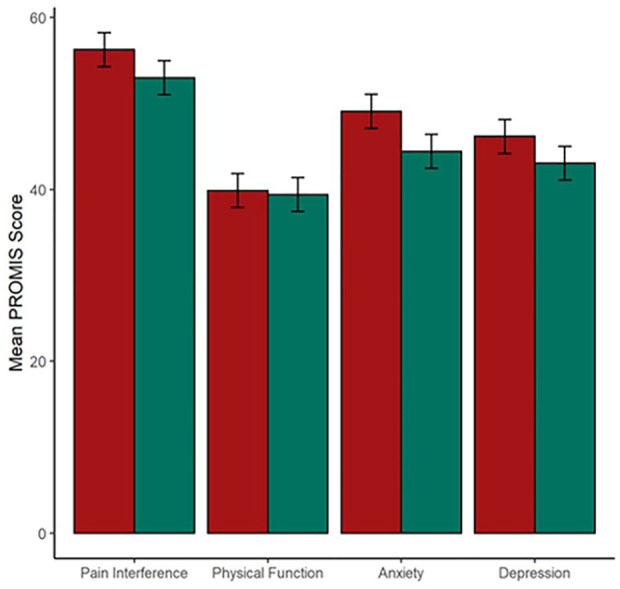
We found no differences in PROMIS scores between mobilization groups even when controlling for possible confounders such as age, BMI, rheumatoid arthritis, smoking status, and diabetes mellitus ( > .05). Furthermore, we found no differences in complications associated with fracture fixation ( > .05). Across our cohort, lower physical function scores were associated with higher BMI, increasing age, and longer time to return to work/play ( < .05). Our analysis further showed that depression, anxiety, pain interference, and physical function levels improve as a function of time ( < .05). Higher BMI was also noted to have a significant impact on PROMIS depression and anxiety when controlling for other variables. African Americans had greater pain interference scores ( < .05).
Our study suggests that early mobilization in a walker boot after operative treatment of ankle fractures is a safe alternative to casting in non-neuropathic patients. When considering operative treatment of ankle fractures, factors such as increasing age and BMI are likely to negatively affect postoperative anxiety, physical function, and depression PROMIS scores regardless of immobilization time.
Level III, retrospective cohort study.
踝关节骨折是骨科医生治疗的最常见损伤之一,但关于踝关节骨折术后固定时间的方案指导却很少。在此,我们旨在研究早期活动与患者报告结局之间的关联。我们的零假设是,在比较固定时间的影响时,患者报告结局测量信息系统(PROMIS)评分在患者中不会发现差异。
一项回顾性研究确定了2015年至2020年在一级创伤中心及其相关设施接受手术固定的踝关节骨折病例。来自9个医疗服务提供者的119名患者符合我们最终分析的纳入标准。47名患者固定时间<6周(早期),68名患者固定时间≥6周(晚期)。我们的主要结局指标包括PROMIS问卷、固定时间和完全负重时间。我们的次要结局指标包括恢复工作时间、伤口并发症(感染、愈合延迟)以及与骨折固定相关的并发症(复位丢失、延迟愈合、再次手术、内固定失败)。采用重复测量方差分析以及线性混合结局回归来预测PROMIS焦虑、抑郁、身体功能和疼痛干扰的各项结局。每个模型都包括年龄、性别、种族、体重指数(BMI)、糖尿病、类风湿关节炎、吸烟状况、付款人、医疗服务提供者、影像学愈合时间、恢复工作时间、完全负重时间以及早期与晚期固定组等预测因素。
即使在控制了年龄、BMI类风湿关节炎、吸烟状况和糖尿病等可能的混杂因素后,我们发现活动组之间的PROMIS评分没有差异(P>0.05)。此外,我们发现与骨折固定相关的并发症没有差异(P>0.05)。在我们的队列中,较低的身体功能评分与较高的BMI、年龄增加以及恢复工作/活动的时间延长有关(P<0.05)。我们的分析进一步表明,抑郁、焦虑、疼痛干扰和身体功能水平随时间改善(P<0.05)。在控制其他变量时,较高的BMI对PROMIS抑郁和焦虑也有显著影响。非裔美国人的疼痛干扰评分更高(P<0.05)。
我们的研究表明,踝关节骨折手术治疗后早期使用步行靴活动对于非神经性患者是一种安全的替代石膏固定的方法。在考虑踝关节骨折的手术治疗时,年龄和BMI增加等因素可能会对术后焦虑、身体功能和抑郁的PROMIS评分产生负面影响,而与固定时间无关。
III级,回顾性队列研究。