Sarrafzadeh Asita, Smoll Nicolas, Schaller Karl
Division of Neurosurgery, Geneva University Hospitals, Geneva Neuroscience Center, Faculty of Medicine University of Geneva, Rue Gabrielle-Perret-Gentil 4, CH-1211, Genève 14, Switzerland.
Trials. 2014 Dec 5;15:478. doi: 10.1186/1745-6215-15-478.
Despite the widespread use of external ventricular drainage, revision rates, and associated complications are reported between 10 and 40%. Current available image-guided techniques using stereotaxy, endoscopy, or ultrasound for catheter placements remain time-consuming techniques. Recently, a smartphone-assisted guide with high precision has been described. The development of an easy-to-use, portable, image-guided system could reduce the need for multiple passes and improve the rate of accurate catheter placement. This study aims to prospectively compare in a randomized controlled manner the accuracy of the freehand pass technique versus an easy-to-use, portable, adjustable guiding device for ventriculostomy catheter placement.
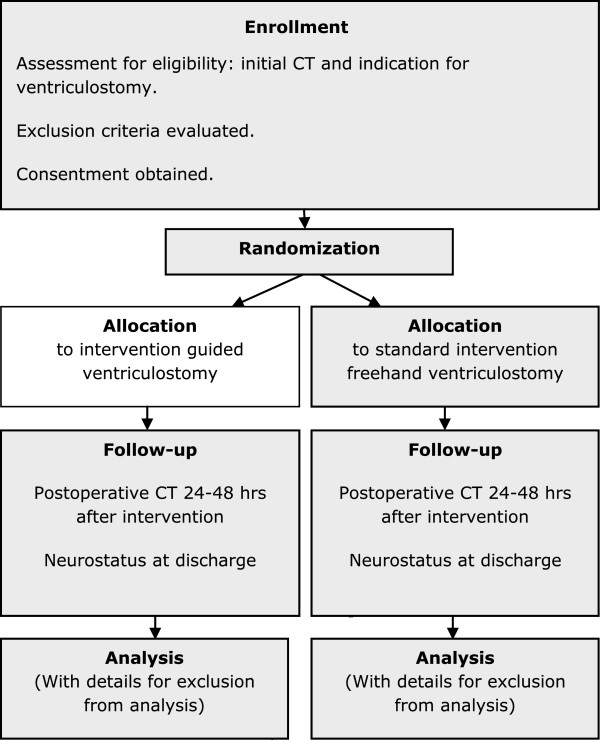
METHODS/DESIGN: This is a single center, prospective, randomized trial with a blinded endpoint (ventricular catheter tip location) assessment. Adult patients with the indication for ventriculostomy, as proven by computed tomography (CT), will be randomly assigned to the treatment group or the control group. For patients in the treatment group, ventriculostomy will be performed using an adjustable guiding device and DICOM (Digital Imaging and Communications in Medicine) image-reading software assistance (for example, using a mini-tablet) based on preoperative CT imaging.Patients in the control group will receive standard freehand ventriculostomy using anatomical landmarks. The catheter may be placed for external drainage or internal (ventriculoperitoneal) shunting in both groups. The primary outcome measure is the rate of correct placements of the ventricular catheter, defined as a score of 1 to 3 on grading system for catheter tip location on a postoperative CT scan. Participants will be followed for the duration of hospital stay, an expected average of two weeks. The primary outcome will be determined by one of the authors blinded to the treatment allocation. We aim to include 236 patients in three years. Secondary outcome measures include: frequency of placements required, frequency of completed placements within the ventricle of the perforated part of the catheter tip, frequency of very early and early shunt failures (revision of the ventricular drainage within 24 hours and within the hospital stay), frequency and percentage of complications (procedure-related and nonsurgical) at discharge.
This is the study design of a single center, prospective, randomized controlled trial to investigate whether guided ventriculostomy is superior to the standard freehand technique. One strength of this study is the prospective, randomized, interventional type of study testing a new easy-to-handle guided versus freehand ventricular catheter placement. A second strength of this study is that the power calculation is based on catheter accuracy using an available grading system for catheter tip location, and is calculated with the use of recent study results of our own population, supported by data from prominent studies.
Clinicaltrials.gov identifier: NCT02048553 (registered on 28 January 2014).
尽管外引流术被广泛应用,但据报道其翻修率和相关并发症发生率在10%至40%之间。目前可用的使用立体定向、内窥镜或超声进行导管置入的图像引导技术仍然耗时。最近,一种高精度的智能手机辅助导向装置已被描述。开发一种易于使用、便携的图像引导系统可以减少多次穿刺的需求,并提高准确导管置入率。本研究旨在以前瞻性随机对照的方式比较徒手穿刺技术与一种易于使用、便携、可调节的导向装置在脑室造瘘导管置入中的准确性。
方法/设计:这是一项单中心、前瞻性、随机试验,采用盲法评估终点(脑室导管尖端位置)。经计算机断层扫描(CT)证实有脑室造瘘指征的成年患者将被随机分配到治疗组或对照组。对于治疗组的患者,将根据术前CT成像,使用可调节导向装置和DICOM(医学数字成像和通信)图像读取软件辅助(例如,使用小型平板电脑)进行脑室造瘘。对照组的患者将使用解剖标志进行标准徒手脑室造瘘。两组患者的导管均可用于外引流或内(脑室-腹腔)分流。主要结局指标是脑室导管正确置入率,定义为术后CT扫描上导管尖端位置分级系统的1至3分。参与者将在住院期间接受随访,预计平均为期两周。主要结局将由一名对治疗分配不知情的作者确定。我们的目标是在三年内纳入236名患者。次要结局指标包括:所需置入频率、导管尖端穿孔部分在脑室内完成置入的频率、极早期和早期分流失败的频率(24小时内及住院期间对脑室引流进行翻修)、出院时并发症(与手术相关和非手术)的频率和百分比。
这是一项单中心、前瞻性随机对照试验的研究设计,旨在调查引导式脑室造瘘术是否优于标准徒手技术。本研究的一个优点是前瞻性、随机、干预性研究类型,测试一种新的易于操作的引导式与徒手脑室导管置入方法。本研究的另一个优点是,功效计算基于使用现有导管尖端位置分级系统的导管准确性,并根据我们自己人群的近期研究结果进行计算,并有著名研究的数据支持。
Clinicaltrials.gov标识符:NCT02048553(于2014年1月28日注册)。
