Allen Kelli D, Bosworth Hayden B, Chatterjee Ranee, Coffman Cynthia J, Corsino Leonor, Jeffreys Amy S, Oddone Eugene Z, Stanwyck Catherine, Yancy William S, Dolor Rowena J
Health Services Research and Development Service, Durham VA Medical Center, Durham, NC, USA.
BMC Musculoskelet Disord. 2014 Dec 6;15:413. doi: 10.1186/1471-2474-15-413.
The Patient and PRovider Interventions for Managing Osteoarthritis (OA) in Primary Care (PRIMO) study is one of the first health services trials targeting OA in a multi-site, primary care network. This multi-site approach is important for assessing generalizability of the interventions. These analyses describe heterogeneity in clinic and patient characteristics, as well as recruitment metrics, across PRIMO study clinics.
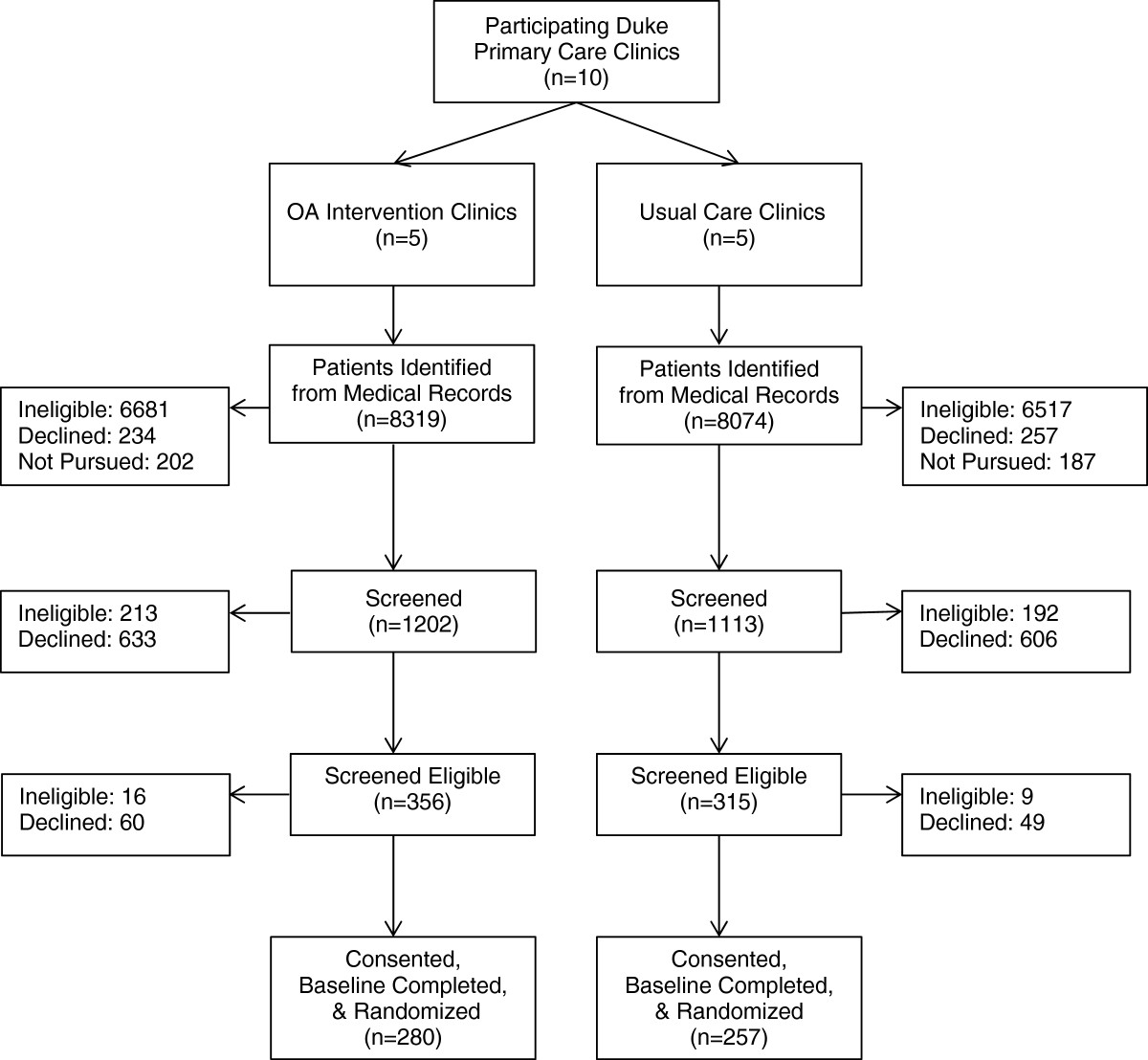
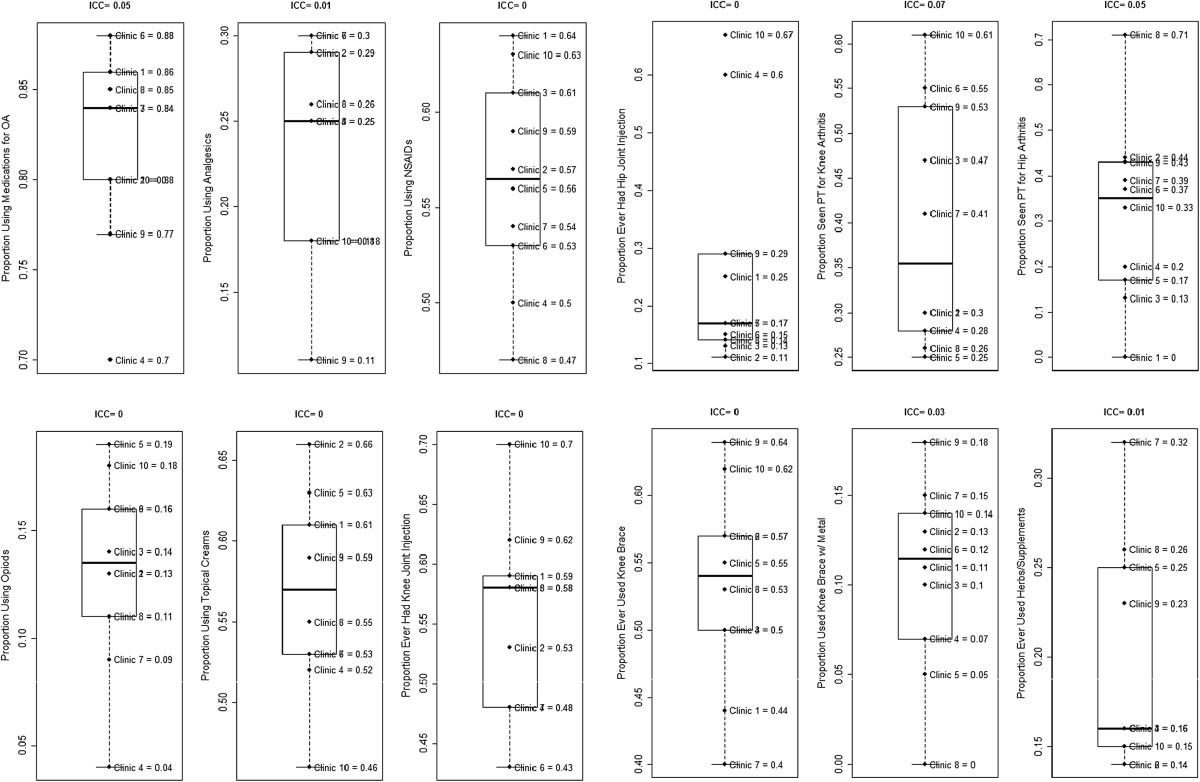
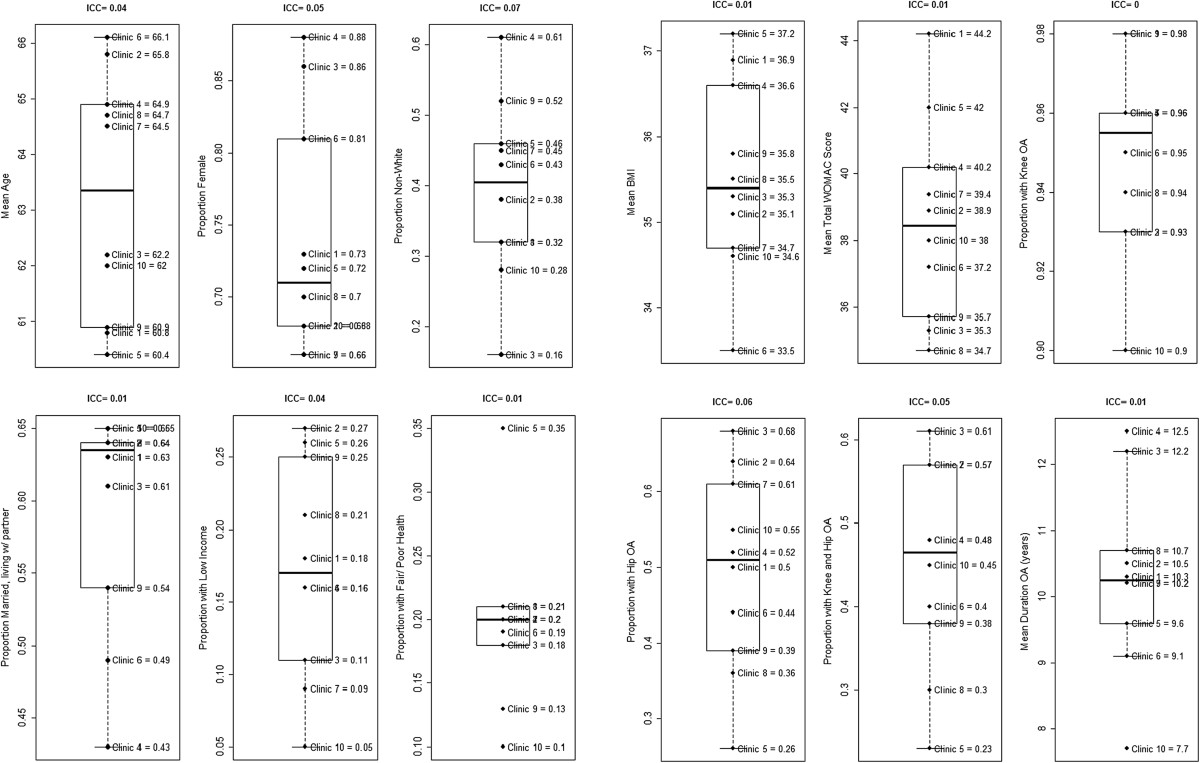
Baseline data were obtained from the PRIMO study, which enrolled n = 537 patients from ten Duke Primary Care practices. The following items were examined across clinics with descriptive statistics: (1) Practice Characteristics, including primary care specialty, numbers and specialties of providers, numbers of patients age 55+, urban/rural location and county poverty level; (2) Recruitment Metrics, including rates of eligibility, refusal and randomization; (3) Participants' Characteristics, including demographic and clinical data (general and OA-related); and (4) Participants' Self-Reported OA Treatment Use, including pharmacological and non-pharmacological therapies. Intraclass correlation coefficients (ICCs) were computed for participant characteristics and OA treatment use to describe between-clinic variation.
Study clinics varied considerably across all measures, with notable differences in numbers of patients age 55+ (1,507-5,400), urban/rural location (ranging from "rural" to "small city"), and proportion of county households below poverty level (12%-26%). Among all medical records reviewed, 19% of patients were initially eligible (10%-31% across clinics), and among these, 17% were randomized into the study (13%-21% across clinics). There was considerable between-clinic variation, as measured by the ICC (>0.01), for the following patient characteristics and OA treatment use variables: age (means: 60.4-66.1 years), gender (66%-88% female), race (16%-61% non-white), low income status (5%-27%), presence of hip OA (26%-68%), presence both knee and hip OA (23%-61%), physical therapy for knee OA (24%-61%) and hip OA (0%-71%), and use of knee brace with metal supports (0%-18%).
Although PRIMO study sites were part of one primary care practice network in one health care system, clinic and patient characteristics varied considerably, as did OA treatment use. This heterogeneity illustrates the importance of including multiple, diverse sites in trials for knee and hip OA, to enhance the generalizability and evaluate potential for real-world implementation.
NCT 01435109.
初级保健中骨关节炎(OA)管理的患者与提供者干预(PRIMO)研究是首批针对多站点初级保健网络中OA的卫生服务试验之一。这种多站点方法对于评估干预措施的普遍性很重要。这些分析描述了PRIMO研究各诊所之间临床和患者特征以及招募指标的异质性。
从PRIMO研究中获取基线数据,该研究招募了来自杜克大学十个初级保健机构的n = 537名患者。通过描述性统计在各诊所间检查以下项目:(1)机构特征,包括初级保健专业、提供者数量和专业、55岁及以上患者数量、城乡位置和县域贫困水平;2)招募指标,包括合格、拒绝和随机分组率;3)参与者特征,包括人口统计学和临床数据(一般和OA相关);4)参与者自我报告的OA治疗使用情况,包括药物和非药物治疗。计算组内相关系数(ICC)以描述参与者特征和OA治疗使用情况的诊所间差异。
所有测量指标在各研究诊所间差异很大,55岁及以上患者数量(1507 - 5400)、城乡位置(从“农村”到“小城市”)以及县域家庭贫困水平比例(12% - 26%)存在显著差异。在所有审查的病历中,19%的患者最初符合条件(各诊所为10% - 31%),其中17%被随机纳入研究(各诊所为13% - 21%)。对于以下患者特征和OA治疗使用变量,诊所间存在显著差异(ICC > 0.01):年龄(均值:60.4 - 66.1岁)、性别(女性66% - 88%)、种族(非白人16% - 61%)、低收入状态(5% - 27%)、髋部OA存在情况(26% - 68%)、膝关节和髋部OA同时存在情况(23% - 61%)、膝关节OA的物理治疗(24% - 61%)和髋部OA的物理治疗(0% - 71%)以及使用带金属支撑的膝关节支具(0% - 18%)。
尽管PRIMO研究站点是一个医疗保健系统中一个初级保健机构网络的一部分,但临床和患者特征差异很大,OA治疗使用情况也是如此。这种异质性说明了在膝关节和髋关节OA试验中纳入多个不同站点的重要性,以提高普遍性并评估实际应用的潜力。
NCT 01435109。