Kim Ki-Yeol, Kim Nam Kyu, Cha In-Ho, Ahn Joong Bae, Choi Jin Sub, Choi Gi-Hong, Lim Joon Suk, Lee Kang Young, Baik Seung Hyuk, Min Byung Soh, Hur Hyuk, Roh Jae Kyung, Shin Sang Joon
Oral Cancer Research Institute, Seoul, Korea.
Department of Surgery, Yonsei University College of Medicine, Seoul, Korea.
Cancer Res Treat. 2015 Apr;47(2):242-50. doi: 10.4143/crt.2014.066. Epub 2014 Sep 11.
Colorectal cancer patients with liver-confined metastases are classified as stage IV, but their prognoses can differ from metastases at other sites. In this study, we suggest a novel method for risk stratification using clinically effective factors.
Data on 566 consecutive patients with colorectal liver metastasis (CLM) between 1989 and 2010 were analyzed. This analysis was based on principal component analysis (PCA).
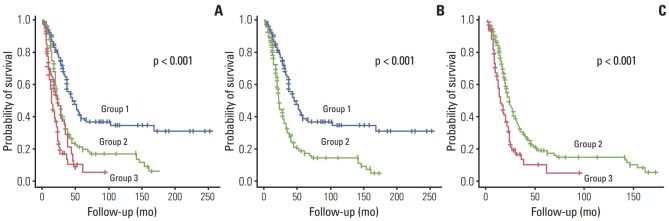
The survival rate was affected by carcinoembryonic antigen (CEA) level (p < 0.001; risk ratio, 1.90), distribution of liver metastasis (p=0.014; risk ratio, 1.46), and disease-free interval (DFI; p < 0.001; risk ratio, 1.98). When patients were divided into three groups according to PCA score using significantly affected factors, they showed significantly different survival patterns (p < 0.001).
The PCA scoring system based on CEA level, distribution of liver metastasis, and DFI may be useful for preoperatively determining prognoses in order to assist in clinical decisionmaking and designing future clinical trials for CLM treatment.
患有局限于肝脏转移的结直肠癌患者被归类为IV期,但他们的预后可能与其他部位的转移不同。在本研究中,我们提出了一种使用临床有效因素进行风险分层的新方法。
分析了1989年至2010年间566例连续性结直肠癌肝转移(CLM)患者的数据。该分析基于主成分分析(PCA)。
生存率受癌胚抗原(CEA)水平(p<0.001;风险比,1.90)、肝转移分布(p = 0.014;风险比,1.46)和无病间期(DFI;p<0.001;风险比,1.98)的影响。当根据使用显著影响因素的PCA评分将患者分为三组时,他们表现出显著不同的生存模式(p<0.001)。
基于CEA水平、肝转移分布和DFI的PCA评分系统可能有助于术前确定预后,以协助临床决策并设计未来CLM治疗的临床试验。