Schott Timm Cornelius, Ludwig Björn
Department of Orthodontics, Eberhard Karls University, Tübingen, Germany.
Private practice, Traben-Trarbach, Germany ; Department of Orthodontics University of Homburg/Saar, Germany.
Patient Prefer Adherence. 2014 Nov 17;8:1587-95. doi: 10.2147/PPA.S69586. eCollection 2014.
The relationship between unhealthy body mass index (BMI) and adherence to orthodontic treatment with removable appliances has not previously been evaluated.
The aim of this study was to quantify the association between BMI and wear time of removable orthodontic appliances and to evaluate BMI changes during orthodontic treatment.
Fifty-three normal-weight and 39 overweight/obese children and adolescents (7-15 years old) undergoing orthodontic treatment with removable appliances were enrolled into the study. BMI categories were determined using standardized age-specific and sex-specific BMI criteria, using data measured at the beginning of therapy and once during orthodontic treatment. Wear times of removable appliances were measured at 15-minute intervals over a period of 5 months using implanted microelectronic sensors. Median wear-time values were used in the analysis with the Mann-Whitney U-test used to test statistical differences between groups.
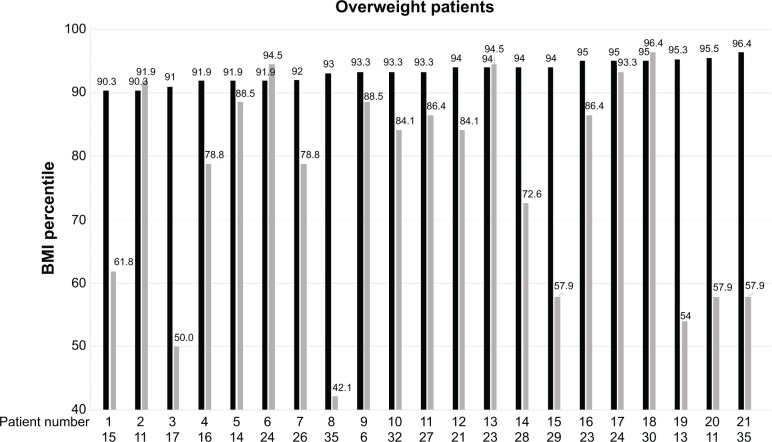
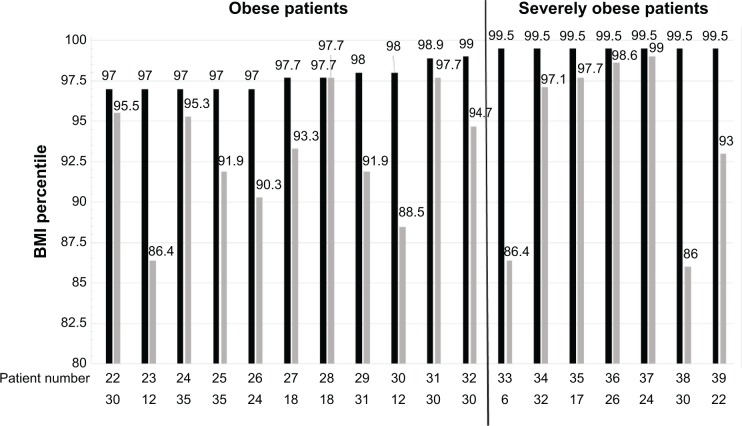
The median wear time of removable orthodontic appliances was 9.3 hours for normal-weight patients and 9.2 hours for overweight/obese patients. No statistically significant (P>0.05) or clinically relevant differences in usage or adherence were detected between normal-weight and overweight/obese patients. BMI did not influence wear time or behavior of removable orthodontic appliances by young patients. The majority of patients showed qualitative decreases in BMI during therapy.
The orthodontic treatment of young patients with removable devices does not require BMI-dependent changes in the treatment strategy. However, the use of removable appliances during meal times raises the possibility of reducing food intake, and in this way the orthodontist may have an active role to play in weight reduction.
此前尚未评估过不健康的体重指数(BMI)与可摘矫治器正畸治疗依从性之间的关系。
本研究旨在量化BMI与可摘正畸矫治器佩戴时间之间的关联,并评估正畸治疗期间BMI的变化。
53名体重正常以及39名超重/肥胖的儿童和青少年(7 - 15岁)参与了本研究,他们均正在接受可摘矫治器的正畸治疗。使用标准化的年龄和性别特异性BMI标准确定BMI类别,数据在治疗开始时以及正畸治疗期间测量一次。使用植入式微电子传感器在5个月的时间内每隔15分钟测量一次可摘矫治器的佩戴时间。分析中使用中位数佩戴时间值,采用曼-惠特尼U检验来检验组间的统计学差异。
体重正常患者可摘正畸矫治器的中位数佩戴时间为9.3小时,超重/肥胖患者为9.2小时。在体重正常和超重/肥胖患者之间未检测到统计学上显著的(P>0.05)或临床上相关的使用或依从性差异。BMI并未影响年轻患者可摘正畸矫治器的佩戴时间或行为。大多数患者在治疗期间BMI出现质性下降。
年轻患者使用可摘矫治器进行正畸治疗时,治疗策略无需根据BMI进行调整。然而,在进餐时间使用可摘矫治器增加了减少食物摄入量的可能性,通过这种方式正畸医生在体重减轻方面可能发挥积极作用。