Hill Richard, Kalathur Ravi Kiran Reddy, Callejas Sergio, Colaço Laura, Brandão Ricardo, Serelde Beatriz, Cebriá Antonio, Blanco-Aparicio Carmen, Pastor Joaquín, Futschik Matthias, Dopazo Ana, Link Wolfgang
IBB-Institute for Biotechnology and Bioengineering, Centre for Molecular and Structural Biomedicine (CBME), University of Algarve, Campus de Gambelas, 8005-139, Faro, Portugal.
Regenerative Medicine Program, Department of Biomedical Sciences and Medicine, University of Algarve, Campus de Gambelas, 8005-139, Faro, Portugal.
Breast Cancer Res. 2014 Dec 9;16(6):482. doi: 10.1186/s13058-014-0482-y.
The activation of the phosphoinositide 3-kinase (PI3K)/AKT signalling pathway is one the most frequent genetic events in breast cancer, consequently the development of PI3K inhibitors has attracted much attention. Here we evaluate the effect of PI3K inhibition on global gene expression in breast cancer cells.
We used a range of methodologies that include in silico compound analysis, in vitro kinase assays, cell invasion assays, proliferation assays, genome-wide transcription studies (Agilent Technologies full genome arrays), gene set enrichment analysis, quantitative real-time PCR, immunoblotting in addition to chromatin immunoprecipitation.
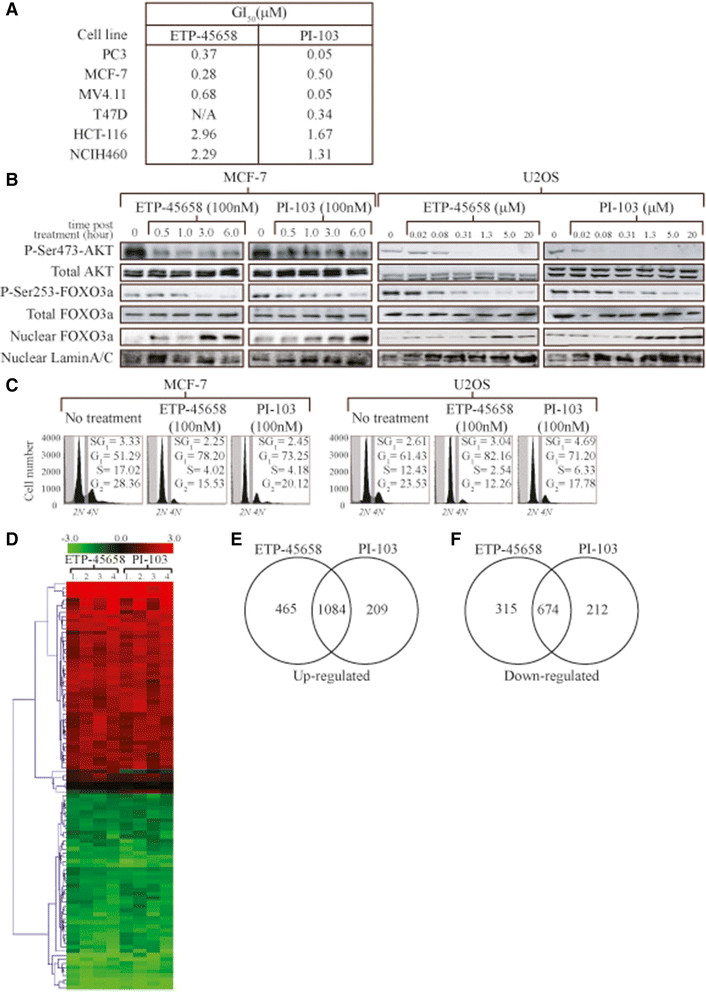
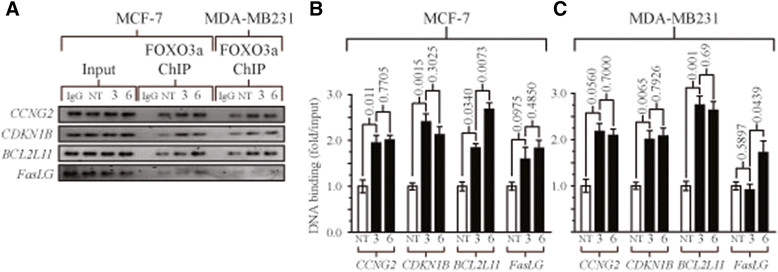
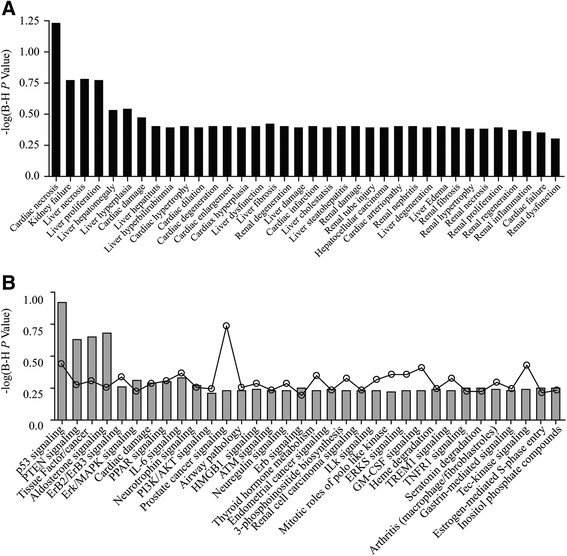
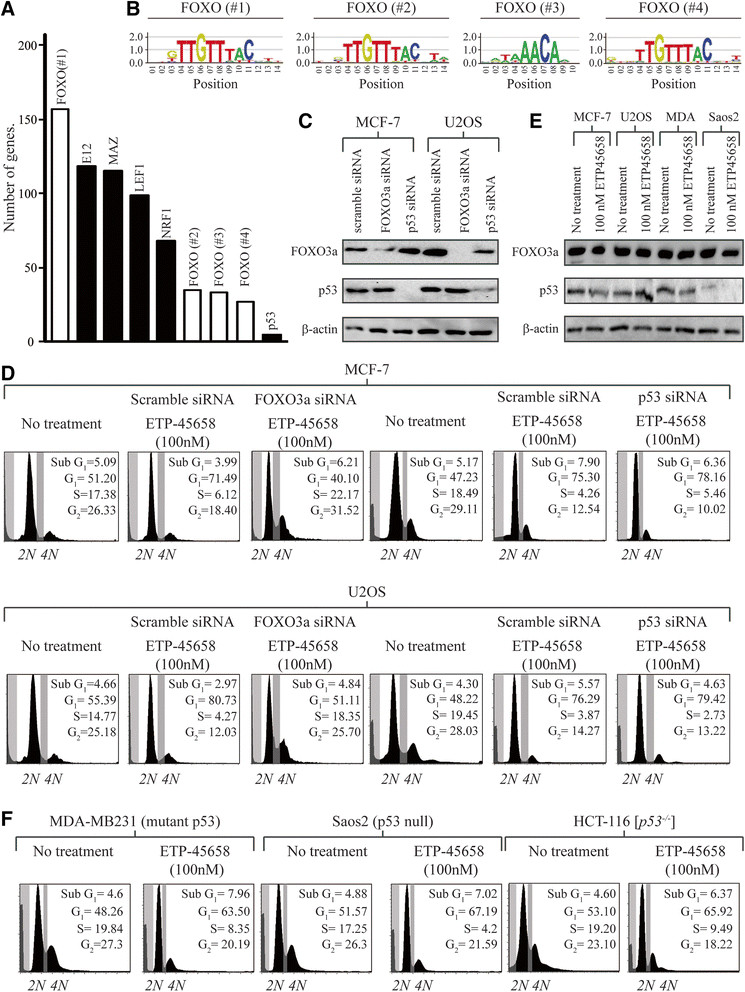
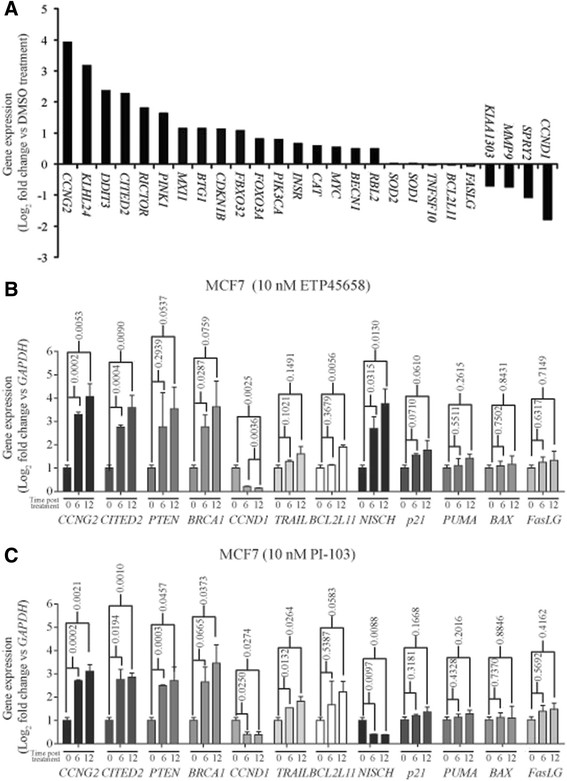
We defined the physico-chemical and the biological properties of ETP-45658, a novel potent PI3K inhibitor. We demonstrated that ETP-45658 potently inhibited cell proliferation within a broad range of human cancer cells, most potently suppressing the growth of breast cancer cells via inhibiting cell cycle. We show that this response is Forkhead box O (FOXO) protein dependent and p53 independent. Our genome-wide microarray analysis revealed that the cell cycle was the most affected biological process after exposure to ETP-45658 (or our control PI3K inhibitor PI-103), that despite the multiple transcription factors that are regulated by the PI3K/AKT signalling cascade, only the binding sites for FOXO transcription factors were significantly enriched and only a subset of all FOXO-dependent genes were induced. This disparity in gene transcription was not due to differential FOXO promoter recruitment.
The constitutive activation of PI3Ks and thus the exclusion of FOXO transcription factors from the nucleus is a key feature of breast cancer. Our results presented here highlight that PI3K inhibition activates specific FOXO-dependent genes that mediate cell cycle arrest in breast cancer cells.
磷酸肌醇3激酶(PI3K)/AKT信号通路的激活是乳腺癌中最常见的基因事件之一,因此PI3K抑制剂的研发备受关注。在此,我们评估PI3K抑制对乳腺癌细胞中全局基因表达的影响。
我们使用了一系列方法,包括计算机辅助化合物分析、体外激酶测定、细胞侵袭测定、增殖测定、全基因组转录研究(安捷伦科技全基因组芯片)、基因集富集分析、定量实时PCR、免疫印迹以及染色质免疫沉淀。
我们确定了新型强效PI3K抑制剂ETP-45658的物理化学和生物学特性。我们证明ETP-45658在广泛的人类癌细胞中有效抑制细胞增殖,通过抑制细胞周期最有效地抑制乳腺癌细胞的生长。我们表明这种反应是叉头框O(FOXO)蛋白依赖性的,且与p53无关。我们的全基因组微阵列分析显示,暴露于ETP-45658(或我们的对照PI3K抑制剂PI-103)后,细胞周期是受影响最大的生物学过程,尽管PI3K/AKT信号级联调节多种转录因子,但只有FOXO转录因子的结合位点显著富集,且所有FOXO依赖性基因中只有一部分被诱导。基因转录的这种差异并非由于FOXO启动子募集的差异。
PI3K的组成性激活以及因此导致FOXO转录因子被排除在细胞核外是乳腺癌的一个关键特征。我们在此展示的结果突出表明,PI3K抑制激活了介导乳腺癌细胞中细胞周期停滞的特定FOXO依赖性基因。