Alhawassi Tariq M, Krass Ines, Bajorek Beata V, Pont Lisa G
Faculty of Pharmacy, University of Sydney, Sydney, NSW, Australia ; College of Pharmacy, King Saud University, Riyadh, Saudi Arabia.
Faculty of Pharmacy, University of Sydney, Sydney, NSW, Australia.
Clin Interv Aging. 2014 Dec 1;9:2079-86. doi: 10.2147/CIA.S71178. eCollection 2014.
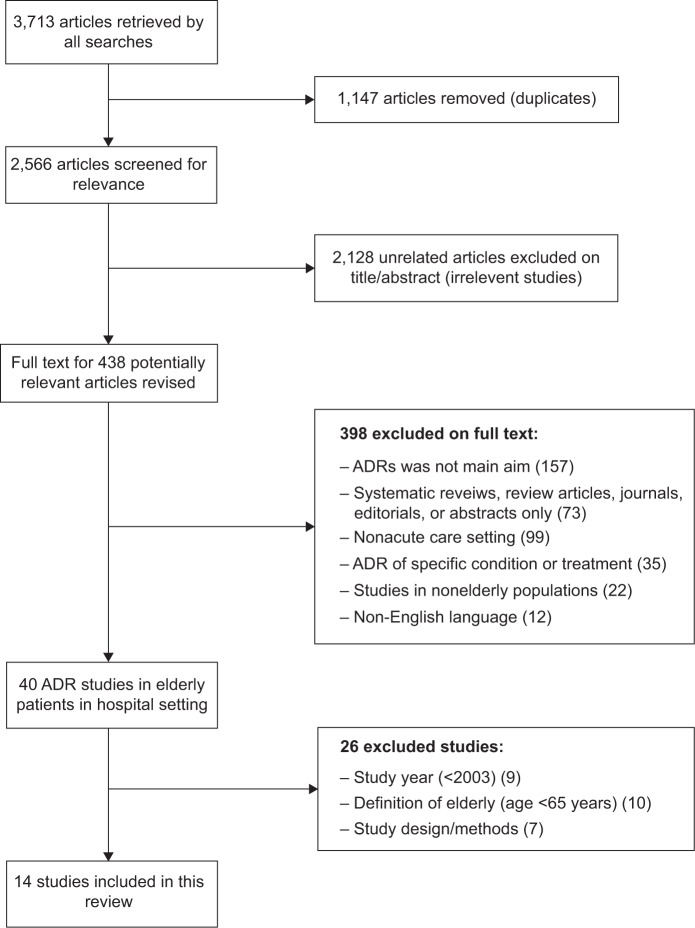
Adverse drug reactions (ADRs) are an important health issue. While prevalence and risk factors associated with ADRs in the general adult population have been well documented, much less is known about ADRs in the elderly population. The aim of this study was to review the published literature to estimate the prevalence of ADRs in the elderly in the acute care setting and identify factors associated with an increased risk of an ADR in the elderly. A systematic review of studies published between 2003 and 2013 was conducted in the Cochrane Database of Systematic Reviews, EMBASE, Google Scholar and MEDLINE. Key search terms included: "adverse drug reactions", "adverse effects", "elderly patients and hospital admission", "drug therapy", "drug adverse effects", "drug related", "aged", "older patients", "geriatric", "hospitalization", and "emergency admissions". For inclusion in the review, studies had to focus on ADRs in the elderly and had to include an explicit definition of what was considered an ADR and/or an explicit assessment of causality, and a clear description of the method used for ADR identification, and had to describe factors associated with an increased risk of an ADR. Fourteen hospital-based observational studies exploring ADRs in the elderly in the acute care setting were eligible for inclusion in this review. The mean prevalence of ADRs in the elderly in the studies included in this review was 11.0% (95% confidence interval [CI]: 5.1%-16.8%). The median prevalence of ADRs leading to hospitalization was 10.0% (95% CI: 7.2%-12.8%), while the prevalence of ADRs occurring during hospitalization was 11.5% (95% CI: 0%-27.7%). There was wide variation in the overall ADR prevalence, from 5.8% to 46.3%. Female sex, increased comorbid complexity, and increased number of medications were all significantly associated with an increased risk of an ADR. Retrospective studies and those relying on identification by the usual treating team reported lower prevalence rates. From this review, we can conclude that ADRs constitute a significant health issue for the elderly in the acute care setting. While there was wide variation in the prevalence of ADRs in the elderly, based on the findings of this study, at least one in ten elderly patients will experience an ADR leading to or during their hospital stay. Older female patients and those with multiple comorbidities and medications appear to be at the highest risk of an ADR in the acute care setting.
药物不良反应(ADR)是一个重要的健康问题。虽然普通成年人群中与ADR相关的患病率和风险因素已有充分记录,但关于老年人群中的ADR却知之甚少。本研究的目的是回顾已发表的文献,以估计急性护理环境中老年人ADR的患病率,并确定与老年人ADR风险增加相关的因素。在Cochrane系统评价数据库、EMBASE、谷歌学术和MEDLINE中对2003年至2013年发表的研究进行了系统评价。关键检索词包括:“药物不良反应”、“不良反应”、“老年患者与住院”、“药物治疗”、“药物不良反应”、“药物相关”、“老年人”、“老年患者”、“老年病学”、“住院治疗”和“急诊入院”。为纳入该评价,研究必须聚焦于老年人的ADR,必须包括对ADR的明确定义以及/或者对因果关系的明确评估,以及对ADR识别所用方法的清晰描述,并且必须描述与ADR风险增加相关的因素。十四项基于医院的观察性研究探索了急性护理环境中老年人的ADR,符合纳入本评价的条件。本评价纳入的研究中老年人ADR的平均患病率为11.0%(95%置信区间[CI]:5.1%-16.8%)。导致住院的ADR的中位数患病率为10.0%(95%CI:7.2%-12.8%),而住院期间发生的ADR的患病率为11.5%(95%CI:0%-27.7%)。总体ADR患病率差异很大,从5.8%到46.3%不等。女性、共病复杂性增加和用药数量增加均与ADR风险增加显著相关。回顾性研究以及那些依赖常规治疗团队进行识别的研究报告的患病率较低。从本评价中,我们可以得出结论,ADR是急性护理环境中老年人的一个重大健康问题。虽然老年人ADR的患病率差异很大,但根据本研究的结果,至少十分之一的老年患者在住院期间或住院期间会经历导致ADR的情况。老年女性患者以及患有多种共病和用药的患者在急性护理环境中似乎ADR风险最高。