
从人脑中纯化α-突触核蛋白发现,随着该蛋白纯度的提高,内源性多聚体存在不稳定性。
Purification of α-synuclein from human brain reveals an instability of endogenous multimers as the protein approaches purity.
作者信息
Luth Eric S, Bartels Tim, Dettmer Ulf, Kim Nora C, Selkoe Dennis J
机构信息
Center for Neurologic Diseases, Brigham and Women's Hospital and Harvard Medical School , Boston, Massachusetts 02115, United States.
出版信息
Biochemistry. 2015 Jan 20;54(2):279-92. doi: 10.1021/bi501188a. Epub 2014 Dec 23.
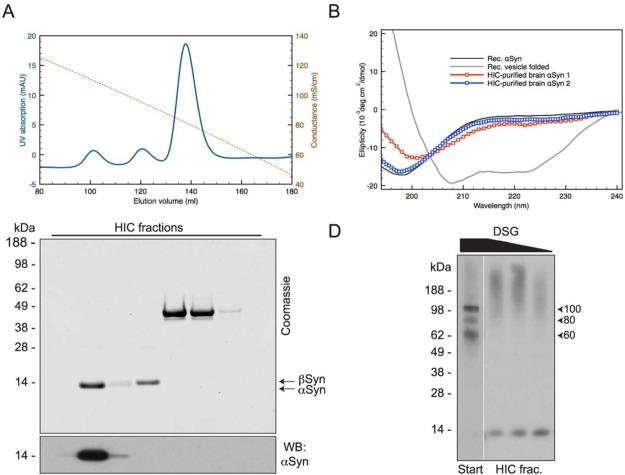
Despite two decades of research, the structure-function relationships of endogenous, physiological forms of α-synuclein (αSyn) are not well understood. Most in vitro studies of this Parkinson's disease-related protein have focused on recombinant αSyn that is unfolded and monomeric, assuming that this represents its state in the normal human brain. Recently, we have provided evidence that αSyn exists in considerable part in neurons, erythrocytes, and other cells as a metastable multimer that principally sizes as a tetramer. In contrast to recombinant αSyn, physiological tetramers purified from human erythrocytes have substantial α-helical content and resist pathological aggregation into β-sheet rich fibers. Here, we report the first method to fully purify soluble αSyn from the most relevant source, human brain. We describe protocols that purify αSyn to homogeneity from nondiseased human cortex using ammonium sulfate precipitation, gel filtration, and ion exchange, hydrophobic interaction, and affinity chromatographies. Cross-linking of the starting material and the partially purified chromatographic fractions revealed abundant αSyn multimers, including apparent tetramers, but these were destabilized in large part to monomers during the final purification step. The method also fully purified the homologue β-synuclein, with a similar outcome. Circular dichroism spectroscopy showed that purified, brain-derived αSyn can display more helical content than the recombinant protein, but this result varied. Collectively, our data suggest that purifying αSyn to homogeneity destabilizes native, α-helix-rich multimers that exist in intact and partially purified brain samples. This finding suggests existence of a stabilizing cofactor (e.g., a small lipid) present inside neurons that is lost during final purification.
尽管经过了二十年的研究,但内源性生理形式的α-突触核蛋白(αSyn)的结构-功能关系仍未得到很好的理解。对这种与帕金森病相关蛋白的大多数体外研究都集中在未折叠的单体重组αSyn上,假定这代表了其在正常人类大脑中的状态。最近,我们提供了证据表明,αSyn在神经元、红细胞和其他细胞中相当一部分以亚稳态多聚体形式存在,主要大小为四聚体。与重组αSyn不同,从人类红细胞中纯化的生理性四聚体具有大量的α-螺旋含量,并且能抵抗病理性聚集成富含β-折叠的纤维。在此,我们报告了第一种从最相关来源——人类大脑中完全纯化可溶性αSyn的方法。我们描述了使用硫酸铵沉淀、凝胶过滤以及离子交换、疏水相互作用和亲和色谱法从未患病的人类皮质中纯化αSyn至同质的方案。起始材料和部分纯化的色谱级分的交联显示出丰富的αSyn多聚体,包括明显的四聚体,但在最终纯化步骤中,这些多聚体在很大程度上不稳定为单体。该方法还完全纯化了同系物β-突触核蛋白,结果类似。圆二色光谱表明,纯化的源自大脑的αSyn比重组蛋白能显示出更多的螺旋含量,但这一结果存在差异。总体而言,我们的数据表明,将αSyn纯化至同质会使完整和部分纯化的脑样本中存在的确富含α-螺旋的天然多聚体不稳定。这一发现表明神经元内部存在一种在最终纯化过程中会丢失的稳定辅因子(例如一种小脂质)。



 Zotero 插件