Ondondo Beatrice, Colbeck Emily, Jones Emma, Smart Kathryn, Lauder Sarah N, Hindley James, Godkin Andrew, Moser Bernhard, Ager Ann, Gallimore Awen
Institute of Infection Immunity and Biochemistry, Cardiff University School of Medicine, Cardiff, UK.
Immunology. 2015 May;145(1):94-104. doi: 10.1111/imm.12430.
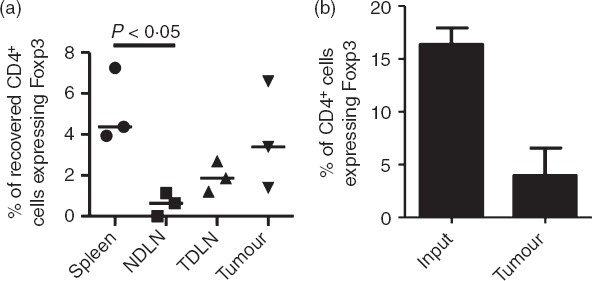
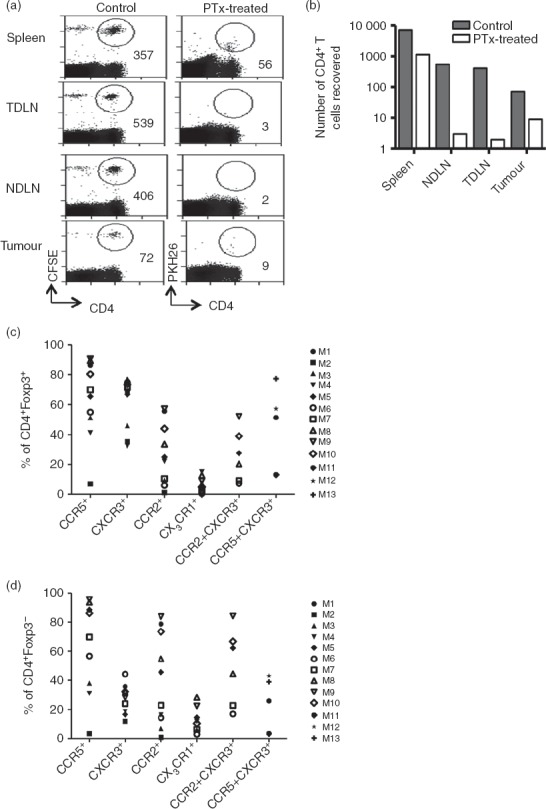
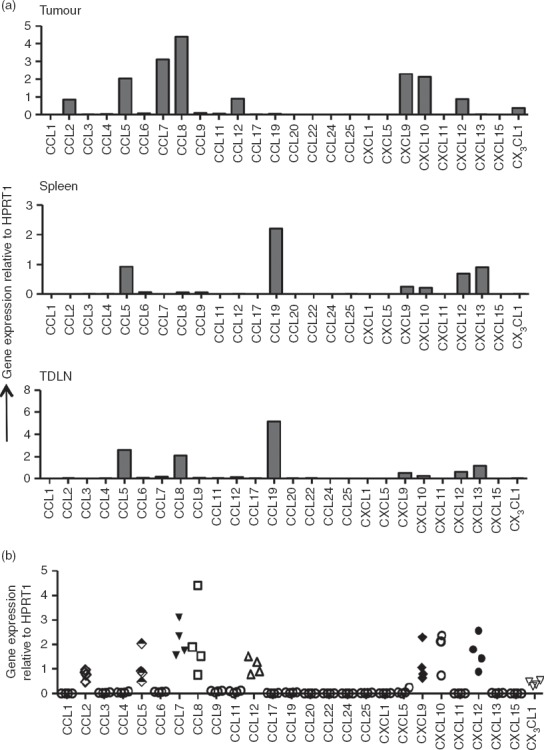
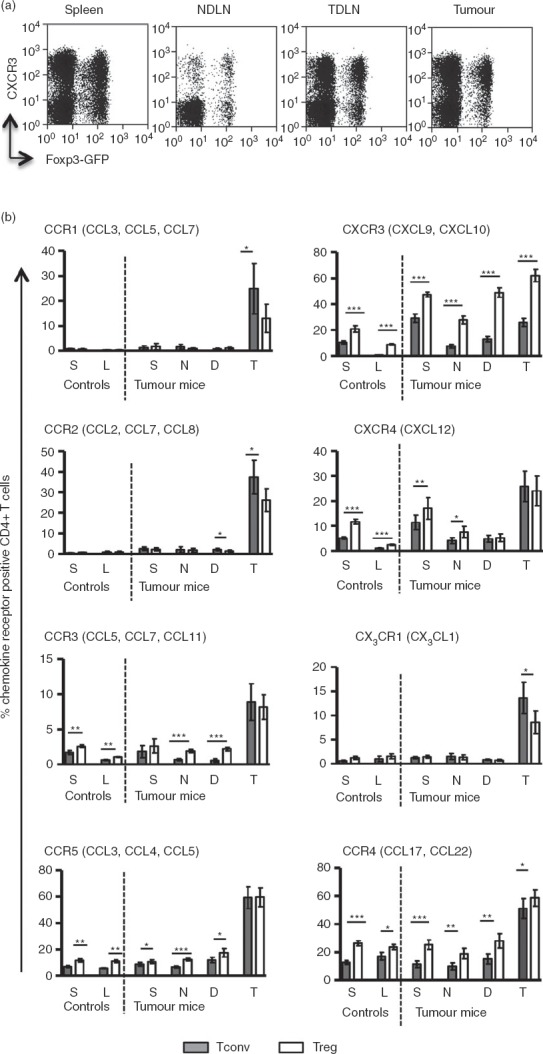
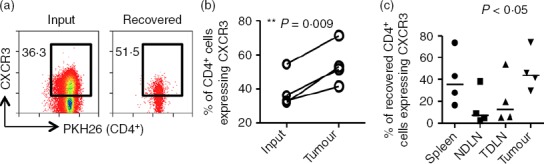
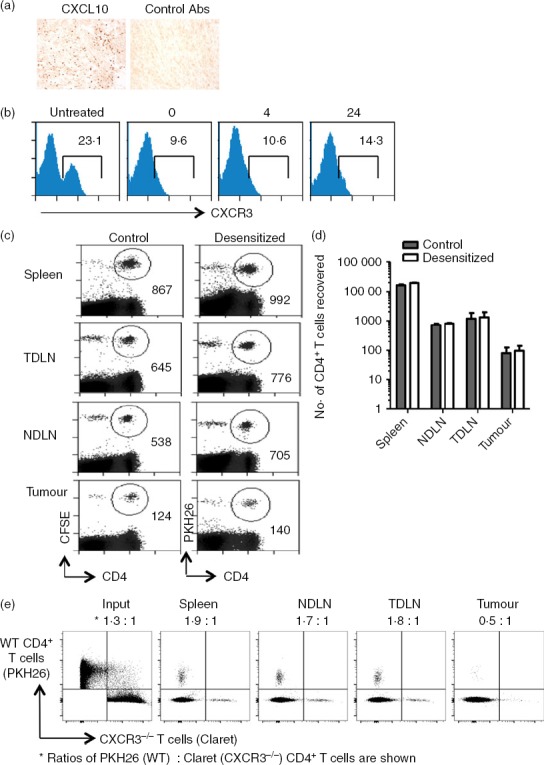
The frequency of CD4(+) Foxp3(+) regulatory T (Treg) cells is often significantly increased in the blood of tumour-bearing mice and people with cancer. Moreover, Treg cell frequencies are often higher in tumours compared with blood and lymphoid organs. We wished to determine whether certain chemokines expressed within the tumour mass selectively recruit Treg cells, thereby contributing to their enrichment within the tumour-infiltrating lymphocyte pool. To achieve this goal, the chemokine profile of carcinogen-induced fibrosarcomas was determined, and the chemokine receptor expression profiles of both CD4(+) Foxp3(-) and CD4(+) Foxp3(+) T cells were compared. These analyses revealed that the tumours are characterized by expression of inflammatory chemokines (CCL2, CCL5, CCL7, CCL8, CCL12, CXCL9, CXCL10 and CX3CL1), reflected by an enrichment of activated Foxp3(-) and Foxp3(+) T cells expressing T helper type 1-associated chemokine receptors. Notably, we found that CXCR3(+) T cells were significantly enriched in the tumours although curiously we found no evidence that CXCR3 was required for their recruitment. Instead, CXCR3 marks a population of activated Foxp3(-) and Foxp3(+) T cells, which use multiple and overlapping ligand receptor pairs to guide their migration to tumours. Collectively, these data indicate that enrichment of Foxp3(+) cells in tumours characterized by expression of inflammatory chemokines, does not occur via a distinct chemokine axis, thus selective chemokine blockade is unlikely to represent a meaningful therapeutic strategy for preventing Treg cell accumulation in tumours.
在荷瘤小鼠和癌症患者的血液中,CD4(+)Foxp3(+)调节性T(Treg)细胞的频率通常会显著增加。此外,与血液和淋巴器官相比,肿瘤中的Treg细胞频率通常更高。我们希望确定肿瘤组织中表达的某些趋化因子是否会选择性募集Treg细胞,从而导致它们在肿瘤浸润淋巴细胞池中富集。为了实现这一目标,我们确定了致癌物诱导的纤维肉瘤的趋化因子谱,并比较了CD4(+)Foxp3(-)和CD4(+)Foxp3(+)T细胞的趋化因子受体表达谱。这些分析表明,肿瘤的特征是炎性趋化因子(CCL2、CCL5、CCL7、CCL8、CCL12、CXCL9、CXCL10和CX3CL1)的表达,这表现为表达1型辅助性T细胞相关趋化因子受体的活化Foxp3(-)和Foxp3(+)T细胞增多。值得注意的是,我们发现CXCR3(+)T细胞在肿瘤中显著富集,不过奇怪的是,我们没有发现证据表明其募集需要CXCR3。相反,CXCR3标记了一群活化的Foxp3(-)和Foxp3(+)T细胞,它们利用多个重叠的配体-受体对来指导其向肿瘤的迁移。总体而言,这些数据表明,在以炎性趋化因子表达为特征的肿瘤中,Foxp3(+)细胞的富集并非通过独特的趋化因子轴发生,因此选择性趋化因子阻断不太可能成为预防Treg细胞在肿瘤中积聚的有效治疗策略。