Malinovschi Andrei, Masoero Monica, Bellocchia Michela, Ciuffreda Antonio, Solidoro Paolo, Mattei Alessio, Mercante Lorena, Heffler Enrico, Rolla Giovanni, Bucca Caterina
Department of Medical Sciences, Clinical Physiology, Uppsala University, Uppsala, Sweden.
Department of Medical Sciences, University of Turin, Via Lamarmora 41, 10128, Turin, Italy.
Respir Res. 2014 Dec 13;15(1):131. doi: 10.1186/s12931-014-0131-0.
Acute exacerbations of COPD (AECOPD) are common and strongly influence disease severity and relative healthcare costs. Vitamin D deficiency is frequent among COPD patients and its contributory role in disease exacerbations is widely debated. Our aim was to assess the relationship of serum vitamin D levels with COPD severity and AECOPD.
Serum vitamin D (25-hydroxyvitamin D) levels were measured in 97 COPD patients and related to lung function, comorbidities, FEV1 decline, AECOPD and hospital admission during the previous year.
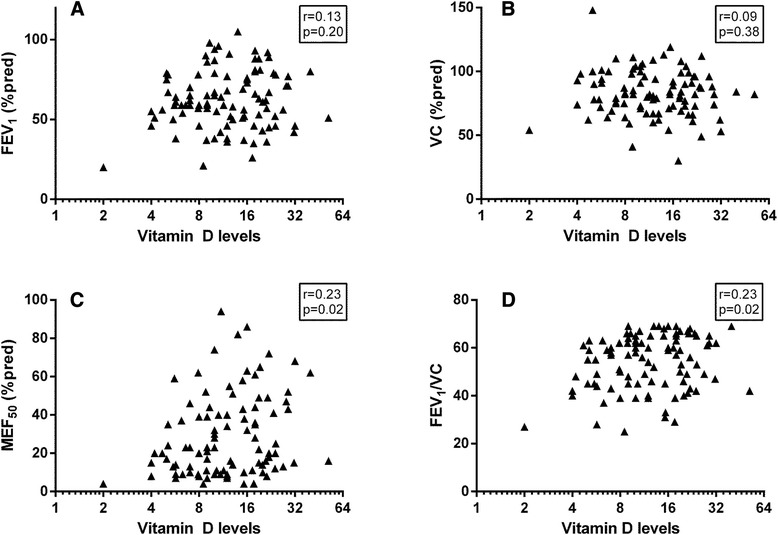
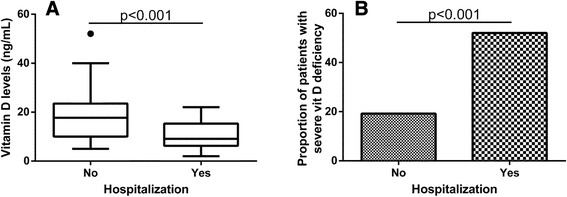
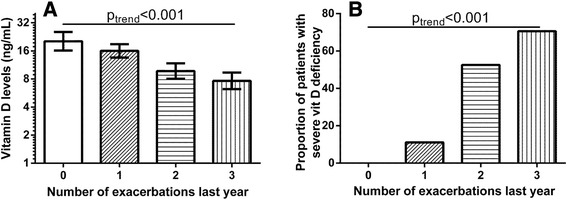
Most patients (96%) had vitamin D deficiency, which was severe in 35 (36%). No significant relationship was found between vitamin D and FEV1 or annual FEV1 decline. No difference between patients with and without severe vitamin D deficiency was found in age, gender, BMI, smoking history, lung function, and comorbidities, apart from osteoporosis (60.9% in severe deficiency vs 22.7%, p = 0.001). In multiple logistic regression models, severe deficiency was independently associated with AECOPD [adjusted odds ratios (aOR) of 30.5 (95% CI 5.55, 168), p < 0.001] and hospitalization [aOR 3.83 (95% CI 1.29, 11.4), p = 0.02]. The odds ratio of being a frequent exacerbator if having severe vitamin D deficiency was 18.1 (95% CI 4.98, 65.8) (p < 0.001), while that of hospitalization was 4.57 (95% CI 1.83, 11.4) (p = 0.001).
In COPD patients severe vitamin D deficiency was related to more frequent disease exacerbations and hospitalization during the year previous to the measurement of vitamin D. This association was independent of patients' characteristics and comorbidities.
慢性阻塞性肺疾病急性加重(AECOPD)很常见,且对疾病严重程度和相关医疗费用有很大影响。慢性阻塞性肺疾病患者中维生素D缺乏很常见,其在疾病加重中的作用存在广泛争议。我们的目的是评估血清维生素D水平与慢性阻塞性肺疾病严重程度及AECOPD之间的关系。
测量了97例慢性阻塞性肺疾病患者的血清维生素D(25-羟维生素D)水平,并将其与肺功能、合并症、第1秒用力呼气容积(FEV1)下降情况、AECOPD以及上一年的住院情况相关联。
大多数患者(96%)存在维生素D缺乏,其中35例(36%)为严重缺乏。未发现维生素D与FEV1或年度FEV1下降之间存在显著关系。除骨质疏松症外(严重缺乏者为60.9%,非严重缺乏者为22.7%,p = 0.001),在年龄、性别、体重指数、吸烟史、肺功能和合并症方面,严重维生素D缺乏患者与非严重缺乏患者之间未发现差异。在多因素逻辑回归模型中,严重缺乏与AECOPD独立相关[调整后的优势比(aOR)为30.5(95%可信区间5.55,168),p < 0.001]以及住院[ aOR 3.83(95%可信区间1.29,11.4),p = 0.02]。如果存在严重维生素D缺乏,成为频繁加重者的优势比为18.1(95%可信区间4.98,65.8)(p < 0.001),而住院的优势比为4.57(95%可信区间1.83,11.4)(p = 0.001)。
在慢性阻塞性肺疾病患者中,严重维生素D缺乏与在测量维生素D前一年中更频繁的疾病加重和住院有关。这种关联独立于患者的特征和合并症。