
新型骨组织工程支架A-W-MGC/CS的生物相容性及体内成骨能力
Biocompatibility and in vivo osteogenic capability of novel bone tissue engineering scaffold A-W-MGC/CS.
作者信息
Li Chen, Wang Guo-Xian, Zhang Zheng, Liu Dan-Ping
机构信息
Biobank, the First Affiliated Hospital of Liaoning Medical University, Jinzhou, 121001, China.
Department of Pharmacology, Liaoning Medical University, Jinzhou, 121000, China.
出版信息
J Orthop Surg Res. 2014 Dec 12;9:100. doi: 10.1186/s13018-014-0100-9.
BACKGROUND
This study aims to investigate the biocompatibility and in vivo osteogenic capability of the novel bone tissue engineering scaffold apatite-wollastonite-magnetic glass ceramic/chitosan (A-W-MGC/CS).
METHODS
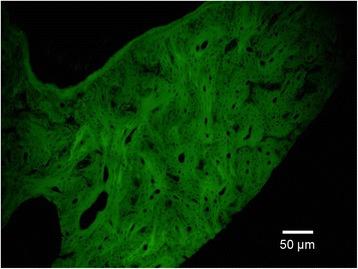
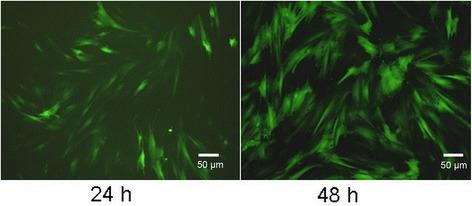
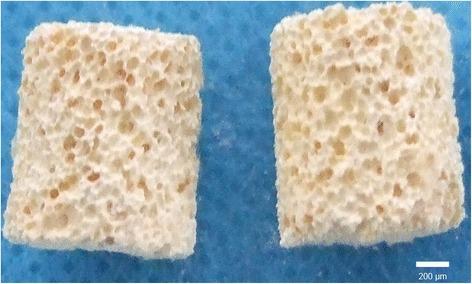
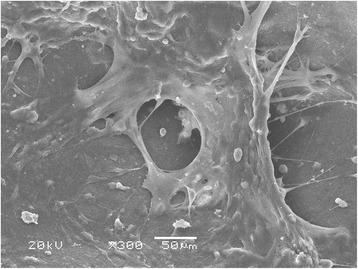
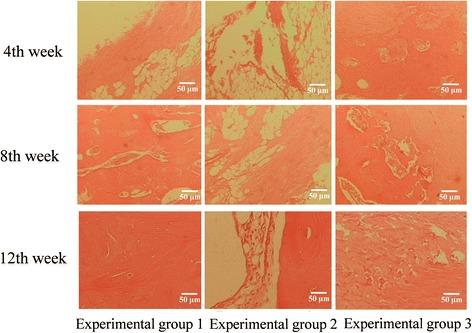
Rabbit bone marrow stromal cells (BMSCs) were transfected with adenovirus-human bone morphogenetic protein-2-green fluorescent protein (Ad-hBMP2-GFP). The transfected BMSCs were then inoculated onto the scaffold material A-W-MGC/CS to construct tissue-engineered bone. The attachment and proliferation of BMSCs were observed by scanning electron microscopy (SEM) and 3-(4,5-dimethylthiazol-2-yl)-2,5-diphenyltetrazolium bromide (MTT) detection, respectively. Rabbit models of bone defects were established and divided into three groups. Experimental group 1 was implanted with prepared tissue-engineered bone. Experimental group 2 was implanted with A-W-MGC/CS without transfected BMSCs. The blank group was injected with transfected BMSCs, without implantation of any scaffold. In the 12th week after surgery, the repair of bone defect was observed by X-ray examination, and histological observations of the area of bone defect were performed.
RESULTS
A-W-MGC/CS resulted in good BMSC attachment and had no obvious effects on cell proliferation. In experimental group 1, good repair of bone defect was observed, and the scaffold material degraded completely. In experimental group 2, new bone was formed, but its quality was poor. In the blank group, there was mainly filling of fibrous connective tissues with no observable bone defect repair.
CONCLUSION
A-W-MGC/CS possesses good biocompatibility and in vivo osteogenic capability for bone defect repair.
背景
本研究旨在探讨新型骨组织工程支架磷灰石-硅灰石-磁性玻璃陶瓷/壳聚糖(A-W-MGC/CS)的生物相容性及体内成骨能力。
方法
用腺病毒-人骨形态发生蛋白-2-绿色荧光蛋白(Ad-hBMP2-GFP)转染兔骨髓基质细胞(BMSCs)。然后将转染后的BMSCs接种到支架材料A-W-MGC/CS上构建组织工程骨。分别通过扫描电子显微镜(SEM)和3-(4,5-二甲基噻唑-2-基)-2,5-二苯基四氮唑溴盐(MTT)检测观察BMSCs的黏附与增殖情况。建立兔骨缺损模型并分为三组。实验组1植入制备好的组织工程骨。实验组2植入未转染BMSCs的A-W-MGC/CS。空白组注射转染后的BMSCs,不植入任何支架。术后第12周,通过X线检查观察骨缺损修复情况,并对骨缺损区域进行组织学观察。
结果
A-W-MGC/CS使BMSCs黏附良好,对细胞增殖无明显影响。实验组1观察到骨缺损修复良好,支架材料完全降解。实验组2有新骨形成,但其质量较差。空白组主要为纤维结缔组织填充,未观察到骨缺损修复。
结论
A-W-MGC/CS具有良好的生物相容性及体内成骨能力,可用于骨缺损修复。



 Zotero 插件