Ortiz Carlos, López Javier, García Héctor, Sevilla Teresa, Revilla Ana, Vilacosta Isidre, Sarriá Cristina, Olmos Carmen, Ferrera Carlos, García Pablo Elpidio, Sáez Carmen, Gómez Itziar, San Román José Alberto
From the Instituto de Ciencias del Corazón (ICICOR), Hospital Clínico Universitario, Valladolid (CO, JL, HG, TS, AR, PEG, IG, JASR); Hospital Clínico Universitario San Carlos (IV, CO, CF); and Servicio de Medicina Interna-Infecciosas, Instituto de Investigación del Hospital La Princesa, Madrid, Spain (CS, CS).
Medicine (Baltimore). 2014 Dec;93(27):e137. doi: 10.1097/MD.0000000000000137.
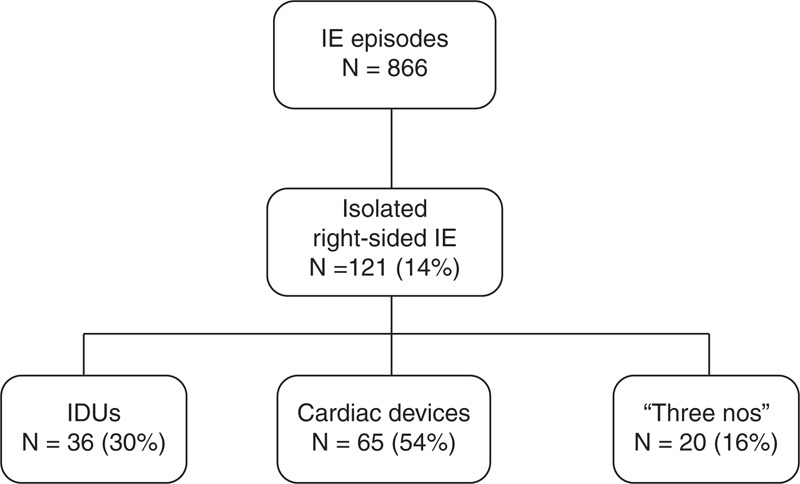
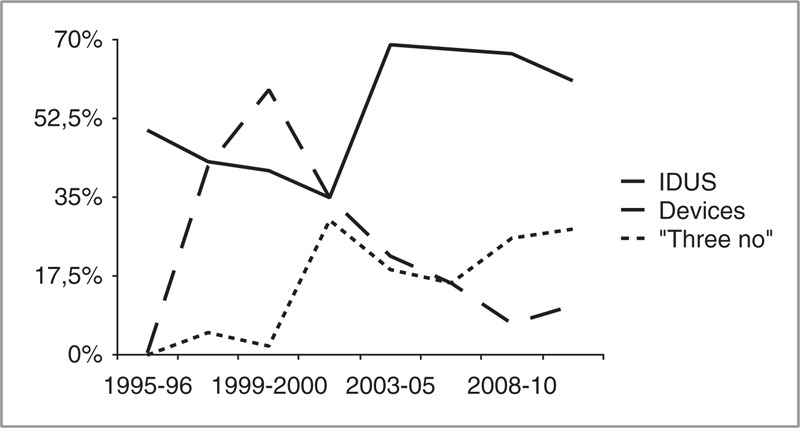
From an epidemiologic point of view, right-sided infective endocarditis (RSIE) affects different types of patients: intravenous drug users (IDUs), cardiac device carriers (pacemakers and implantable automatic defibrillators), and the "3 noes" endocarditis group: no left-sided, no IDUs, no cardiac devices. Our objective is to describe and compare the clinical profile and outcome of these groups of patients. Every episode of infective endocarditis (IE) consecutively diagnosed in 3 tertiary centers from 1996 to 2012 was included in an ongoing multipurpose database. We assessed 85 epidemiologic, clinical, echocardiographic, and outcome variables in patients with isolated RSIE. A bivariated comparative analysis between the 3 groups was conducted.Among 866 IE episodes, 121 were classified as isolated RSIE (14%): 36 IDUs (30%), 65 cardiac device carriers (54%), and 20 "3 noes" group (16%). IDUs were mainly young men (36 ± 7 years) without previous heart disease, few comorbidities, and frequent previous endocarditis episodes (28%). Human immunodeficiency virus infection was frequent (69%). Cardiac device carriers were older (66 ± 15 years) and had less comorbidities (34%). Removal of the infected device was performed in 91% of the patients without any death. The "3 noes" endocarditis group was composed mainly by middle-age men (56 ± 18 years), health care related infections (50%), and had many comorbidities (75%). Whereas Staphylococcus aureus were the most frequent cause in IDUs (72% vs 34% in device carriers and 34% in the "3 noes" group, P = 0.001), coagulase negative Staphylococci predominated in the device carriers (58% vs 11% in drug users and 35% in the "3 noes", P < 0.001). Significant differences in mortality were found (17% in drug users, 3% in device carriers, and 30% in the "3 noes" group; P < 0.001). These results suggest that RSIE should be separated into 3 groups (IDUs, cardiac device carriers, and the "3 noes") and considered as independent entities as there are relevant epidemiologic, clinical, microbiological, echocardiographic, and prognostic differences among them.
从流行病学角度来看,右侧感染性心内膜炎(RSIE)影响不同类型的患者:静脉吸毒者(IDU)、心脏器械携带者(起搏器和植入式自动除颤器)以及“三无”心内膜炎组:无左侧病变、非静脉吸毒者、无心脏器械。我们的目的是描述和比较这些患者组的临床特征及预后。1996年至2012年在3个三级中心连续诊断的每一例感染性心内膜炎(IE)均纳入一个正在进行的多用途数据库。我们评估了孤立性RSIE患者的85项流行病学、临床、超声心动图及预后变量。对这3组进行了双变量比较分析。
在866例IE发作中,121例被归类为孤立性RSIE(14%):36例静脉吸毒者(30%)、65例心脏器械携带者(54%)和20例“三无”组(16%)。静脉吸毒者主要为年轻男性(36±7岁),无前驱心脏病,合并症少,既往心内膜炎发作频繁(28%)。人类免疫缺陷病毒感染常见(69%)。心脏器械携带者年龄较大(66±15岁),合并症较少(34%)。91%的患者进行了感染器械移除,无死亡病例。“三无”心内膜炎组主要由中年男性(56±18岁)组成,与医疗保健相关的感染(50%),合并症多(75%)。金黄色葡萄球菌是静脉吸毒者中最常见的病因(72%,器械携带者中为34%,“三无”组中为34%,P = 0.001),凝固酶阴性葡萄球菌在器械携带者中占主导(58%,吸毒者中为11%,“三无”组中为35%,P < 0.001)。发现死亡率有显著差异(吸毒者中为17%,器械携带者中为3%,“三无”组中为30%;P < 0.001)。这些结果表明,RSIE应分为3组(静脉吸毒者、心脏器械携带者和“三无”组),并视为独立的实体,因为它们之间存在相关的流行病学、临床、微生物学、超声心动图及预后差异。