Ta Michelle H T, Rao Padmashree, Korgaonkar Mayuresh, Foster Sheryl F, Peduto Anthony, Harris David C H, Rangan Gopala K
Michael Stern Laboratory for Polycystic Kidney Disease, Centre for Transplant and Renal Research, Westmead Millennium Institute, University of Sydney, Sydney, New South Wales, Australia.
Brain Dynamics Centre, Westmead Millennium Institute, Westmead Hospital, University of Sydney, Sydney, New South Wales, Australia.
Physiol Rep. 2014 Dec 11;2(12). doi: 10.14814/phy2.12196. Print 2014 Dec 1.
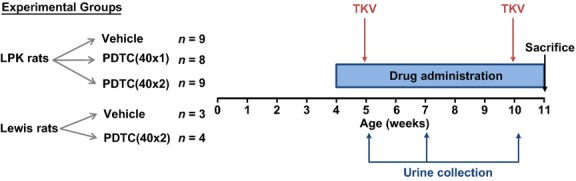
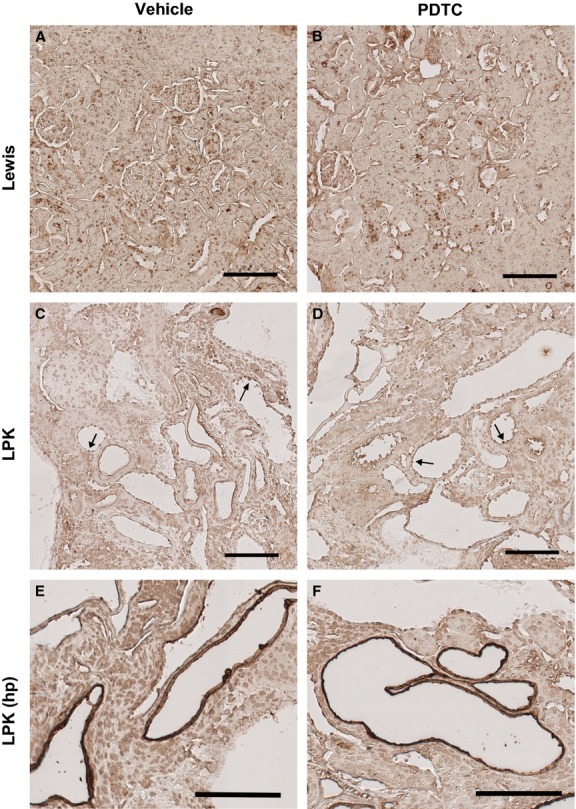
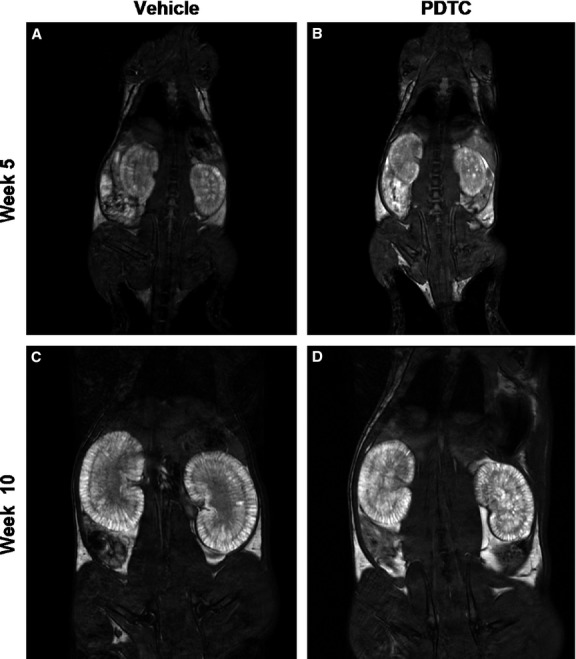
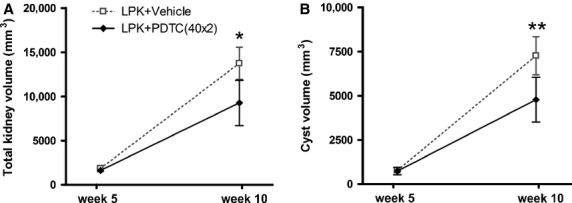
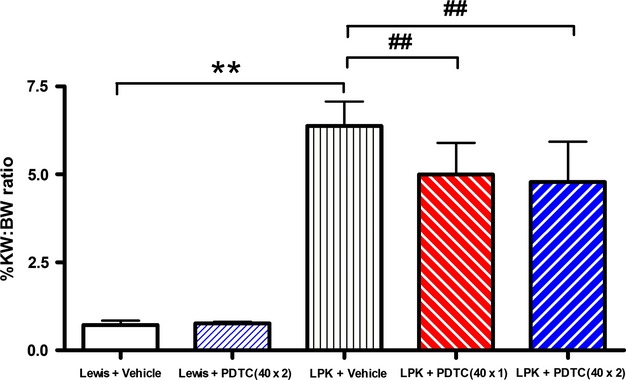
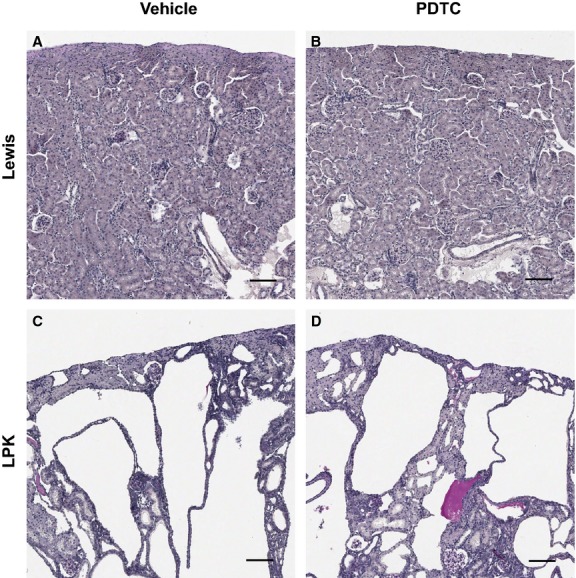
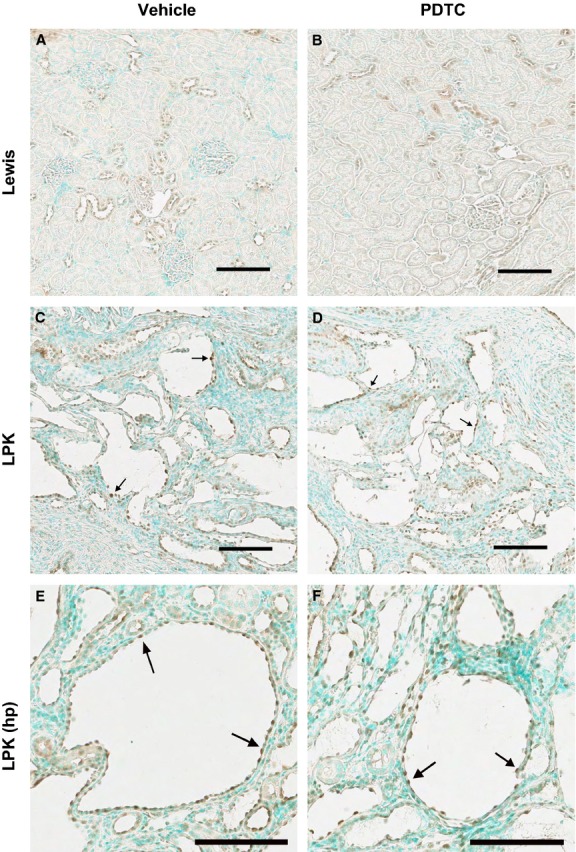
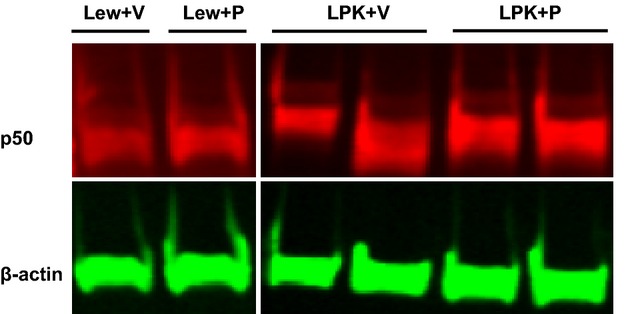
Heterocyclic dithiocarbamates have anti-inflammatory and anti-proliferative effects in rodent models of chronic kidney disease. In this study, we tested the hypothesis that pyrrolidine dithiocarbamate (PDTC) reduces the progression of polycystic kidney disease (PKD). Male Lewis polycystic kidney (LPK) rats (an ortholog of Nek8/NPHP9) received intraperitoneal injections of either saline vehicle or PDTC (40 mg/kg once or twice daily) from postnatal weeks 4 until 11. By serial magnetic resonance imaging at weeks 5 and 10, the relative within-rat increase in total kidney volume and cyst volume were 1.3-fold (P = 0.01) and 1.4-fold (P < 0.01) greater, respectively, in LPK + Vehicle compared to the LPK + PDTC(40 mg/kg twice daily) group. At week 11 in LPK rats, PDTC attenuated the increase in kidney weight to body weight ratio by 25% (P < 0.01) and proteinuria by 66% (P < 0.05 vs. LPK + Vehicle) but did not improve renal dysfunction. By quantitative whole-slide image analysis, PDTC did not alter interstitial CD68+ cell accumulation, interstitial fibrosis, or renal cell proliferation in LPK rats at week 11. The phosphorylated form of the nuclear factor (NF)-κB subunit, p105, was increased in cystic epithelial cells of LPK rats, but was not altered by PDTC. Moreover, PDTC did not significantly alter nuclear expression of the p50 subunit or NF-κB (p65)-DNA binding. Kidney enlargement in LPK rats was resistant to chronic treatment with a proteasome inhibitor, bortezomib. In conclusion, PDTC reduced renal cystic enlargement and proteinuria but lacked anti-inflammatory effects in LPK rats.
杂环二硫代氨基甲酸盐在慢性肾脏病的啮齿动物模型中具有抗炎和抗增殖作用。在本研究中,我们验证了吡咯烷二硫代氨基甲酸盐(PDTC)可减缓多囊肾病(PKD)进展这一假说。雄性Lewis多囊肾(LPK)大鼠(Nek8/NPHP9的直系同源物)从出生后第4周直至第11周接受腹腔注射生理盐水或PDTC(40 mg/kg,每日一次或两次)。通过在第5周和第10周进行的连续磁共振成像,与LPK + PDTC(40 mg/kg,每日两次)组相比,LPK + 生理盐水组大鼠肾脏总体积和囊肿体积的相对增加分别高1.3倍(P = 0.01)和1.4倍(P < 0.01)。在LPK大鼠的第11周,PDTC使肾脏重量与体重之比的增加减少了25%(P < 0.01),蛋白尿减少了66%(与LPK + 生理盐水组相比,P < 0.05),但未改善肾功能障碍。通过定量全玻片图像分析,PDTC在第11周时未改变LPK大鼠的间质CD68 + 细胞积聚、间质纤维化或肾细胞增殖。核因子(NF)-κB亚基p105的磷酸化形式在LPK大鼠的囊性上皮细胞中增加,但未被PDTC改变。此外,PDTC未显著改变p50亚基的核表达或NF-κB(p65)与DNA的结合。LPK大鼠的肾脏肿大对蛋白酶体抑制剂硼替佐米的长期治疗具有抗性。总之,PDTC减少了肾囊肿增大和蛋白尿,但在LPK大鼠中缺乏抗炎作用。