Oh Esther S, Li Meng, Fafowora Tolulope M, Inouye Sharon K, Chen Cathy H, Rosman Lori M, Lyketsos Constantine G, Sieber Frederick E, Puhan Milo A
Department of Medicine, John Hopkins University School of Medicine, Baltimore, MD, USA.
Department of Psychiatry and Behavioral Sciences, John Hopkins University School of Medicine, Baltimore, MD, USA.
Int J Geriatr Psychiatry. 2015 Sep;30(9):900-10. doi: 10.1002/gps.4233. Epub 2014 Dec 11.
Systematically identify preoperative clinical risk factors for incident postoperative delirium in individuals undergoing hip fracture repair in order to guide clinicians in identifying high risk patients at admission.
This is a systematic review of prospective observational studies with estimation of association between preoperative risk factors and incident postoperative delirium in multivariate models. Electronic searches were conducted in PubMed, Embase, PsycINFO, CINAHL, Cochrane Library, Proquest Dissertations and Theses, and WorldCatDissertations. Hand searches were conducted in selected journals and their supplements.
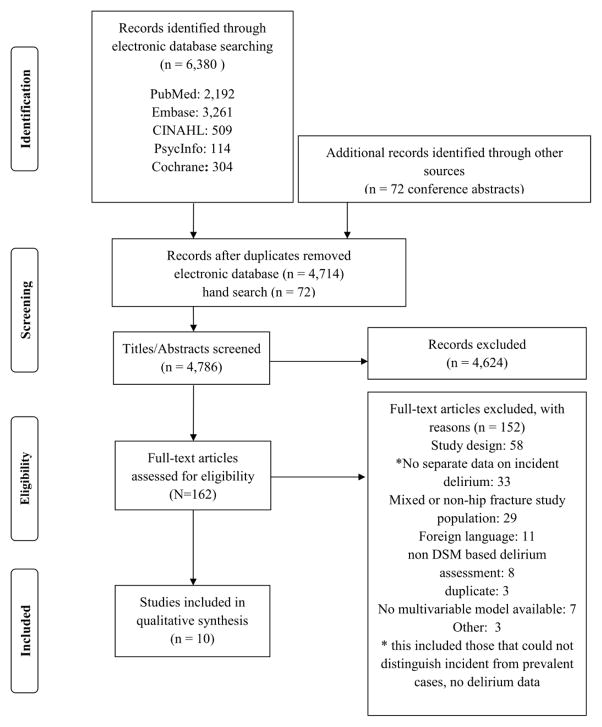
Search yielded 6380 titles and abstracts from electronic databases and 72 titles from hand searches, and 10 studies met inclusion criteria. The following risk factors were significant in bivariate models: cognitive impairment, age, gender, institutionalization, functional impairment, body mass index (BMI), albumin, comorbidities, American Society of Anesthesiologist classification, acute medical conditions, polypharmacy, and vision impairment. Among all of these risk factors, cognitive impairment most consistently remained statistically significant after adjusting for other risk factors in multivariate models, followed by BMI/albumin and multiple comorbidities.
In our systematic review, cognitive impairment was one of the strongest preoperative risk factors for postoperative delirium after hip fracture surgery. Preoperative cognitive assessment may be one of the most useful methods of identifying those who are at high risk for postoperative delirium and prioritizing delivery of delirium prevention measures.
系统识别接受髋部骨折修复术患者术后发生谵妄的术前临床风险因素,以指导临床医生在入院时识别高危患者。
这是一项对前瞻性观察性研究的系统评价,在多变量模型中估计术前风险因素与术后谵妄发生率之间的关联。在PubMed、Embase、PsycINFO、CINAHL、Cochrane图书馆、Proquest学位论文数据库和WorldCat学位论文数据库中进行了电子检索。在选定的期刊及其增刊中进行了手工检索。
电子数据库检索得到6380个标题和摘要,手工检索得到72个标题,10项研究符合纳入标准。以下风险因素在双变量模型中具有显著性:认知障碍、年龄、性别、机构化、功能障碍、体重指数(BMI)、白蛋白、合并症、美国麻醉医师协会分级、急性内科疾病、多种药物治疗和视力障碍。在所有这些风险因素中,在多变量模型中调整其他风险因素后,认知障碍最始终保持统计学显著性,其次是BMI/白蛋白和多种合并症。
在我们的系统评价中,认知障碍是髋部骨折手术后术后谵妄最强的术前风险因素之一。术前认知评估可能是识别术后谵妄高危人群并优先采取谵妄预防措施的最有用方法之一。