Suh Alexander, Churakov Gennady, Ramakodi Meganathan P, Platt Roy N, Jurka Jerzy, Kojima Kenji K, Caballero Juan, Smit Arian F, Vliet Kent A, Hoffmann Federico G, Brosius Jürgen, Green Richard E, Braun Edward L, Ray David A, Schmitz Jürgen
Institute of Experimental Pathology (ZMBE), University of Münster, Germany Department of Evolutionary Biology (EBC), Uppsala University, Sweden
Institute of Experimental Pathology (ZMBE), University of Münster, Germany.
Genome Biol Evol. 2014 Dec 11;7(1):205-17. doi: 10.1093/gbe/evu256.
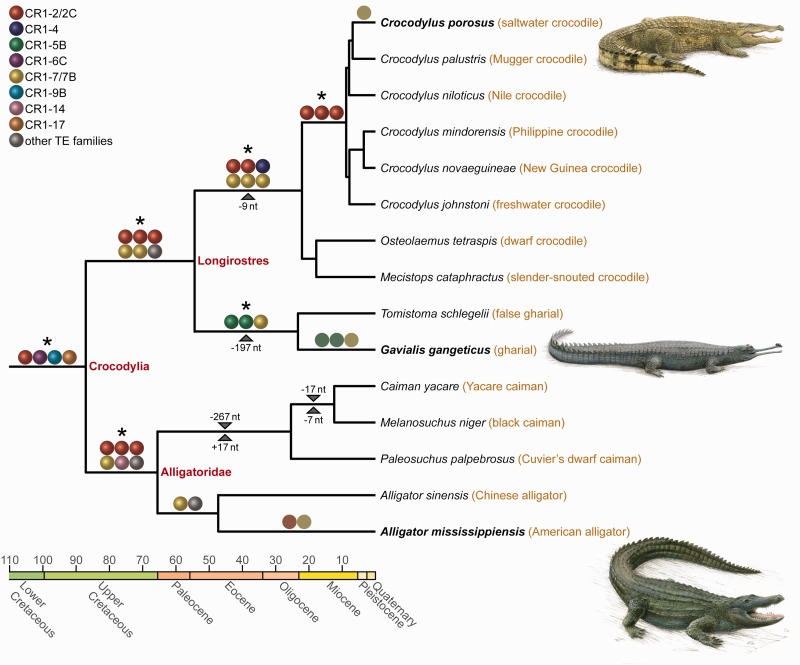
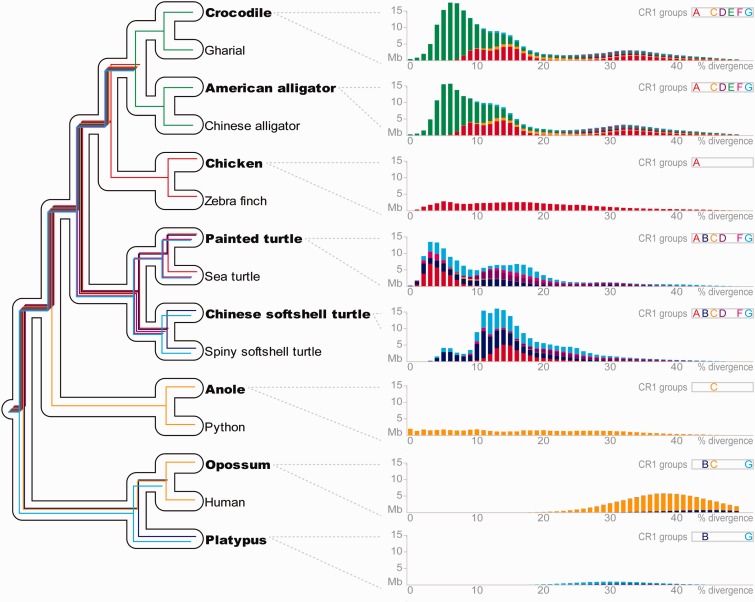
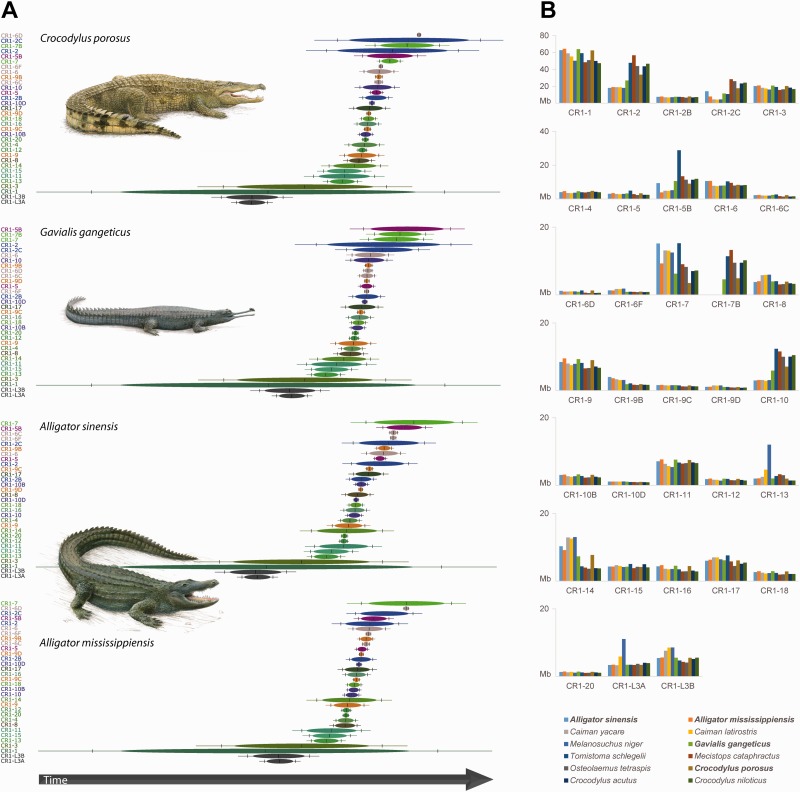
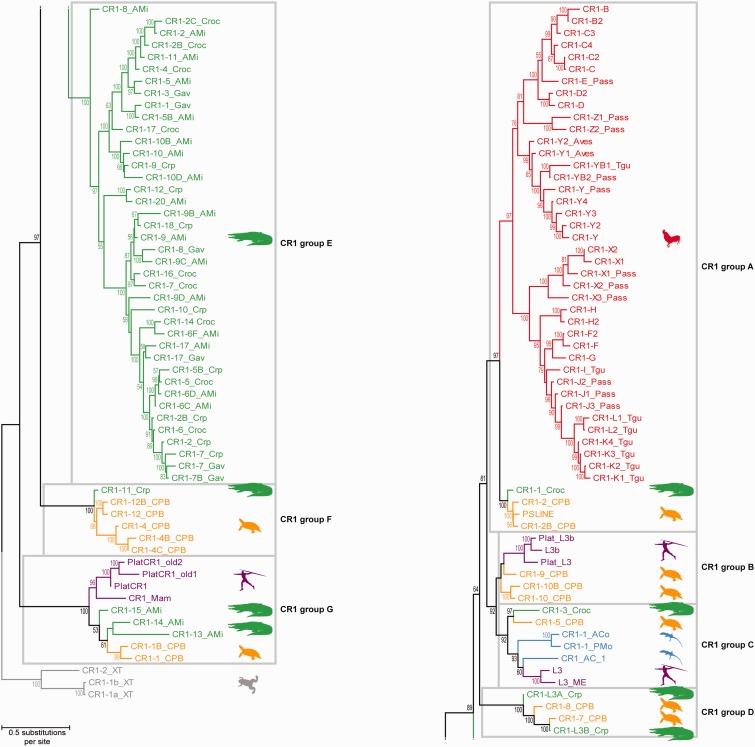
Chicken repeat 1 (CR1) retroposons are long interspersed elements (LINEs) that are ubiquitous within amniote genomes and constitute the most abundant family of transposed elements in birds, crocodilians, turtles, and snakes. They are also present in mammalian genomes, where they reside as numerous relics of ancient retroposition events. Yet, despite their relevance for understanding amniote genome evolution, the diversity and evolution of CR1 elements has never been studied on an amniote-wide level. We reconstruct the temporal and quantitative activity of CR1 subfamilies via presence/absence analyses across crocodilian phylogeny and comparative analyses of 12 crocodilian genomes, revealing relative genomic stasis of retroposition during genome evolution of extant Crocodylia. Our large-scale phylogenetic analysis of amniote CR1 subfamilies suggests the presence of at least seven ancient CR1 lineages in the amniote ancestor; and amniote-wide analyses of CR1 successions and quantities reveal differential retention (presence of ancient relics or recent activity) of these CR1 lineages across amniote genome evolution. Interestingly, birds and lepidosaurs retained the fewest ancient CR1 lineages among amniotes and also exhibit smaller genome sizes. Our study is the first to analyze CR1 evolution in a genome-wide and amniote-wide context and the data strongly suggest that the ancestral amniote genome contained myriad CR1 elements from multiple ancient lineages, and remnants of these are still detectable in the relatively stable genomes of crocodilians and turtles. Early mammalian genome evolution was thus characterized by a drastic shift from CR1 prevalence to dominance and hyperactivity of L2 LINEs in monotremes and L1 LINEs in therians.
鸡重复序列1(CR1)逆转座子是长散在重复序列(LINEs),在羊膜动物基因组中普遍存在,是鸟类、鳄鱼、龟和蛇中转座元件最丰富的家族。它们也存在于哺乳动物基因组中,以众多古代逆转座事件的遗迹形式存在。然而,尽管它们与理解羊膜动物基因组进化相关,但CR1元件的多样性和进化从未在全羊膜动物水平上进行过研究。我们通过对鳄鱼系统发育的存在/缺失分析以及对12个鳄鱼基因组的比较分析,重建了CR1亚家族的时间和定量活性,揭示了现存鳄目动物基因组进化过程中逆转座的相对基因组稳定性。我们对羊膜动物CR1亚家族的大规模系统发育分析表明,羊膜动物祖先中至少存在七个古老的CR1谱系;对CR1序列和数量的全羊膜动物分析揭示了这些CR1谱系在羊膜动物基因组进化过程中的差异保留(古代遗迹或近期活性的存在)。有趣的是,鸟类和鳞龙类在羊膜动物中保留的古老CR1谱系最少,并且基因组大小也较小。我们的研究首次在全基因组和全羊膜动物背景下分析了CR1的进化,数据强烈表明,羊膜动物祖先基因组包含来自多个古老谱系的无数CR1元件,在鳄鱼和龟相对稳定的基因组中仍可检测到这些元件的残余。因此,早期哺乳动物基因组进化的特征是从CR1占主导地位急剧转变为单孔类动物中L2 LINEs和兽类中L1 LINEs的优势和高活性。