Xia Xiaoping, Chen Wei, Li Jiaoyuan, Chen Xueqin, Rui Rui, Liu Cheng, Sun Yu, Liu Li, Gong Jing, Yuan Peng
Clinical Laboratory of the Fourth Affiliated Hospital, Zhejiang University School of Medicine, Yiwu, 322000, Zhejiang Province, China.
State Key Laboratory of Environment Health (Incubation), MOE (Ministry of Education) Key Laboratory of Environment &Health, Ministry of Environmental Protection Key Laboratory of Environment and Health (Wuhan), and Department of Epidemiology and Biostatistics, School of Public Health, Tongji Medical College, Huazhong University of Science and Technology, Wuhan, China.
Sci Rep. 2014 Dec 15;4:7480. doi: 10.1038/srep07480.
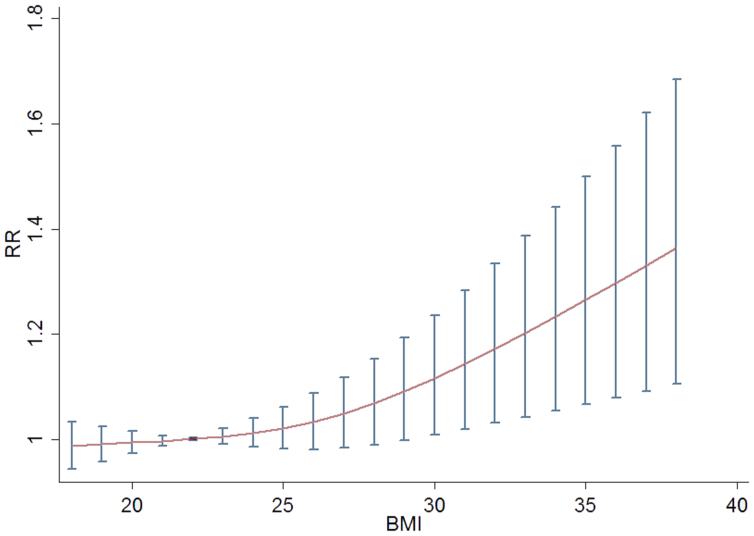
The role of Body Mass Index (BMI) for Breast Cancer (BC) remains to be great interest for a long time. However, the precise effect of nonlinear dose-response for BMI and BC risk is still unclear. We conducted a dose-response meta-analysis to quantitatively assess the effect of BMI on BC risk. Twelve prospective studies with 4,699 cases identified among 426,199 participants and 25 studies of 22,809 cases identified among 1,155,110 participants in premenopausal and postmenopausal groups, respectively, were included in this meta-analysis. Significant non-linear dose-response (P < 0.001) association was identified between BMI and BC risk in postmenopausal women. Individuals with BMI of 25, 30, and 35 kg/m(2) yielded relative risks (RRs) of 1.02 [95% confidence interval (CI): 0.98-1.06], 1.12 (95% CI: 1.01-1.24), and 1.26 (95% CI: 1.07-1.50), respectively, when compared to the mean level of the normal BMI range. However, inverse result though not significant was observed in premenopausal women. In conclusion, the results of this meta-analysis highlighted that obesity contributed to increased BC risk in a nonlinear dose-response manner in postmenopausal women, and it is important to realize that body weight control may be a crucial process to reduce BC susceptibility.
长期以来,体重指数(BMI)在乳腺癌(BC)中的作用一直备受关注。然而,BMI与BC风险之间非线性剂量反应的确切影响仍不清楚。我们进行了一项剂量反应荟萃分析,以定量评估BMI对BC风险的影响。该荟萃分析纳入了12项前瞻性研究,在426,199名参与者中确定了4,699例病例;以及25项研究,分别在绝经前和绝经后组的1,155,110名参与者中确定了22,809例病例。在绝经后女性中,BMI与BC风险之间存在显著的非线性剂量反应(P < 0.001)关联。与正常BMI范围的平均水平相比,BMI为25、30和35 kg/m²的个体的相对风险(RRs)分别为1.02 [95%置信区间(CI):0.98 - 1.06]、1.12(95% CI:1.01 - 1.24)和1.26(95% CI:1.07 - 1.50)。然而,在绝经前女性中观察到了相反的结果,尽管不显著。总之,这项荟萃分析的结果强调,肥胖以非线性剂量反应方式导致绝经后女性BC风险增加,并且必须认识到控制体重可能是降低BC易感性的关键过程。