Bódizs Róbert, Gombos Ferenc, Ujma Péter P, Kovács Ilona
Institute of Behavioural Sciences, Semmelweis University Budapest, Hungary ; Department of General Psychology, Pázmány Péter Catholic University Budapest, Hungary.
Department of General Psychology, Pázmány Péter Catholic University Budapest, Hungary.
Front Hum Neurosci. 2014 Nov 28;8:952. doi: 10.3389/fnhum.2014.00952. eCollection 2014.
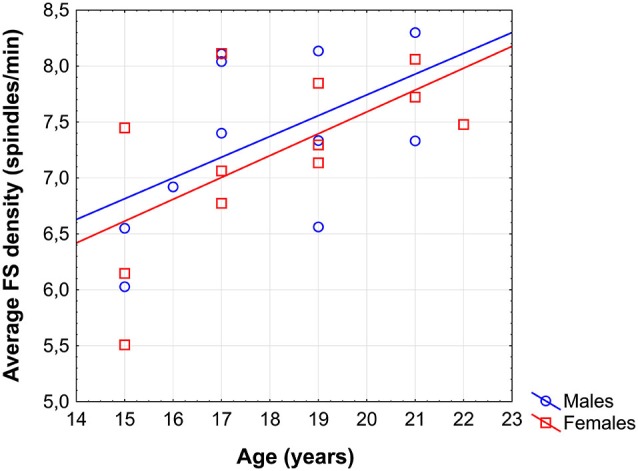
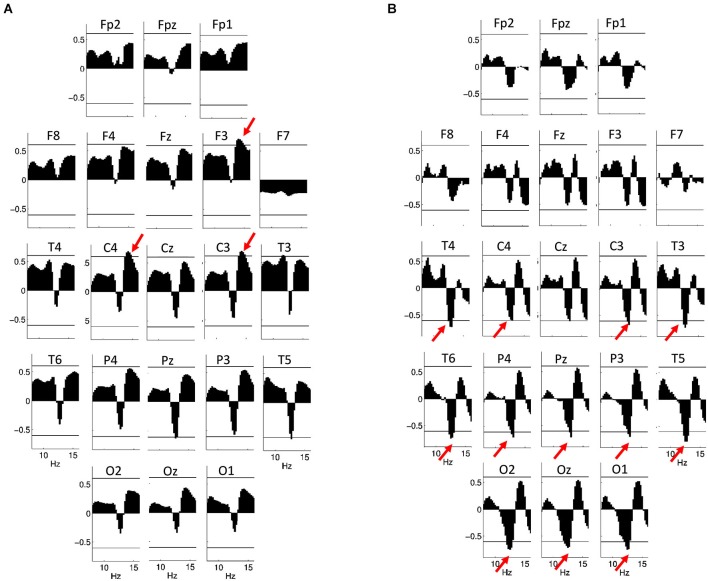
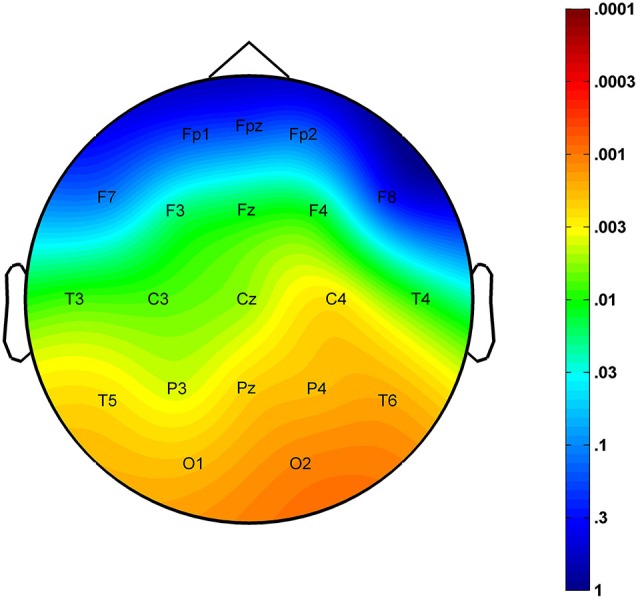
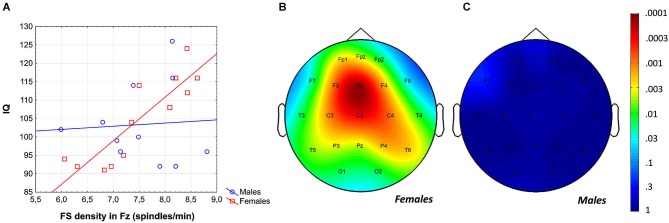
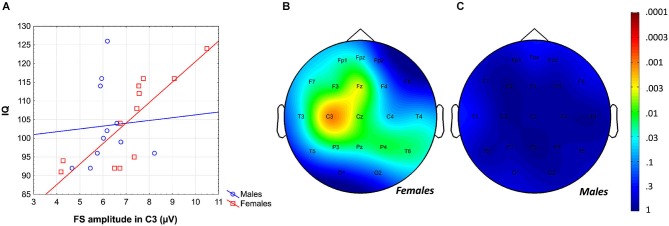
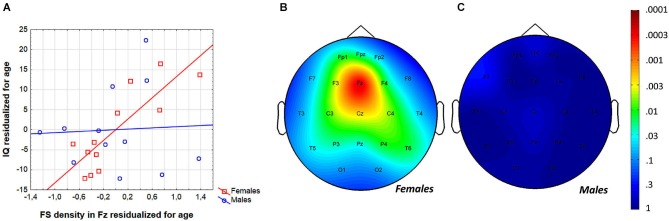
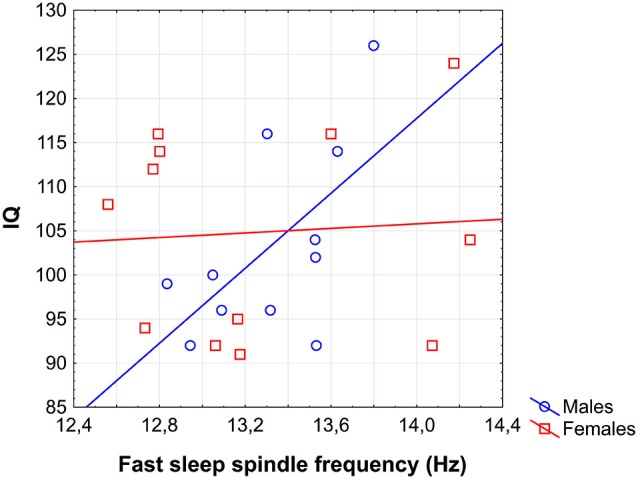
Evidence supports the intricate relationship between sleep electroencephalogram (EEG) spindling and cognitive abilities in children and adults. Although sleep EEG changes during adolescence index fundamental brain reorganization, a detailed analysis of sleep spindling and the spindle-intelligence relationship was not yet provided for adolescents. Therefore, adolescent development of sleep spindle oscillations were studied in a home polysomnographic study focusing on the effects of chronological age and developmentally acquired overall mental efficiency (fluid IQ) with sex as a potential modulating factor. Subjects were 24 healthy adolescents (12 males) with an age range of 15-22 years (mean: 18 years) and fluid IQ of 91-126 (mean: 104.12, Raven Progressive Matrices Test). Slow spindles (SSs) and fast spindles (FSs) were analyzed in 21 EEG derivations by using the individual adjustment method (IAM). A significant age-dependent increase in average FS density (r = 0.57; p = 0.005) was found. Moreover, fluid IQ correlated with FS density (r = 0.43; p = 0.04) and amplitude (r = 0.41; p = 0.049). The latter effects were entirely driven by particularly reliable FS-IQ correlations in females [r = 0.80 (p = 0.002) and r = 0.67 (p = 0.012), for density and amplitude, respectively]. Region-specific analyses revealed that these correlations peak in the fronto-central regions. The control of the age-dependence of FS measures and IQ scores did not considerably reduce the spindle-IQ correlations with respect to FS density. The only positive spindle-index of fluid IQ in males turned out to be the frequency of FSs (r = 0.60, p = 0.04). Increases in FS density during adolescence may index reshaped structural connectivity related to white matter maturation in the late developing human brain. The continued development over this age range of cognitive functions is indexed by specific measures of sleep spindling unraveling gender differences in adolescent brain maturation and perhaps cognitive strategy.
有证据支持儿童和成人睡眠脑电图(EEG)纺锤波与认知能力之间存在复杂关系。尽管青春期睡眠EEG变化标志着大脑的根本性重组,但尚未对青少年的睡眠纺锤波及纺锤波与智力的关系进行详细分析。因此,在一项家庭多导睡眠图研究中,以年龄和发育获得的整体心理效率(流体智力)为重点,以性别作为潜在调节因素,研究了青少年睡眠纺锤波振荡的发展情况。研究对象为24名健康青少年(12名男性),年龄范围为15至22岁(平均:18岁),流体智力为91至126(平均:104.12,瑞文渐进矩阵测验)。通过使用个体调整法(IAM)在21个EEG导联中分析慢纺锤波(SSs)和快纺锤波(FSs)。发现平均FS密度存在显著的年龄依赖性增加(r = 0.57;p = 0.005)。此外,流体智力与FS密度(r = 0.43;p = 0.04)和振幅(r = 0.41;p = 0.049)相关。后一种效应完全由女性中特别可靠的FS-智力相关性驱动[密度和振幅的r分别为0.80(p = 0.002)和0.67(p = 0.012)]。区域特异性分析表明,这些相关性在额中央区域达到峰值。对FS测量值和智商分数的年龄依赖性进行控制,并没有显著降低FS密度方面的纺锤波-智力相关性。男性中流体智力唯一的正向纺锤波指标是FSs的频率(r = 0.60,p = 0.04)。青春期FS密度的增加可能标志着与发育较晚的人类大脑白质成熟相关的结构连接性重塑。在这个年龄范围内认知功能的持续发展通过睡眠纺锤波的特定测量指标来体现,揭示了青少年大脑成熟以及可能的认知策略中的性别差异。