Tudzynski Bettina
Institute of Biology and Biotechnology of Plants, Westfaelische Wilhelms-University Muenster Muenster, Germany.
Front Microbiol. 2014 Nov 28;5:656. doi: 10.3389/fmicb.2014.00656. eCollection 2014.
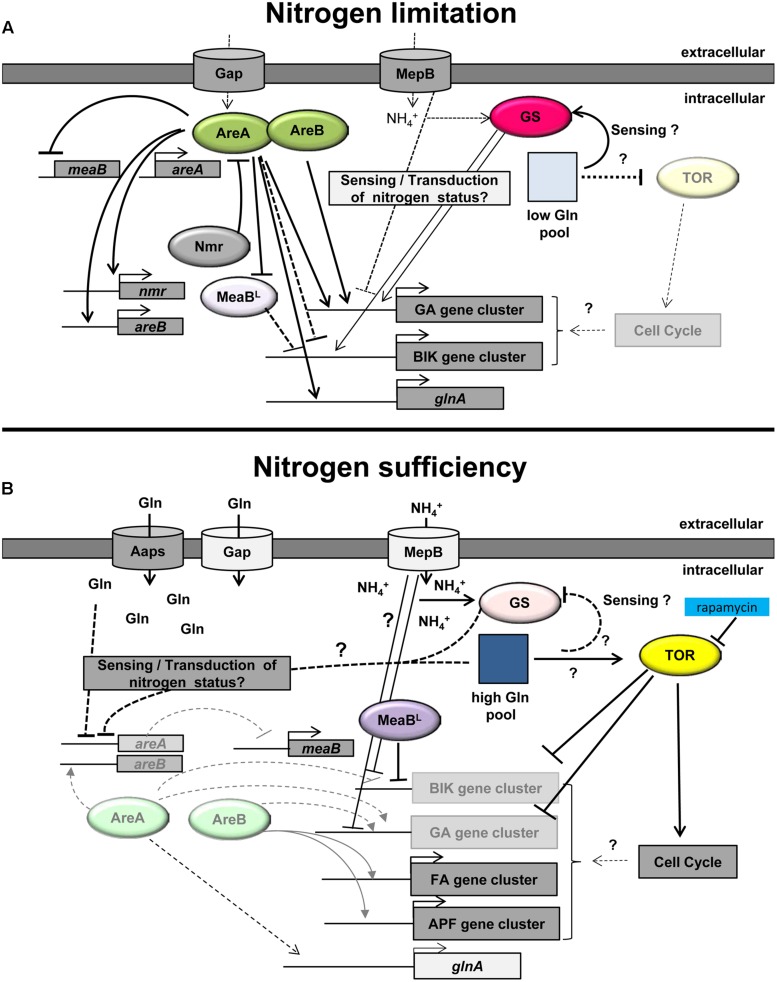
Fungi occupy diverse environments where they are constantly challenged by stressors such as extreme pH, temperature, UV exposure, and nutrient deprivation. Nitrogen is an essential requirement for growth, and the ability to metabolize a wide variety of nitrogen sources enables fungi to colonize different environmental niches and survive nutrient limitations. Favored nitrogen sources, particularly ammonium and glutamine, are used preferentially, while the expression of genes required for the use of various secondary nitrogen sources is subject to a regulatory mechanism called nitrogen metabolite repression. Studies on gene regulation in response to nitrogen availability were carried out first in Saccharomyces cerevisiae, Aspergillus nidulans, and Neurospora crassa. These studies revealed that fungi respond to changes in nitrogen availability with physiological and morphological alterations and activation of differentiation processes. In all fungal species studied, the major GATA transcription factor AreA and its co-repressor Nmr are central players of the nitrogen regulatory network. In addition to growth and development, the quality and quantity of nitrogen also affects the formation of a broad range of secondary metabolites (SMs). Recent studies, mainly on species of the genus Fusarium, revealed that AreA does not only regulate a large set of nitrogen catabolic genes, but can also be involved in regulating production of SMs. Furthermore, several other regulators, e.g., a second GATA transcription factor, AreB, that was proposed to negatively control nitrogen catabolic genes by competing with AreA for binding to GATA elements, was shown to act as activator of some nitrogen-repressed as well as nitrogen-induced SM gene clusters. This review highlights our latest understanding of canonical (AreA-dependent) and non-canonical nitrogen regulation mechanisms by which fungi may regulate biosynthesis of certain SMs in response to nitrogen availability.
真菌占据着多样的环境,在这些环境中,它们不断受到诸如极端pH值、温度、紫外线照射和营养剥夺等应激源的挑战。氮是生长的必需元素,能够代谢多种氮源使真菌能够在不同的生态位定殖并在营养限制条件下存活。真菌优先利用偏好的氮源,特别是铵和谷氨酰胺,而利用各种次要氮源所需基因的表达则受到一种称为氮代谢物阻遏的调控机制的影响。关于真菌响应氮可用性的基因调控研究最早在酿酒酵母、构巢曲霉和粗糙脉孢菌中展开。这些研究表明,真菌会通过生理和形态变化以及分化过程的激活来响应氮可用性的变化。在所有研究的真菌物种中,主要的GATA转录因子AreA及其共阻遏物Nmr是氮调控网络的核心参与者。除了生长和发育外,氮的质量和数量还会影响多种次级代谢产物(SMs)的形成。最近的研究,主要是关于镰刀菌属物种的研究,表明AreA不仅调控大量氮分解代谢基因,还可能参与调控次级代谢产物的产生。此外,其他几个调控因子,例如第二个GATA转录因子AreB,有人提出它通过与AreA竞争结合GATA元件来负调控氮分解代谢基因,但它也被证明可作为一些氮阻遏以及氮诱导的次级代谢产物基因簇的激活剂。本综述重点介绍了我们对真菌可能通过经典(依赖AreA)和非经典氮调控机制来响应氮可用性从而调控某些次级代谢产物生物合成的最新认识。