Letz Saskia, Haag Christine, Schulze Egbert, Frank-Raue Karin, Raue Friedhelm, Hofner Benjamin, Mayr Bernhard, Schöfl Christof
Division of Endocrinology and Diabetes, Department of Medicine I, Universitätsklinikum Erlangen, Erlangen, Germany.
Endocrine Practice, Heidelberg, Germany.
PLoS One. 2014 Dec 15;9(12):e115178. doi: 10.1371/journal.pone.0115178. eCollection 2014.
Activating calcium sensing receptor (CaSR) mutations cause autosomal dominant hypocalcemia (ADH) characterized by low serum calcium, inappropriately low PTH and relative hypercalciuria. Four activating CaSR mutations cause additional renal wasting of sodium, chloride and other salts, a condition called Bartter syndrome (BS) type 5. Until today there is no specific medical treatment for BS type 5 and ADH. We investigated the effects of different allosteric CaSR antagonists (calcilytics) on activating CaSR mutants.
All 4 known mutations causing BS type 5 and five ADH mutations were expressed in HEK 293T cells and receptor signalling was studied by measurement of intracellular free calcium in response to extracellular calcium ([Ca2+]o). To investigate the effect of calcilytics, cells were stimulated with 3 mM [Ca2+]o in the presence or absence of NPS-2143, ATF936 or AXT914.
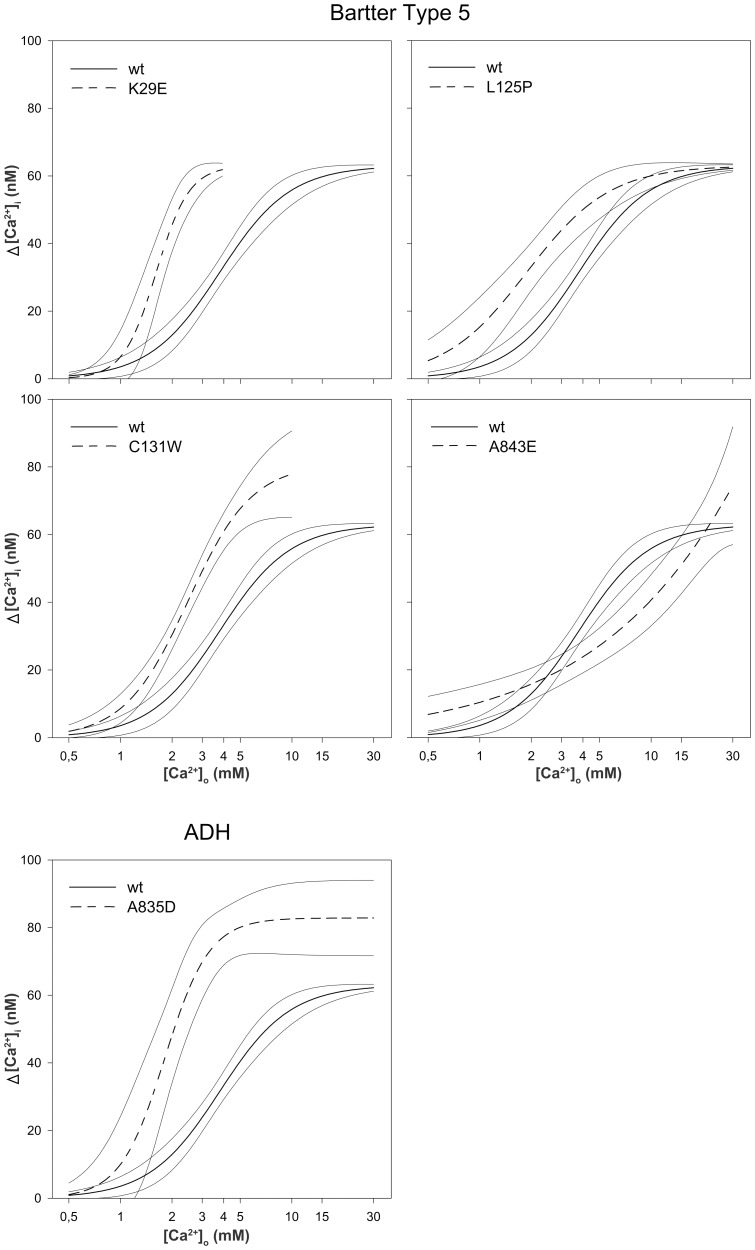
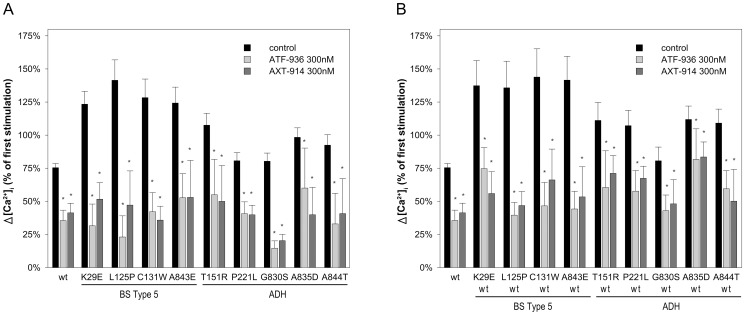
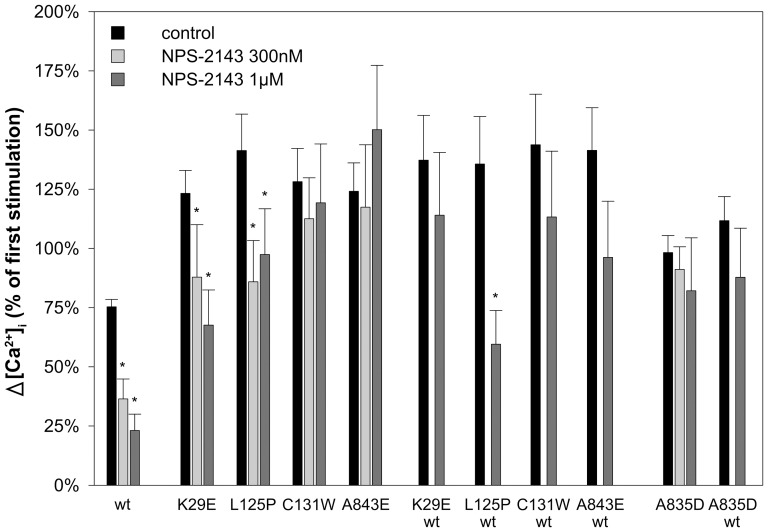
All BS type 5 and ADH mutants showed enhanced signalling activity to [Ca2+]o with left shifted dose response curves. In contrast to the amino alcohol NPS-2143, which was only partially effective, the quinazolinone calcilytics ATF936 and AXT914 significantly mitigated excessive cytosolic calcium signalling of all BS type 5 and ADH mutants studied. When these mutants were co-expressed with wild-type CaSR to approximate heterozygosity in patients, ATF936 and AXT914 were also effective on all mutants.
The calcilytics ATF936 and AXT914 are capable of attenuating enhanced cytosolic calcium signalling activity of CaSR mutations causing BS type 5 and ADH. Quinazolinone calcilytics might therefore offer a novel treatment option for patients with activating CaSR mutations.
激活型钙敏感受体(CaSR)突变导致常染色体显性低钙血症(ADH),其特征为血清钙水平低、甲状旁腺激素(PTH)水平不适当降低以及相对高钙尿症。四种激活型CaSR突变会导致钠、氯和其他盐类的额外肾脏丢失,这种情况被称为5型巴特综合征(BS)。直至今日,5型BS和ADH尚无特效药物治疗。我们研究了不同变构CaSR拮抗剂(钙敏感受体阻滞剂)对激活型CaSR突变体的影响。
导致5型BS的所有4种已知突变以及5种ADH突变在人胚肾293T细胞(HEK 293T)中表达,并通过测量细胞内游离钙对细胞外钙([Ca2+]o)的反应来研究受体信号传导。为研究钙敏感受体阻滞剂的作用,在存在或不存在NPS - 2143、ATF936或AXT914 的情况下,用3 mM [Ca2+]o刺激细胞。
所有5型BS和ADH突变体对[Ca2+]o均表现出增强的信号活性,剂量反应曲线左移。与仅部分有效的氨基醇NPS - 2143不同,喹唑啉酮类钙敏感受体阻滞剂ATF936和AXT914显著减轻了所研究的所有5型BS和ADH突变体过度的胞质钙信号传导。当这些突变体与野生型CaSR共表达以模拟患者的杂合状态时,ATF936和AXT914对所有突变体也均有效。
钙敏感受体阻滞剂ATF936和AXT914能够减弱导致5型BS和ADH的CaSR突变增强的胞质钙信号传导活性。因此,喹唑啉酮类钙敏感受体阻滞剂可能为激活型CaSR突变患者提供一种新的治疗选择。