Waller Rebecca, Shaw Daniel S, Forbes Erika E, Hyde Luke W
Department of Psychology, University of Michigan, Ann Arbor, MI, USA.
J Abnorm Child Psychol. 2015 Aug;43(6):1025-39. doi: 10.1007/s10802-014-9965-7.
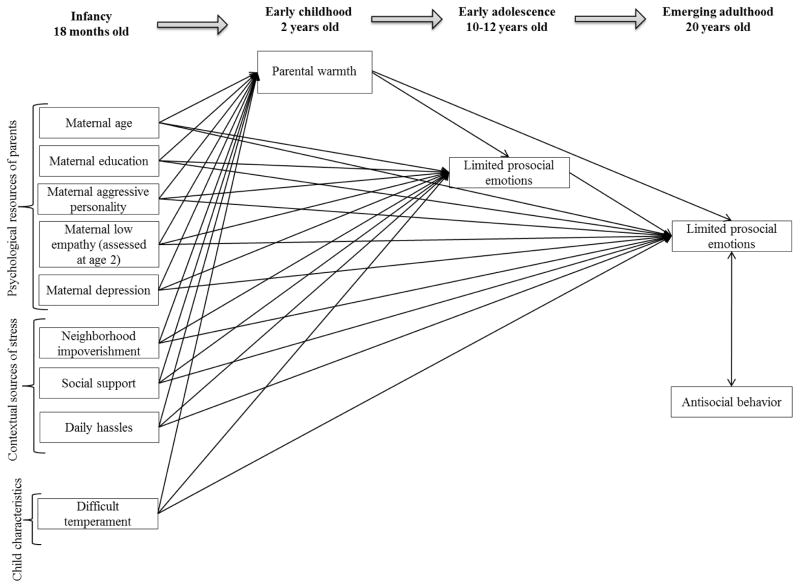
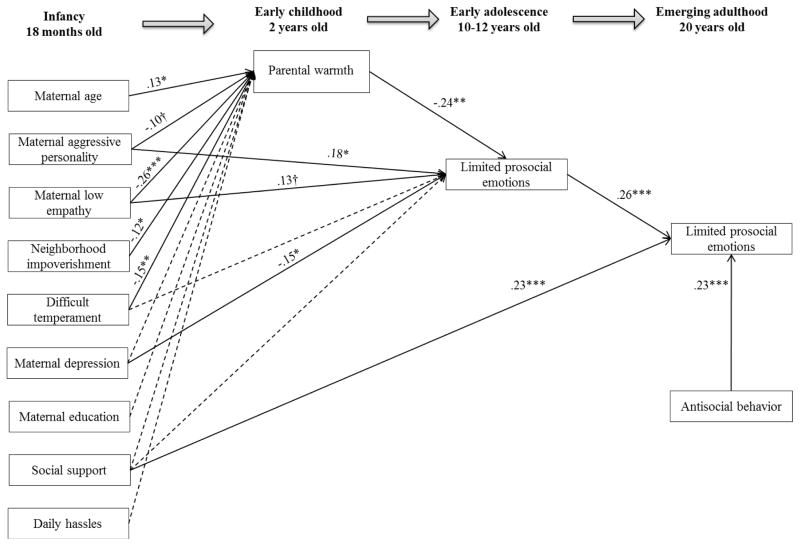
A growing body of evidence suggests that parenting influences the development of youth callous unemotional (CU) behavior. However, less is known about the effects of parenting or contextual risk factors on 'limited prosocial emotions' (LPE), a recent conceptualization of CU behavior added to the DSM-5. We focused on LPE at ages 10-12 and age 20 among low income, urban males (N = 310), and examined potential developmental precursors, including contextual risk factors assessed during infancy and observed maternal warmth during the toddler period. We found unique direct associations between maternal warmth, maternal aggression, and low empathetic awareness on LPE at ages 10-12, controlling for concurrent self-reported antisocial behavior. Further, there were indirect effects of maternal aggression, low empathetic awareness, and difficult infant temperament assessed in infancy on LPE at ages 10-12 via their influence on maternal warmth at age 2. Finally, there were lasting indirect effects of parental warmth on LPE at age 20, via LPE at ages 10-12. We discuss the implications of these findings for ecological models of antisocial behavior and LPE development, and preventative interventions that target the broader early parenting environment.
越来越多的证据表明,养育方式会影响青少年冷酷无情(CU)行为的发展。然而,对于养育方式或环境风险因素对“有限亲社会情感”(LPE)的影响,我们了解得较少。“有限亲社会情感”是最近被添加到《精神疾病诊断与统计手册》第5版中的一种关于CU行为的概念。我们聚焦于低收入城市男性(N = 310)在10 - 12岁和20岁时的LPE,并研究了潜在的发展先兆,包括婴儿期评估的环境风险因素以及幼儿期观察到的母亲温暖程度。我们发现,在控制了同时期自我报告的反社会行为后,母亲的温暖程度、母亲的攻击性以及低共情意识与10 - 12岁时的LPE之间存在独特的直接关联。此外,婴儿期评估的母亲攻击性、低共情意识和困难的婴儿气质,通过它们对2岁时母亲温暖程度的影响,对10 - 12岁时的LPE产生间接影响。最后,父母的温暖程度通过10 - 12岁时的LPE,对20岁时的LPE产生持久的间接影响。我们讨论了这些发现对反社会行为和LPE发展的生态模型以及针对更广泛早期养育环境的预防干预措施的意义。