Lavedán Santamaría Ana, Jürschik Giménez Pilar, Botigué Satorra Teresa, Nuin Orrio Carmen, Viladrosa Montoy Maria
Departamento de Enfermería, Universidad de Lleida, Lleida, España.
Departamento de Enfermería, Universidad de Lleida, Lleida, España.
Aten Primaria. 2015 Jun-Jul;47(6):367-75. doi: 10.1016/j.aprim.2014.07.012. Epub 2014 Dec 12.
To estimate the prevalence of falls and to identify their associated factors in community-dwelling elderly.
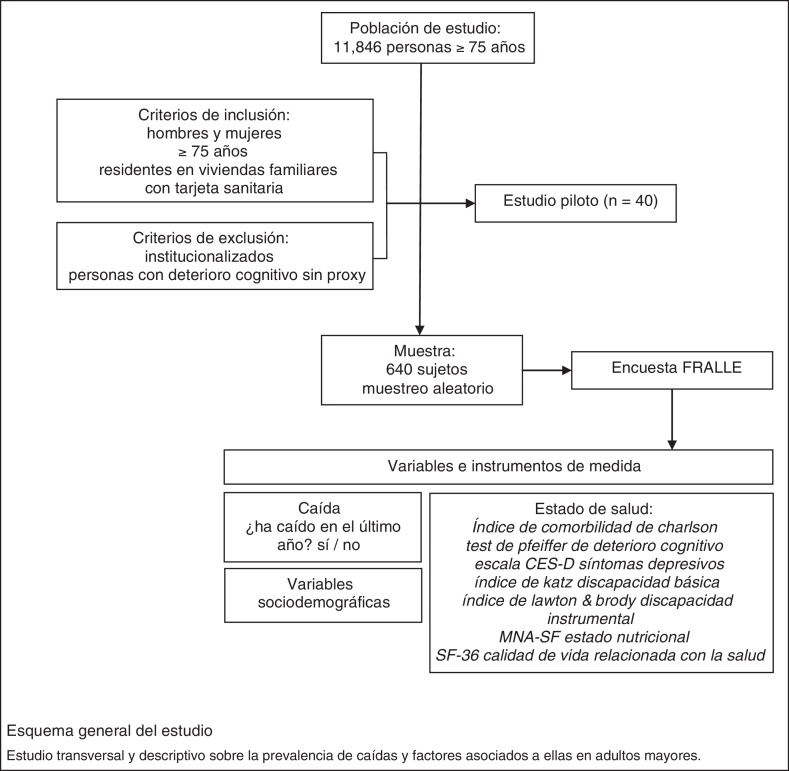
A descriptive, cross-sectional study.
Primary Health Care, Lleida.
Six hundred and forty people aged 75 and older were included, in possession of a health card and living in single-family houses, through random sampling. Main measurements Data source comes from the survey of frailty in Lleida (FRALLE Survey). The variables used were the occurrence of falls, sociodemographic factors, health status, quality of life related to health and fear of falling.
The prevalence of falls was 25.0% (95% CI 24.8-25.1). After multivariate analysis, basic disability (OR=2.17; 95% CI 1.32-3.58), depressive symptoms (OR=1.67; 95% CI 1.07-2.59) and fear of falling (OR=2.53; 95% CI 1.63-3.94) were the only factors independently associated with falls in the last year.
One out of 4 older people reported at least a fall in the last year. This study demonstrates that fear of falling, depressive symptoms and basic disability are independent variables associated with previous falls. These 3 factors can lead to a flattering spiral of falling and may be potential targets for effective functioning in the context of falls.
评估社区居住老年人跌倒的患病率,并确定其相关因素。
描述性横断面研究。
莱里达初级卫生保健机构。
通过随机抽样纳入640名75岁及以上的老年人,他们持有健康卡且居住在独栋房屋中。主要测量指标 数据来源为莱里达衰弱调查(FRALLE调查)。所使用的变量包括跌倒的发生情况、社会人口学因素、健康状况、与健康相关的生活质量以及跌倒恐惧。
跌倒的患病率为25.0%(95%置信区间24.8 - 25.1)。多变量分析后,基本残疾(比值比=2.17;95%置信区间1.32 - 3.58)、抑郁症状(比值比=1.67;95%置信区间1.07 - 2.59)和跌倒恐惧(比值比=2.53;95%置信区间1.63 - 3.94)是过去一年中与跌倒独立相关的仅有的因素。
四分之一的老年人报告在过去一年中至少跌倒过一次。本研究表明,跌倒恐惧、抑郁症状和基本残疾是与既往跌倒相关的独立变量。这三个因素可导致跌倒的恶性循环,可能是跌倒背景下有效功能的潜在干预靶点。