Lee Sung Ho, Chang Sung-A, Jang Shin Yi, Lee Sang-Chol, Song Young Bin, Park Seung Woo, Choi Seung-Hyuk, Gwon Hyeon-Cheol, Oh Jae K, Kim Duk-Kyung
Division of Cardiology, Department of Medicine, Kangbuk Samsung Hospital, Sungkyunkwan University School of Medicine, Seoul, Korea.
Division of Cardiology, Department of Medicine, Heart Vascular Stroke Institute, Samsung Medical Center, Sungkyunkwan University School of Medicine, Seoul, Korea.
Yonsei Med J. 2015 Jan;56(1):38-44. doi: 10.3349/ymj.2015.56.1.38.
Coronary artery disease (CAD) shares several risk factors with abdominal aortic aneurysm (AAA). We evaluated the prevalence during transthoracic echocardiography (TTE) and risk factors of AAA in patients with CAD.
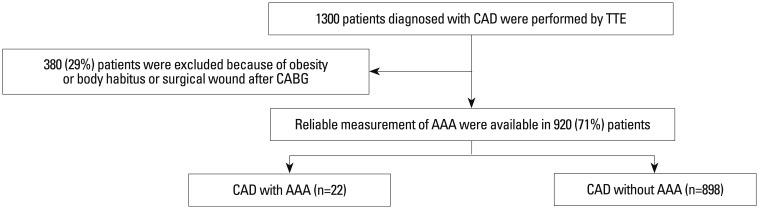
A total of 1300 CAD patients were screened from August 2009 to May 2010, and measurement of abdominal aorta size was feasible in 920 patients (71%) at the end of routine TTE. An AAA was defined as having a maximal diameter of ≥30 mm.
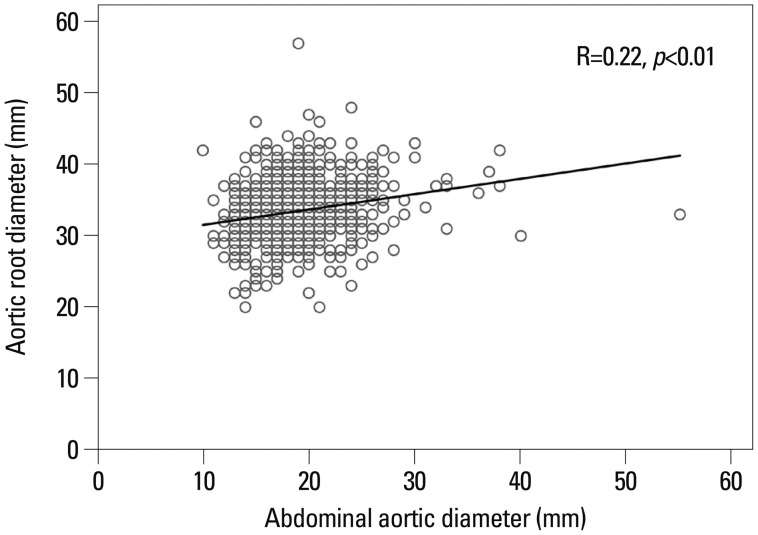
Of the 920 patients, 22 (2.4% of the study population) were diagnosed with AAA; of these AAA patients, 86% were male, and 82% were over 65 years-old. Abdominal aortic size was weakly correlated with aortic root diameter (r=0.22, p<0.01). Although the proportions of male gender, hypertension, and dyslipidemia were higher in AAA patients, such differences were not statistically significant. Advanced age [odds ratio (OR)=1.07; 95% confidence interval (CI): 1.01-1.12; p<0.01], smoking (OR=3.44; 95% CI: 1.18-10.04; p=0.02), and peripheral arterial disease (OR=5.88; 95% CI: 1.38-25.05; p=0.01) were found to be associated with AAA.
Although prevalence of AAA is very low in the Asian population, the prevalence of AAA in Asian CAD patients is higher than the general population. Therefore, opportunistic examination of the abdominal aorta during routine TTE could be effective, especially for male CAD patients over 65 years with a history of smoking or peripheral arterial disease.
冠状动脉疾病(CAD)与腹主动脉瘤(AAA)有若干共同的危险因素。我们评估了CAD患者经胸超声心动图(TTE)检查期间AAA的患病率及其危险因素。
2009年8月至2010年5月期间共筛查了1300例CAD患者,在常规TTE结束时,920例患者(71%)可行腹主动脉大小测量。AAA定义为最大直径≥30mm。
在920例患者中,22例(占研究人群的2.4%)被诊断为AAA;在这些AAA患者中,86%为男性,82%年龄超过65岁。腹主动脉大小与主动脉根部直径呈弱相关(r=0.22,p<0.01)。虽然AAA患者中男性、高血压和血脂异常的比例较高,但这些差异无统计学意义。高龄[比值比(OR)=1.07;95%置信区间(CI):1.01-1.12;p<0.01]、吸烟(OR=3.44;95%CI:1.18-10.04;p=0.02)和外周动脉疾病(OR=5.88;95%CI:1.38-25.05;p=0.01)与AAA相关。
虽然AAA在亚洲人群中的患病率很低,但亚洲CAD患者中AAA的患病率高于一般人群。因此,在常规TTE期间对腹主动脉进行机会性检查可能是有效的,特别是对于65岁以上有吸烟史或外周动脉疾病的男性CAD患者。