Kenney Amanda M, McKay John K, Richards James H, Juenger Thomas E
Department of Biological Sciences, St. Edward's University Austin, Texas.
Department of Bioagricultural Sciences and Pest Management, Colorado State University Fort Collins, Colorado.
Ecol Evol. 2014 Dec;4(23):4505-21. doi: 10.1002/ece3.1270. Epub 2014 Nov 19.
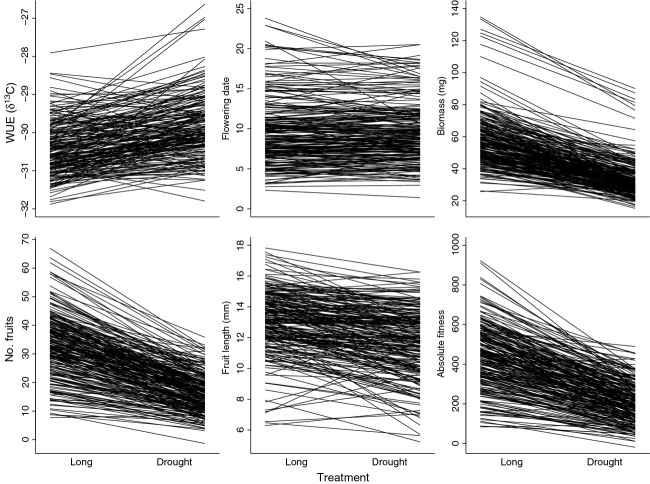
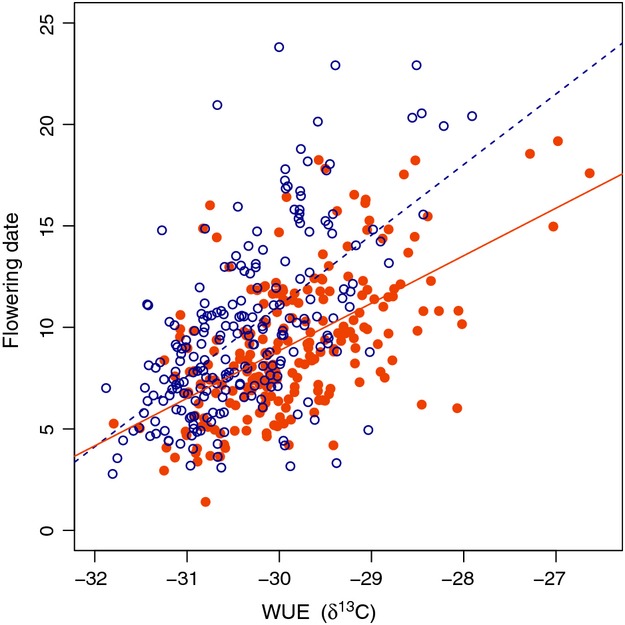
Flowering time and water-use efficiency (WUE) are two ecological traits that are important for plant drought response. To understand the evolutionary significance of natural genetic variation in flowering time, WUE, and WUE plasticity to drought in Arabidopsis thaliana, we addressed the following questions: (1) How are ecophysiological traits genetically correlated within and between different soil moisture environments? (2) Does terminal drought select for early flowering and drought escape? (3) Is WUE plasticity to drought adaptive and/or costly? We measured a suite of ecophysiological and reproductive traits on 234 spring flowering accessions of A. thaliana grown in well-watered and season-ending soil drying treatments, and quantified patterns of genetic variation, correlation, and selection within each treatment. WUE and flowering time were consistently positively genetically correlated. WUE was correlated with WUE plasticity, but the direction changed between treatments. Selection generally favored early flowering and low WUE, with drought favoring earlier flowering significantly more than well-watered conditions. Selection for lower WUE was marginally stronger under drought. There were no net fitness costs of WUE plasticity. WUE plasticity (per se) was globally neutral, but locally favored under drought. Strong genetic correlation between WUE and flowering time may facilitate the evolution of drought escape, or constrain independent evolution of these traits. Terminal drought favored drought escape in these spring flowering accessions of A. thaliana. WUE plasticity may be favored over completely fixed development in environments with periodic drought.
开花时间和水分利用效率(WUE)是植物干旱响应中两个重要的生态性状。为了理解拟南芥开花时间、WUE以及干旱条件下WUE可塑性的自然遗传变异的进化意义,我们提出了以下问题:(1)在不同土壤湿度环境中,生态生理性状在内部以及之间是如何进行遗传关联的?(2)终末期干旱是否会选择早开花和干旱逃避?(3)WUE对干旱的可塑性是适应性的和/或代价高昂的吗?我们在充分浇水和季节性土壤干燥处理条件下种植的234份春季开花的拟南芥材料上测量了一系列生态生理和生殖性状,并对每种处理下的遗传变异、相关性和选择模式进行了量化。WUE和开花时间始终呈正遗传相关。WUE与WUE可塑性相关,但处理之间的方向发生了变化。选择通常有利于早开花和低WUE,干旱条件下比充分浇水条件下更显著地有利于早开花。干旱条件下对较低WUE的选择略强。WUE可塑性没有净适合度代价。WUE可塑性(本身)在总体上是中性的,但在干旱条件下局部受到青睐。WUE和开花时间之间的强遗传相关性可能促进干旱逃避的进化,或者限制这些性状的独立进化。终末期干旱有利于这些春季开花的拟南芥材料的干旱逃避。在周期性干旱的环境中,WUE可塑性可能比完全固定的发育更受青睐。