Asmyhr Maria G, Linke Simon, Hose Grant, Nipperess David A
Department of Biological Sciences, Macquarie University, Sydney, New South Wales, Australia.
Australian Rivers Institute, Griffith University, Brisbane, Queensland, Australia.
PLoS One. 2014 Dec 16;9(12):e115132. doi: 10.1371/journal.pone.0115132. eCollection 2014.
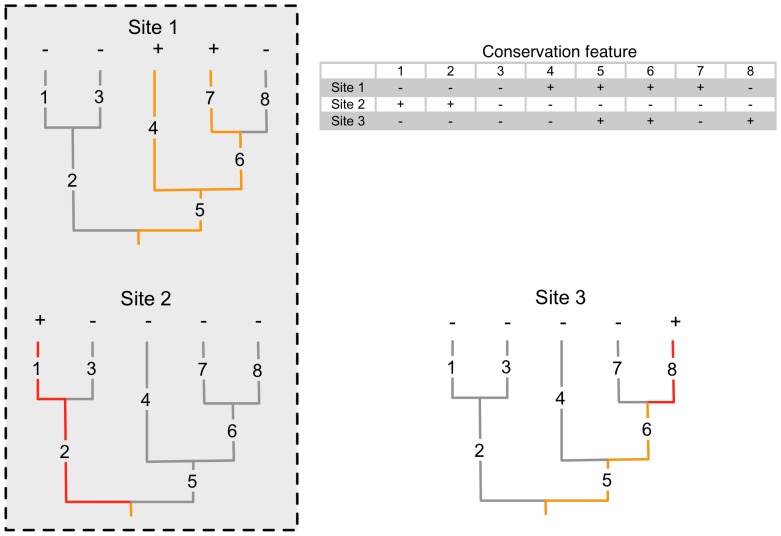
Aquifer ecosystems provide a range of important services including clean drinking water. These ecosystems, which are largely inaccessible to humans, comprise a distinct invertebrate fauna (stygofauna), which is characterized by narrow distributions, high levels of endemism and cryptic species. Although being under enormous anthropogenic pressure, aquifers have rarely been included in conservation planning because of the general lack of knowledge of species diversity and distribution. Here we use molecular sequence data and phylogenetic diversity as surrogates for stygofauna diversity in aquifers of New South Wales, Australia. We demonstrate how to incorporate these data as conservation features in the systematic conservation planning software Marxan. We designated each branch of the phylogenetic tree as a conservation feature, with the branch length as a surrogate for the number of distinct characters represented by each branch. Two molecular markers (nuclear 18S ribosomal DNA and mitochondrial cytochrome oxidase subunit I) were used to evaluate how marker variability and the resulting tree topology affected the site-selection process. We found that the sites containing the deepest phylogenetic branches were deemed the most irreplaceable by Marxan. By integrating phylogenetic data, we provide a method for including taxonomically undescribed groundwater fauna in systematic conservation planning.
含水层生态系统提供一系列重要服务,包括清洁饮用水。这些生态系统很大程度上人类难以触及,包含独特的无脊椎动物区系(洞穴动物区系),其特点是分布范围狭窄、特有性程度高且存在隐存物种。尽管面临巨大的人为压力,但由于普遍缺乏对物种多样性和分布的了解,含水层很少被纳入保护规划。在此,我们使用分子序列数据和系统发育多样性作为澳大利亚新南威尔士州含水层洞穴动物区系多样性的替代指标。我们展示了如何将这些数据作为保护特征纳入系统保护规划软件Marxan。我们将系统发育树的每个分支指定为一个保护特征,分支长度作为每个分支所代表的独特特征数量的替代指标。使用两个分子标记(核18S核糖体DNA和线粒体细胞色素氧化酶亚基I)来评估标记变异性和由此产生的树拓扑结构如何影响选址过程。我们发现,Marxan认为包含最深系统发育分支的地点最不可替代。通过整合系统发育数据,我们提供了一种将分类学上未描述的地下水动物纳入系统保护规划的方法。