Faculty of Pharmacy, University of Sydney, Sydney, New South Wales, Australia.
School of Healthcare, University of Leeds, Leeds, UK.
BMJ Open. 2014 Dec 16;4(12):e006585. doi: 10.1136/bmjopen-2014-006585.
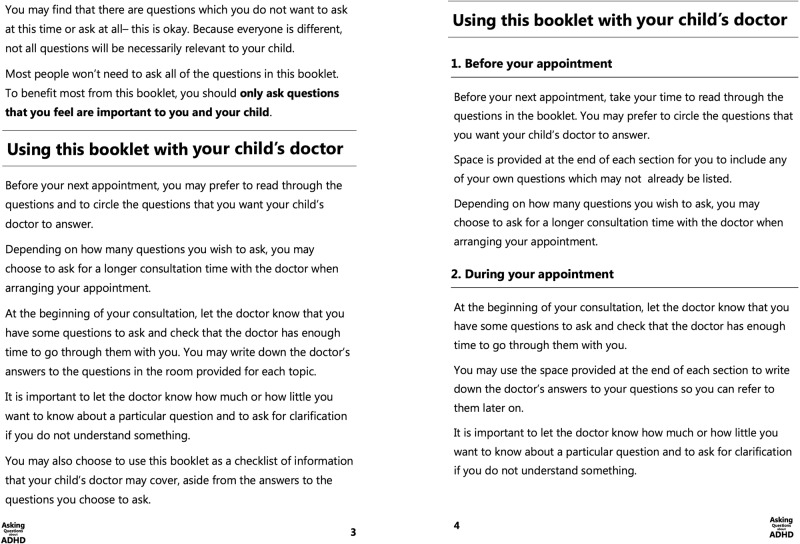
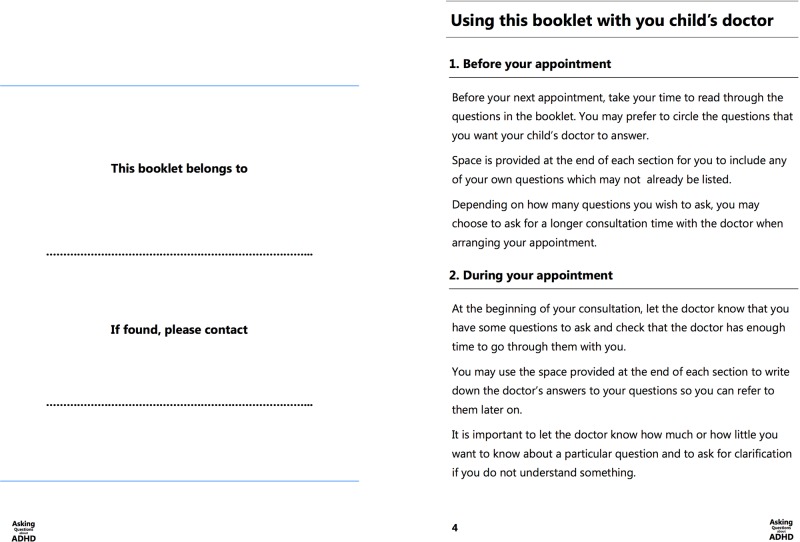
This study involved the development of a question prompt list (QPL) booklet designed to facilitate communication and shared decision-making between parents/carers of children diagnosed with attention-deficit/hyperactivity disorder (ADHD) and their clinicians; and user-testing of the QPL to assess its usability.
Best practice in information writing and design was used to format the QPL content into a 16-page booklet. We then applied user-testing, which uses mixed methods to assess document performance with small cohorts of participants and then improves it in an iterative process. Individual interviews assessed the ability of QPL users to locate and understand key points of information, followed by a semistructured questionnaire, to ascertain their general views about the booklet.
Testing was undertaken with two cohorts of 10 parents/carers of children with ADHD (n=20); matched on age, gender and educational attainment.
In round 1, we tested 15 key points of information related to the QPL. Participant responses and feedback from round 1 informed a revised version of the booklet, tested in a subsequent round.
The target was for 8/10 of the participants to be able to find and demonstrate an understanding of all key information points, in accordance with European guidelines for medicine leaflet testing.
After round 1, problems related to 4/15 information points were identified (booklet purpose; preparing for appointments; asking about a second medical opinion; selecting which questions to ask). Participants also made suggestions regarding the booklet's layout and design. After round 2, all information points were located and understood by at least 8/10 participants.
This is the first study to have developed a usable ADHD-specific QPL for use by parents/carers of children with ADHD during clinical consultations, and the first demonstration of the utility of user-testing methods in ensuring QPL usability.
本研究旨在开发一种问题提示清单(QPL)手册,以促进被诊断为注意力缺陷/多动障碍(ADHD)的儿童的父母/照顾者与其临床医生之间的沟通和共同决策;并对 QPL 进行用户测试,以评估其可用性。
最佳信息编写和设计实践用于将 QPL 内容格式化为 16 页的手册。然后,我们应用用户测试,该测试使用混合方法来评估小样本参与者的文档性能,然后在迭代过程中进行改进。个别访谈评估了 QPL 用户定位和理解关键信息点的能力,然后进行半结构化问卷调查,以确定他们对该手册的总体看法。
测试是在两个 ADHD 儿童的父母/照顾者(n=20)队列中进行的;年龄、性别和教育程度相匹配。
在第一轮中,我们测试了与 QPL 相关的 15 个关键信息点。参与者的反应和第一轮的反馈为小册子的修订版提供了信息,随后在第二轮中进行了测试。
目标是 8/10 的参与者能够找到并理解所有关键信息点,符合欧洲药物说明书测试指南。
第一轮后,确定了与 4/15 个信息点相关的问题(手册目的;为预约做准备;询问第二医疗意见;选择要询问的问题)。参与者还就小册子的布局和设计提出了建议。第二轮后,至少有 8/10 的参与者找到了并理解了所有信息点。
这是第一项为 ADHD 儿童的父母/照顾者在临床咨询期间使用而开发的可用 ADHD 特定 QPL 的研究,也是第一项展示用户测试方法在确保 QPL 可用性方面的实用性的研究。